Department of Neurology, Faculty of Medicine, Shimane University, 89-1, Enya-cho, Izumo city, Shimane, 693-8501, Japan.
Sci Rep. 2017 Jan 5;7:40107. doi: 10.1038/srep40107.
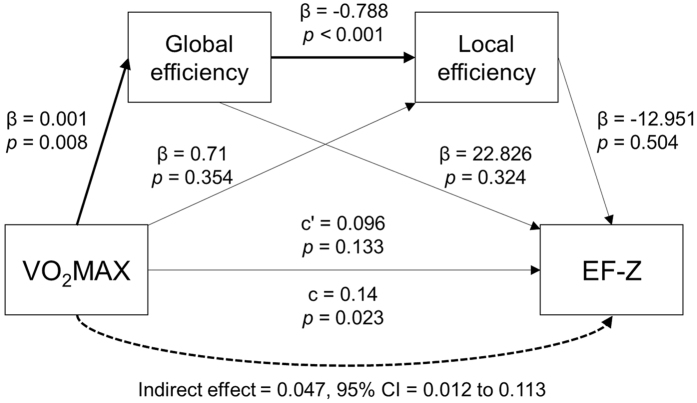
Aging is associated with deterioration in a number of cognitive functions. Previous reports have demonstrated the beneficial effect of physical fitness on cognitive function, especially executive function (EF). The graph theoretical approach models the brain as a complex network represented graphically as nodes and edges. We analyzed several measures of EF, an index of physical fitness, and resting-state functional magnetic resonance imaging data from healthy older volunteers to elucidate the associations among EF, cardiorespiratory fitness, and brain network properties. The topological neural properties were significantly related to the level of EF and/or physical fitness. Global efficiency, which represents how well the whole brain is integrated, was positively related, whereas local efficiency, which represents how well the brain is functionally segregated, was negatively related, to the level of EF and fitness. The associations among EF, physical fitness and topological resting-state functional network property appear related to compensation and dedifferentiation in older age. A mediation analysis showed that high-fit older adults gain higher global efficiency of the brain at the expense of lower local efficiency. The results suggest that physical fitness may be beneficial in maintaining EF in healthy aging by enhancing the efficiency of the global brain network.
衰老是许多认知功能恶化的原因。先前的报告表明,身体健康对认知功能,尤其是执行功能(EF)有有益影响。图论方法将大脑建模为一个复杂的网络,以节点和边的形式图形化表示。我们分析了健康老年人志愿者的 EF 多项措施、身体健康指数和静息状态功能磁共振成像数据,以阐明 EF、心肺健康和大脑网络属性之间的关联。拓扑神经特性与 EF 和/或身体健康水平显著相关。全局效率代表整个大脑的整合程度,与 EF 和身体健康水平呈正相关,而局部效率代表大脑的功能分离程度,与 EF 和身体健康水平呈负相关。EF、身体健康和拓扑静息状态功能网络特性之间的关联似乎与老年人的代偿和去分化有关。中介分析表明,高适应能力的老年人以降低局部效率为代价获得更高的大脑全局效率。结果表明,身体健康可能通过提高大脑全局网络的效率,对维持健康衰老的 EF 有益。