Dong Xinwen, Dong Jin, Zhao Yue, Guo Jipeng, Wang Zhanju, Liu Mingqi, Zhang Yunbo, Na Xiaolin
Department of Environmental Hygiene, Public Health College, Harbin Medical University, Harbin 150081, China.
Int J Environ Res Public Health. 2017 Jan 4;14(1):44. doi: 10.3390/ijerph14010044.
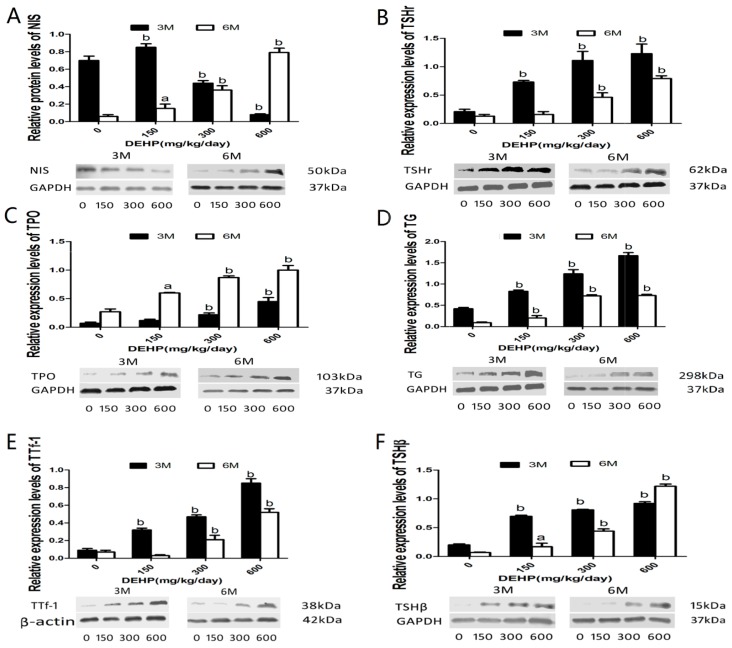
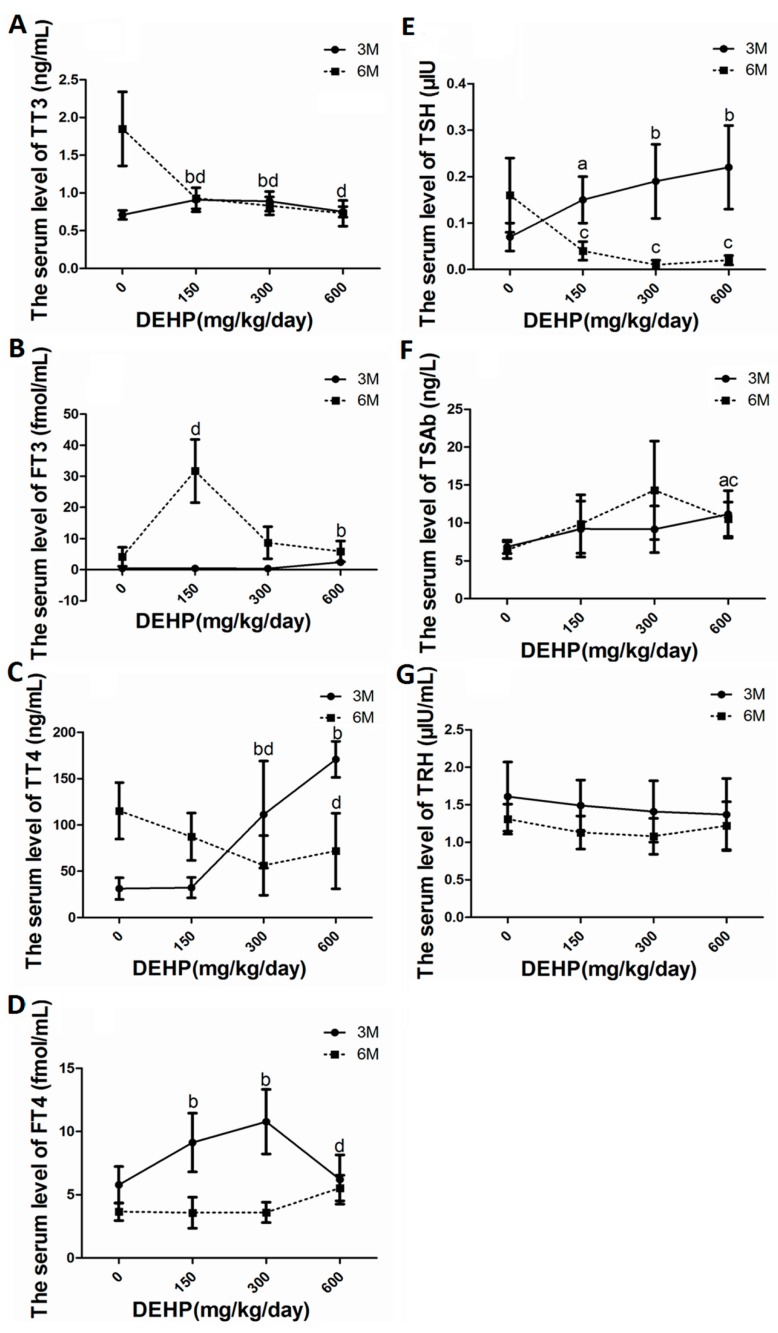
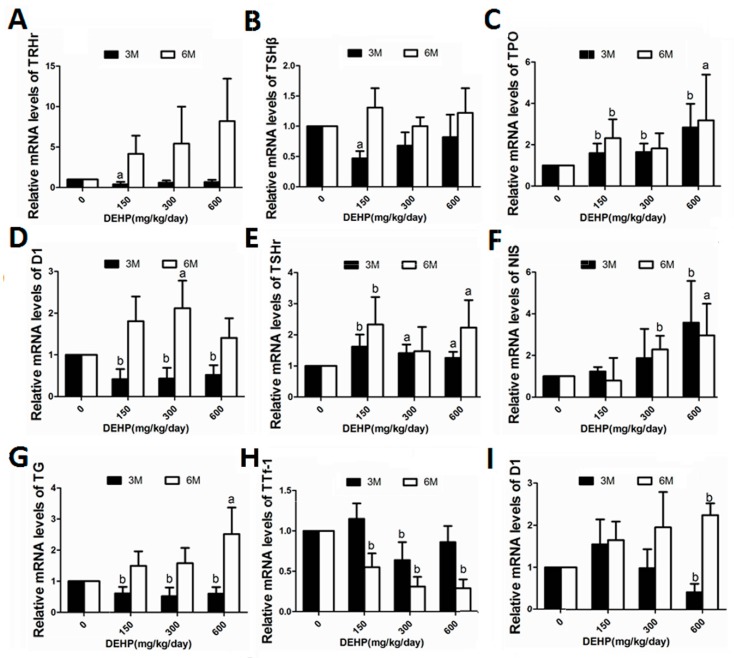
Di-(2-ethylhexyl)phthalate (DEHP) was a widely used chemical with human toxicity. Recent in vivo and in vitro studies suggested that DEHP-exposure may be associated with altered serum thyroid hormones (THs) levels, but the underlying molecular mechanisms were largely unknown. To explore the possible molecular mechanisms, 128 Wistar rats were dosed with DEHP by gavage at 0, 150, 300, and 600 mg/kg/day for 3 months (M) and 6 M, respectively. After exposure, expression of genes and proteins in the thyroid, pituitary, and hypothalamus tissues of rats were analyzed by Q-PCR and western blot, while the sera and urine samples were assayed by radioimmunoassay and ELISA. Results showed that serum THs levels were suppressed by DEHP on the whole. DEHP treatment influenced the levels of rats' thyrotropin releasing hormone receptor (TRHr), Deiodinases 1 (D1), thyroid stimulating hormone beta (TSHβ), sodium iodide symporter (NIS), thyroid stimulating hormone receptor (TSHr), thyroperoxidase (TPO), thyroid transcription factor 1 (TTF-1), and thyroglobulin (TG) mRNA/protein expression in the hypothalamus-pituitary-thyroid (HPT) axis and decreased urine iodine. Taken together, observed findings indicate that DEHP could reduce thyroid hormones via disturbing the HPT axis, and the activated TSH/TSHR pathway is required to regulate thyroid function via altering TRHr, TSHβ, NIS, TSHr, TPO, TTF-1 and TG mRNA/protein expression of the HPT axis.
邻苯二甲酸二(2-乙基己基)酯(DEHP)是一种广泛使用且具有人体毒性的化学物质。最近的体内和体外研究表明,接触DEHP可能与血清甲状腺激素(THs)水平改变有关,但其潜在的分子机制在很大程度上尚不清楚。为了探究可能的分子机制,分别以0、150、300和600mg/kg/天的剂量对128只Wistar大鼠进行灌胃给予DEHP,持续3个月和6个月。暴露后,通过实时定量聚合酶链反应(Q-PCR)和蛋白质免疫印迹法分析大鼠甲状腺、垂体和下丘脑组织中基因和蛋白质的表达,同时通过放射免疫测定法和酶联免疫吸附测定法检测血清和尿液样本。结果表明,总体上DEHP抑制了血清THs水平。DEHP处理影响了大鼠下丘脑-垂体-甲状腺(HPT)轴中促甲状腺激素释放激素受体(TRHr)、脱碘酶1(D1)、促甲状腺激素β亚基(TSHβ)、钠碘同向转运体(NIS)、促甲状腺激素受体(TSHr)、甲状腺过氧化物酶(TPO)、甲状腺转录因子1(TTF-1)和甲状腺球蛋白(TG)的mRNA/蛋白质表达,并降低了尿碘。综上所述,观察结果表明,DEHP可通过干扰HPT轴来降低甲状腺激素,并且激活的TSH/TSHR途径需要通过改变HPT轴的TRHr、TSHβ、NIS、TSHr、TPO、TTF-1和TG的mRNA/蛋白质表达来调节甲状腺功能。