Cao Shoubo, Jin Shi, Shen Jing, Cao Jingyan, Zhang Hua, Meng Qingwei, Wang Chunyan, Zhang Aiqi, Zhang Pei, Yu Yan
Department of Medical Oncology, Harbin Medical University Cancer Hospital, Harbin, China.
Oncotarget. 2017 Jan 31;8(5):8657-8669. doi: 10.18632/oncotarget.14395.
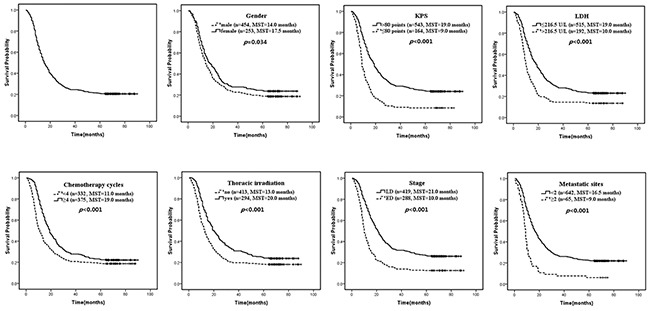
The management of small cell lung cancer (SCLC) has reached a plateau. Etoposide and platinum-based chemotherapy plus thoracic irradiation remain the standard treatment strategy for SCLC. Our study aims to assess the potential prognostic factors of patients treated with etoposide and platinum-based chemotherapy and explore which group of patients can benefit more from standard treatment strategies. On univariate analysis, age>65 years, male patients, KPS (Karnofsky Performance Status)≤80 points, positive smoking history, anemia, lymphocyte counts≤1.65×10⁹/L, neutrophil to lymphocyte ratio (NLR)>3.18, lymphocyte to monocyte ratio (LMR)≤2.615, lactate dehydrogenase (LDH)>216.5 U/L, alkaline phosphatase (ALP)>119.5 U/L, absence of surgery, absence of thoracic irradiation, chemotherapy cycles<4, metastatic sites≥2 and extensive disease were correlated with a poor prognosis. Gender, KPS, chemotherapy cycles, thoracic irradiation, metastatic sites, LDH and tumor stage held statistical significance on multivariate analysis (p<0.05). High LDH was closely correlated with extensive disease, metastatic sites≥2, anemia, low LMR, high NLR and ALP levels. Subgroup analysis showed patients with male gender, KPS≤80 points, LDH≤216.5U/L, extensive disease and metastatic sites<2 could benefit more from ≥4 chemotherapy cycles. Patients with male gender, KPS>80 points, LDH≤216.5U/L, limited disease and metastatic sites<2 could benefit more from thoracic irradiation (p<0.05 on uni- and multivariate analysis). In conclusion, female patients, KPS>80 points, chemotherapy cycles≥4, thoracic irradiation, metastatic sites<2, LDH≤216.5U/L and limited disease were independent positive prognostic factors for SCLC patients treated with etoposide and platinum-based chemotherapy. Selected patients can benefit more from the management of ≥4 cycles of chemotherapy and thoracic irradiation.
小细胞肺癌(SCLC)的治疗已进入平台期。依托泊苷和铂类化疗联合胸部放疗仍是SCLC的标准治疗策略。我们的研究旨在评估接受依托泊苷和铂类化疗患者的潜在预后因素,并探索哪组患者能从标准治疗策略中获益更多。单因素分析显示,年龄>65岁、男性患者、KPS(卡氏功能状态评分)≤80分、有吸烟史、贫血、淋巴细胞计数≤1.65×10⁹/L、中性粒细胞与淋巴细胞比值(NLR)>3.18、淋巴细胞与单核细胞比值(LMR)≤2.615、乳酸脱氢酶(LDH)>216.5 U/L、碱性磷酸酶(ALP)>119.5 U/L、未行手术、未行胸部放疗、化疗周期<4、转移部位≥2以及广泛期疾病与预后不良相关。性别、KPS、化疗周期、胸部放疗、转移部位、LDH和肿瘤分期在多因素分析中具有统计学意义(p<0.05)。高LDH与广泛期疾病、转移部位≥2、贫血、低LMR、高NLR和ALP水平密切相关。亚组分析显示,男性、KPS≤80分、LDH≤216.5U/L、广泛期疾病且转移部位<2的患者从≥4个化疗周期中获益更多。男性、KPS>80分、LDH≤216.5U/L、局限期疾病且转移部位<2的患者从胸部放疗中获益更多(单因素和多因素分析p<0.05)。总之,女性患者、KPS>80分、化疗周期≥4、胸部放疗、转移部位<2、LDH≤216.5U/L以及局限期疾病是接受依托泊苷和铂类化疗的SCLC患者独立的阳性预后因素。特定患者从≥4个周期化疗和胸部放疗的治疗中获益更多。