Larsen Finn Breinholt, Pedersen Marie Hauge, Friis Karina, Glümer Charlotte, Lasgaard Mathias
DEFACTUM - Public Health & Health Services Research, Central Denmark Region, Aarhus, Denmark.
Research Centre for Prevention and Health, Capital Region of Denmark, Glostrup University Hospital, Glostrup, Denmark.
PLoS One. 2017 Jan 5;12(1):e0169426. doi: 10.1371/journal.pone.0169426. eCollection 2017.
To identify patterns of multimorbidity in the general population and examine how these patterns are related to socio-demographic factors and health-related quality of life.
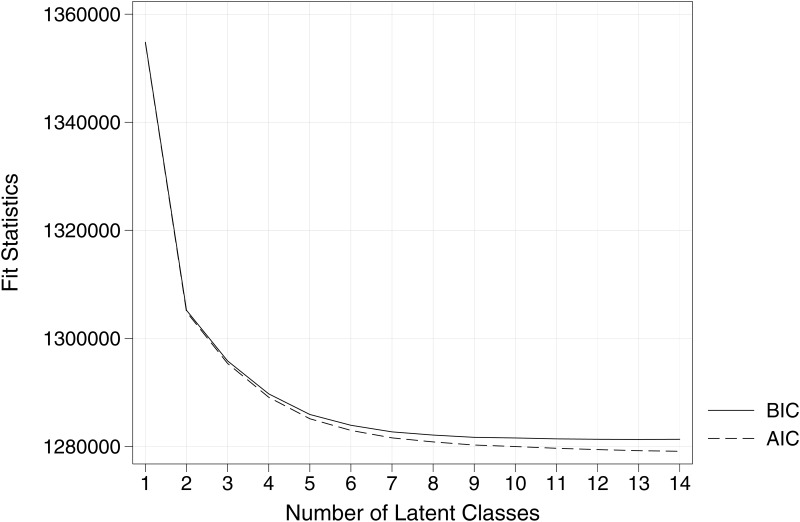
We used latent class analysis to identify subgroups with statistically distinct and clinically meaningful disease patterns in a nationally representative sample of Danish adults (N = 162,283) aged 16+ years. The analysis was based on 15 chronic diseases.
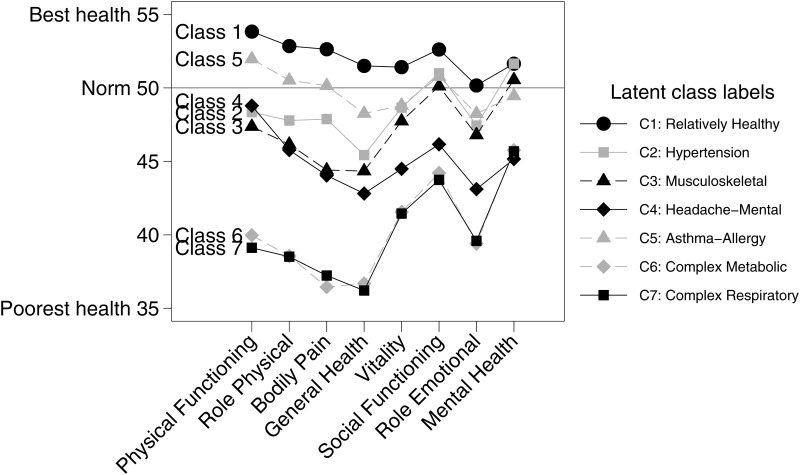
Seven classes with different disease patterns were identified: a class with no or only a single chronic condition (59% of the population) labeled "1) Relatively Healthy" and six classes with a very high prevalence of multimorbidity labeled; "2) Hypertension" (14%); "3) Musculoskeletal Disorders" (10%); "4) Headache-Mental Disorders" (7%); "5) Asthma-Allergy" (6%); "6) Complex Cardiometabolic Disorders" (3%); and "7) Complex Respiratory Disorders" (2%). Female gender was associated with an increased likelihood of belonging to any of the six multimorbidity classes except for class 2 (Hypertension). Low educational attainment predicted membership of all of the multimorbidity classes except for class 5 (Asthma-Allergy). Marked differences in health-related quality of life between the seven latent classes were found. Poor health-related quality of life was highly associated with membership of class 6 (Complex Cardiometabolic Disorders) and class 7 (Complex Respiratory Disorders). Despite different disease patterns, these two classes had nearly identical profiles in relation to health-related quality of life.
The results clearly support that diseases tend to compound and interact, which suggests that a differentiated public health and treatment approach towards multimorbidity is needed.
确定普通人群中的共病模式,并研究这些模式如何与社会人口学因素及健康相关生活质量相关。
我们采用潜在类别分析,在一个具有全国代表性的16岁及以上丹麦成年人样本(N = 162,283)中识别具有统计学上不同且具有临床意义的疾病模式的亚组。该分析基于15种慢性病。
识别出了七种具有不同疾病模式的类别:一类没有或仅有单一慢性病(占人群的59%),标记为“1)相对健康”,以及六类共病患病率非常高的类别,分别标记为:“2)高血压”(14%);“3)肌肉骨骼疾病”(10%);“4)头痛 - 精神障碍”(7%);“5)哮喘 - 过敏”(6%);“6)复杂心脏代谢疾病”(3%);和“7)复杂呼吸系统疾病”(2%)。女性除了第2类(高血压)外,属于其他六种共病类别的可能性增加。低教育程度预示着除第5类(哮喘 - 过敏)外所有共病类别的成员身份。在七个潜在类别之间发现了与健康相关生活质量的显著差异。健康相关生活质量差与第6类(复杂心脏代谢疾病)和第7类(复杂呼吸系统疾病)的成员身份高度相关。尽管疾病模式不同,但这两类在与健康相关生活质量方面的概况几乎相同。
结果明确支持疾病往往会叠加和相互作用,这表明需要针对共病采取差异化的公共卫生和治疗方法。