Biava Mirella, Caglioti Claudia, Bordi Licia, Castilletti Concetta, Colavita Francesca, Quartu Serena, Nicastri Emanuele, Lauria Francesco Nicola, Petrosillo Nicola, Lanini Simone, Hoenen Thomas, Kobinger Gary, Zumla Alimuddin, Di Caro Antonino, Ippolito Giuseppe, Capobianchi Maria Rosaria, Lalle Eleonora
National Institute for Infectious Diseases "Lazzaro Spallanzani" IRCCS, Via Portuense, Rome, Italy.
International Public Health Crisis Group (IPHCG).
PLoS Pathog. 2017 Jan 5;13(1):e1006065. doi: 10.1371/journal.ppat.1006065. eCollection 2017 Jan.
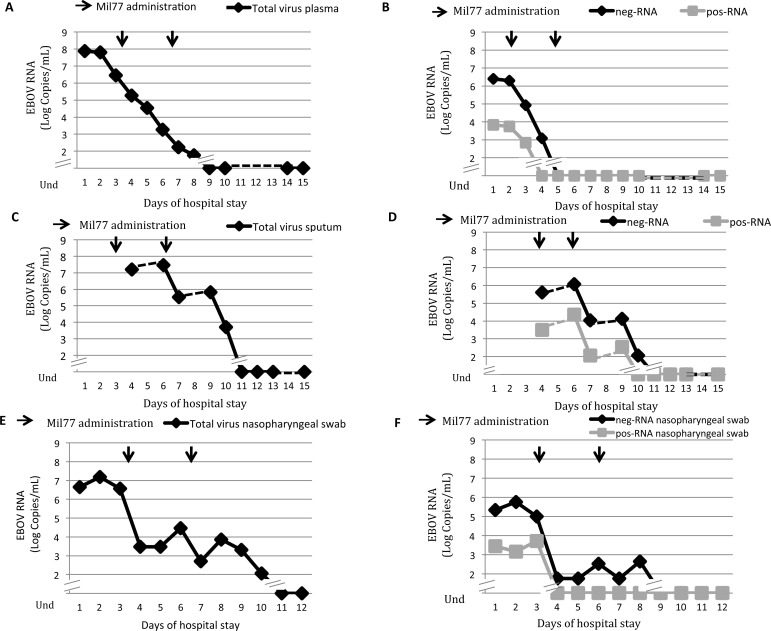
An unprecedented Ebola virus (EBOV) epidemic occurred in 2013-2016 in West Africa. Over this time the epidemic exponentially grew and moved to Europe and North America, with several imported cases and many Health Care Workers (HCW) infected. Better understanding of EBOV infection patterns in different body compartments is mandatory to develop new countermeasures, as well as to fully comprehend the pathways of human-to-human transmission. We have longitudinally explored the persistence of EBOV-specific negative sense genomic RNA (neg-RNA) and the presence of positive sense RNA (pos-RNA), including both replication intermediate (antigenomic-RNA) and messenger RNA (mRNA) molecules, in the upper and lower respiratory tract, as compared to plasma, in a HCW infected with EBOV in Sierra Leone, who was hospitalized in the high isolation facility of the National Institute for Infectious Diseases "Lazzaro Spallanzani" (INMI), Rome, Italy. We observed persistence of pos-RNA and neg-RNAs in longitudinally collected specimens of the lower respiratory tract, even after viral clearance from plasma, suggesting possible local replication. The purpose of the present study is to enhance the knowledge on the biological features of EBOV that can contribute to the human-to-human transmissibility and to develop effective intervention strategies. However, further investigation is needed in order to better understand the clinical meaning of viral replication and shedding in the respiratory tract.
2013年至2016年,西非爆发了前所未有的埃博拉病毒(EBOV)疫情。在此期间,疫情呈指数级增长,并蔓延至欧洲和北美,出现了多例输入性病例,许多医护人员(HCW)被感染。为了制定新的应对措施以及全面了解人际传播途径,必须更好地了解EBOV在不同身体部位的感染模式。我们纵向研究了一名在塞拉利昂感染EBOV的医护人员上、下呼吸道中EBOV特异性负链基因组RNA(neg-RNA)的持久性以及正链RNA(pos-RNA)的存在情况,包括复制中间体(反基因组RNA)和信使RNA(mRNA)分子,并将其与血浆中的情况进行了比较。该医护人员在意大利罗马国家传染病研究所“拉扎罗·斯帕兰扎尼”(INMI)的高级隔离设施中住院。我们观察到,即使血浆中的病毒已清除,下呼吸道纵向采集的标本中仍存在pos-RNA和neg-RNA,这表明可能存在局部复制。本研究的目的是增进对EBOV生物学特征的了解,这些特征可能有助于人际传播,并制定有效的干预策略。然而,为了更好地理解呼吸道中病毒复制和脱落的临床意义,还需要进一步研究。