Houlihan Catherine F, McGowan Catherine R, Dicks Steve, Baguelin Marc, Moore David A J, Mabey David, Roberts Chrissy H, Kumar Alex, Samuel Dhan, Tedder Richard, Glynn Judith R
Faculty of Infectious and Tropical Diseases, London School of Hygiene & Tropical Medicine, London, United Kingdom.
Faculty of Medical Sciences, University College London, London, United Kingdom.
PLoS Med. 2017 May 16;14(5):e1002300. doi: 10.1371/journal.pmed.1002300. eCollection 2017 May.
Healthcare and other front-line workers are at particular risk of infection with Ebola virus (EBOV). Despite the large-scale deployment of international responders, few cases of Ebola virus disease have been diagnosed in this group. Since asymptomatic or pauci-symptomatic infection has been described, it is plausible that infections have occurred in healthcare workers but have escaped being diagnosed. We aimed to assess the prevalence of asymptomatic or pauci-symptomatic infection, and of exposure events, among returned responders to the West African Ebola epidemic 2014-2016.
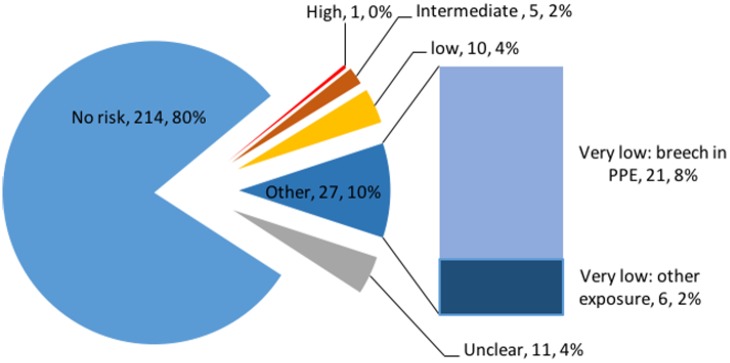
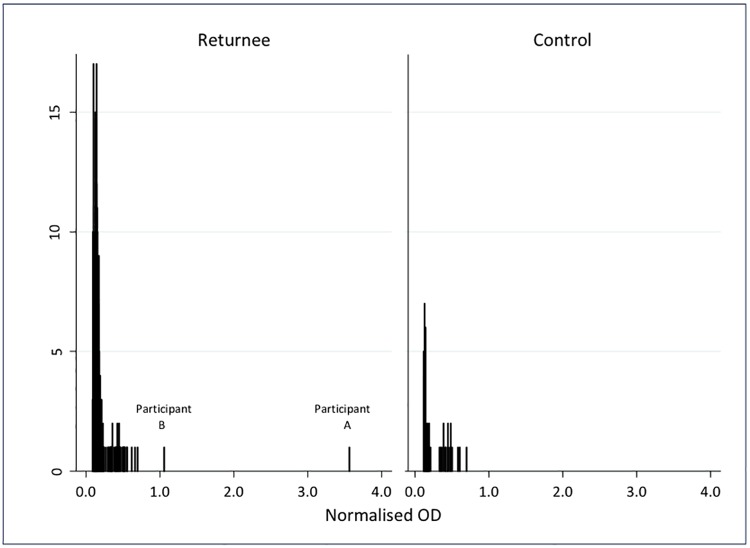
We used snowball sampling to identify responders who had returned to the UK or Ireland, and used an online consent and questionnaire to determine their exposure to EBOV and their experience of illness. Oral fluid collection devices were sent and returned by post, and samples were tested using an EBOV IgG capture assay that detects IgG to Ebola glycoprotein. Blood was collected from returnees with reactive samples for further testing. Unexposed UK controls were also recruited. In all, 300 individuals consented, of whom 268 (89.3%) returned an oral fluid sample (OFS). The majority had worked in Sierra Leone in clinical, laboratory, research, and other roles. Fifty-three UK controls consented and provided samples using the same method. Of the returnees, 47 (17.5%) reported that they had had a possible EBOV exposure. Based on their free-text descriptions, using a published risk assessment method, we classified 43 (16%) as having had incidents with risk of Ebola transmission, including five intermediate-risk and one high-risk exposure. Of the returnees, 57 (21%) reported a febrile or diarrhoeal illness in West Africa or within 1 mo of return, of whom 40 (70%) were not tested at the time for EBOV infection. Of the 268 OFSs, 266 were unreactive. Two returnees, who did not experience an illness in West Africa or on return, had OFSs that were reactive on the EBOV IgG capture assay, with similar results on plasma. One individual had no further positive test results; the other had a positive result on a double-antigen bridging assay but not on a competitive assay or on an indirect EBOV IgG ELISA. All 53 controls had non-reactive OFSs. While the participants were not a random sample of returnees, the number participating was high.
This is the first study, to our knowledge, of the prevalence of EBOV infection in international responders. More than 99% had clear negative results. Sera from two individuals had discordant results on the different assays; both were negative on the competitive assay, suggesting that prior infection was unlikely. The finding that a significant proportion experienced "near miss" exposure events, and that most of those who experienced symptoms did not get tested for EBOV at the time, suggests a need to review and standardise protocols for the management of possible exposure to EBOV, and for the management of illness, across organisations that deploy staff to outbreaks.
医护人员及其他一线工作者感染埃博拉病毒(EBOV)的风险尤其高。尽管国际救援人员已大规模部署,但该群体中确诊的埃博拉病毒病病例却很少。鉴于已有无症状或症状轻微感染的描述,医护人员有可能已发生感染但未被诊断出来。我们旨在评估2014 - 2016年西非埃博拉疫情后回国的救援人员中无症状或症状轻微感染以及暴露事件的发生率。
我们采用滚雪球抽样法识别返回英国或爱尔兰的救援人员,并通过在线同意书和问卷来确定他们接触EBOV的情况以及患病经历。口服液体采集装置通过邮寄方式寄出并回收,样本采用检测埃博拉糖蛋白IgG的EBOV IgG捕获试验进行检测。对检测呈反应性的回国人员采集血液进行进一步检测。同时招募了未接触过EBOV的英国对照人群。共有300人同意参与,其中268人(89.3%)返回了口服液体样本(OFS)。大多数人曾在塞拉利昂从事临床、实验室、研究及其他工作。53名英国对照人群同意参与并采用相同方法提供样本。在回国人员中,47人(17.5%)报告称他们可能接触过EBOV。根据他们的自由文本描述,采用已发表的风险评估方法,我们将43人(16%)归类为有埃博拉传播风险的事件,其中包括5次中等风险和1次高风险暴露。在回国人员中,57人(21%)报告在西非或回国后1个月内出现发热或腹泻疾病,其中40人(70%)当时未接受EBOV感染检测。在268份OFS中,266份检测无反应。两名在西非或回国时未患病的回国人员,其OFS在EBOV IgG捕获试验中呈反应性,血浆检测结果类似。一人后续检测无进一步阳性结果;另一人在双抗原桥接试验中呈阳性,但在竞争试验或间接EBOV IgG ELISA中呈阴性。所有53名对照人群的OFS检测均无反应。尽管参与者并非回国人员的随机样本,但参与人数众多。
据我们所知,这是第一项关于国际救援人员中EBOV感染发生率的研究。超过99%的检测结果为明确阴性。两名个体的血清在不同检测中结果不一致;两者在竞争试验中均为阴性,提示既往感染的可能性不大。相当一部分人经历了“险些感染”的暴露事件,且大多数出现症状的人当时未接受EBOV检测,这一发现表明有必要对部署工作人员应对疫情的各组织中可能接触EBOV的管理方案以及疾病管理方案进行审查和标准化。