Geusens Piet, Pavelka Karel, Rovensky Jozef, Vanhoof Johan, Demeester Nathalie, Calomme Mario, Vanden Berghe Dirk
Biomedical Research Institute (BIOMED), Hasselt University, Diepenbeek, Belgium.
Rheumatology, Maastricht UMC, Maastricht, The Netherlands.
BMC Musculoskelet Disord. 2017 Jan 5;18(1):2. doi: 10.1186/s12891-016-1370-7.
The aim of this study was to assess the efficacy of choline-stabilized orthosilicic acid (ch-OSA) in patients with symptomatic knee osteoarthritis (OA).
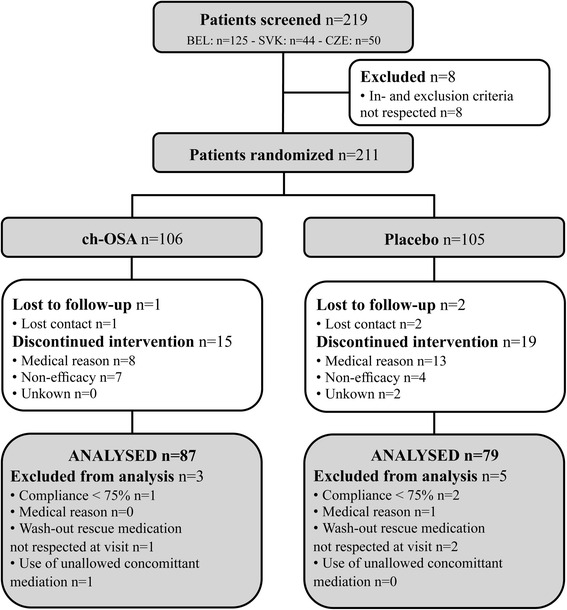
In a multicenter, double-blind, placebo-controlled study, 211 patients with knee OA (Kellgren and Lawrence grade II or III) and moderate to moderately severe pain were randomly allocated to ch-OSA or placebo for 12 weeks. The primary outcome was the change in the WOMAC pain subscale from baseline to week 12. Secondary outcomes were changes from baseline to week 12 in WOMAC total, WOMAC stiffness, WOMAC physical function, Subject Global Assessment and levels of cartilage degradation biomarkers C-terminal telopeptide of collagen type II (CTX-II) and cartilage oligomeric matrix protein (COMP). Pre-specified subgroup analyses included the effect of gender.
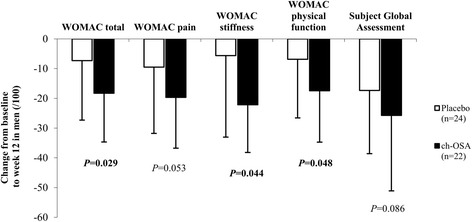
A total of 166 (120 women, 46 men) patients were included in the analysis (87 and 79 in the ch-OSA and placebo group, respectively). In the total study population, no differences were observed between the two treatment groups for the different outcomes but significant treatment x gender interactions were found. In men taking ch-OSA, a significant improvement in WOMAC total, WOMAC stiffness and WOMAC physical function as well as a lower increase in biomarker levels of cartilage degradation was observed, but not in women. The change in WOMAC pain showed a similar positive trend in men taking ch-OSA.
After 12 weeks of treatment, no effect was found of ch-OSA in the total study population on clinical parameters and biomarkers, but a gender interaction was observed. In men, ch-OSA was found effective in reducing symptoms of knee OA, which was associated with a slight but significant reduction of biomarkers that are related to cartilage degradation.
The study was registered retrospectively: ISRCTN88583133 . Registration date: 2015-10-07.
本研究旨在评估胆碱稳定化正硅酸(ch-OSA)对有症状的膝关节骨关节炎(OA)患者的疗效。
在一项多中心、双盲、安慰剂对照研究中,211例膝关节OA(凯尔格伦和劳伦斯分级为II级或III级)且有中度至中度严重疼痛的患者被随机分配接受ch-OSA或安慰剂治疗12周。主要结局是从基线到第12周WOMAC疼痛子量表的变化。次要结局是从基线到第12周WOMAC总分、WOMAC僵硬程度、WOMAC身体功能、患者整体评估以及软骨降解生物标志物II型胶原C末端肽(CTX-II)和软骨寡聚基质蛋白(COMP)水平的变化。预先设定的亚组分析包括性别效应。
共有166例患者(120例女性,46例男性)纳入分析(ch-OSA组和安慰剂组分别为87例和79例)。在整个研究人群中,两个治疗组在不同结局方面未观察到差异,但发现了显著的治疗×性别交互作用。服用ch-OSA的男性中,观察到WOMAC总分、WOMAC僵硬程度和WOMAC身体功能有显著改善,以及软骨降解生物标志物水平的升高较低,但女性未出现这种情况。服用ch-OSA的男性中,WOMAC疼痛的变化呈现出类似的积极趋势。
治疗12周后,在整个研究人群中未发现ch-OSA对临床参数和生物标志物有影响,但观察到了性别交互作用。在男性中,发现ch-OSA可有效减轻膝关节OA症状,这与与软骨降解相关的生物标志物略有但显著的降低有关。
该研究为回顾性注册:ISRCTN88583133。注册日期:2015年10月7日。