Noé Andrés, Ribeiro Rafaela M, Anselmo Rui, Maixenchs Maria, Sitole Layce, Munguambe Khatia, Blanco Silvia, le Souef Peter, García-Basteiro Alberto L
School of Paediatrics and Child Health, University of Western Australia, Crawley, Australia.
Centro de Investigação em Saúde de Manhiça (CISM), CP 1929, Maputo, Mozambique.
BMC Pulm Med. 2017 Jan 5;17(1):2. doi: 10.1186/s12890-016-0344-8.
Tuberculosis (TB) control is more likely to be achieved if the level of knowledge regarding TB is increased among health workers managing high-risk groups. No formal assessments regarding knowledge, attitudes and practises of health workers about TB have been published for Mozambique, a country facing challenges in the fight against TB, with a fragile health system and considerable work overload of health personnel. The main objective of the study was to determine the level of knowledge, identify attitudes and assess practices regarding TB care and control among health care workers of the district of Manhiça.
A descriptive cross-sectional study was performed through the use of a specifically designed Knowledge, Attitudes and Practices (KAP) questionnaire in the district of Manhiça, a high tuberculosis and HIV burden rural area in Southern Mozambique. In this district, 14 health care facilities service a population of approximately 160,000 people. The questionnaire took 30-45 min to administer with external assistance not permitted. The survey contained 79 questions pertaining to four different areas: demographics, TB knowledge, attitudes and practices.
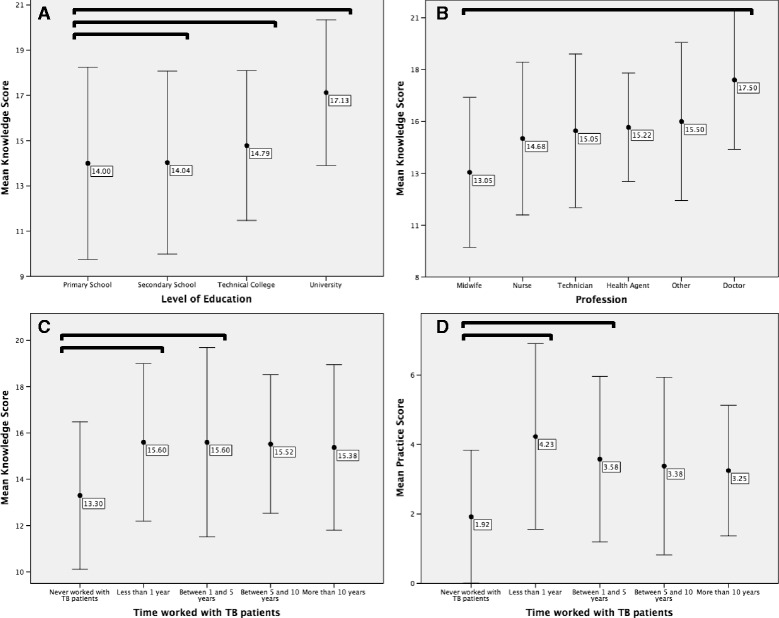
The study sample included 170 health care workers. The average knowledge score was 14.89 points (SD = 3.61) out of a total possible 26 points. Less than 30% of respondents had heard of Xpert MTB/RIF®. Seventy per cent agreed there was stigma associated with TB and 48.2% believed this stigma was greater than that associated with HIV. The average practice score was 3.2 out of 9 points (35.6%, SD = 2.4).
Health care worker's knowledge gaps identified in this study may result in substandard patient care. Specific deficiencies in understanding existed in terms of paediatric TB and Xpert MTB/RIF® testing. The present study provides impetus for tailored TB education among health care workers from a high TB burden rural area in Southern Mozambique.
如果在管理高危人群的卫生工作者中提高对结核病(TB)的认识水平,结核病控制更有可能实现。莫桑比克在抗击结核病方面面临挑战,其卫生系统脆弱,卫生人员工作负担相当重,但尚未发表关于该国卫生工作者对结核病的知识、态度和做法的正式评估。本研究的主要目的是确定马尼卡区卫生保健工作者对结核病护理和控制的知识水平、识别态度并评估做法。
在莫桑比克南部结核病和艾滋病毒负担较重的农村地区马尼卡区,通过使用专门设计的知识、态度和做法(KAP)问卷进行了一项描述性横断面研究。在该地区,14个卫生保健机构为约16万人提供服务。问卷在不允许外部协助的情况下需要30 - 45分钟才能完成。该调查包含79个与四个不同领域相关的问题:人口统计学、结核病知识、态度和做法。
研究样本包括170名卫生保健工作者。在满分26分中,平均知识得分是14.89分(标准差 = 3.61)。不到30%的受访者听说过Xpert MTB/RIF®。70%的人同意结核病存在污名化现象,48.2%的人认为这种污名化比与艾滋病毒相关的污名化更严重。平均做法得分是9分中的3.2分(35.6%,标准差 = 2.4)。
本研究中发现的卫生保健工作者的知识差距可能导致患者护理不达标。在儿童结核病和Xpert MTB/RIF®检测方面存在具体的理解不足。本研究为莫桑比克南部结核病负担较重的农村地区的卫生保健工作者开展针对性的结核病教育提供了动力。