Yang Ling-Yu, Huang Chia-Chang, Hsu Hui-Chi, Yang Ying-Ying, Chang Ching-Chi, Chuang Chiao-Lin, Lee Wei-Shin, Liang Jen-Feng, Cheng Hao Min, Huang Chin-Chou, Lee Fa-Yauh, Ho Shung-Tai, Kirby Ralph
Department of Medical Education, Yilan, Taiwan.
Department of Medicine, National Yang-Ming University, Taipei, Taiwan.
BMC Med Educ. 2017 Jan 6;17(1):2. doi: 10.1186/s12909-016-0843-6.
Clerkship provides a unique way of transferring the knowledge and skills gathered during medical school's curriculum into real-ward clinical care environment. The annual program evaluation has indicated that the training of clerks in diagnostic and clinical reasoning skills needed to be enhanced. Recently, "clinical excellence" program have been promoted in our institution to augment the excellence in clinical care of new clerks. Current study aims to evaluate whether this pilot program improve the "clinical excellence" of new clerks.
In a pilot study, groups of new clerks in years 2013 and 2014 voluntarily attended either a small-group brainstorming course or a didactic classroom tutoring courses as part of their 3-month internal medicine clinical rotation block. A third group of new clerks did not join either of the above courses and this group served as the control group. Pre-block/post-block self-assessment and post-block 5-station mini-Objective Subjective Clinical Examinations (OSCEs) were used to evaluate the effectiveness of these two additional courses that trained diagnostic and clinical reasoning skills.
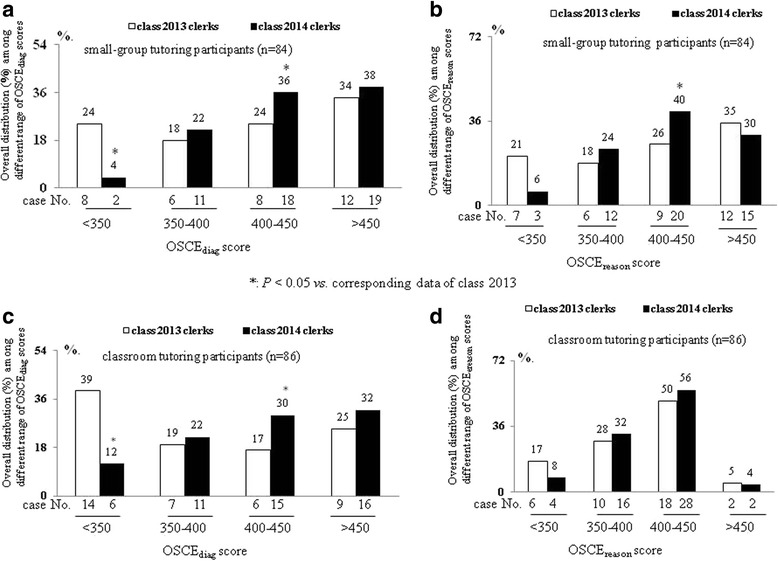
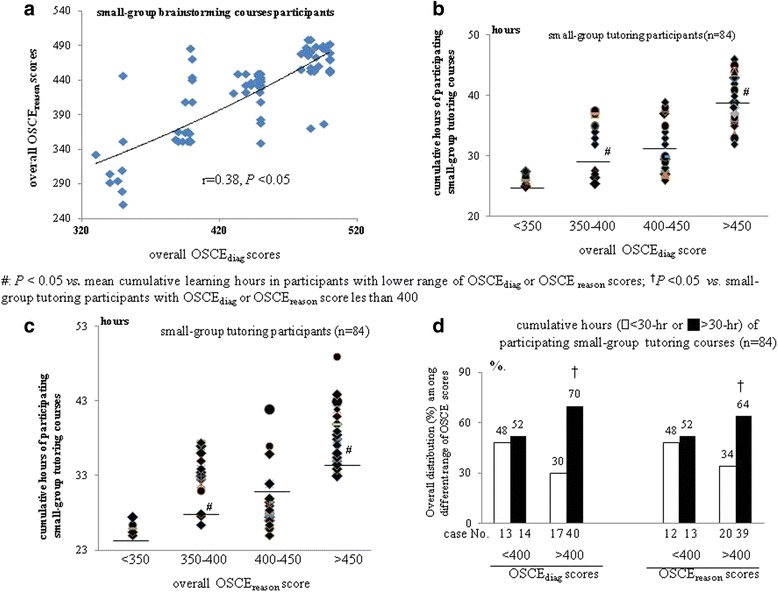
Overtime, the percentages of new clerks that attended voluntarily either the small-group brainstorming or classroom tutoring courses were increased. Higher post-block self-assessed diagnostic and clinical reasoning skill scores were found among individuals who attended the small-group brainstorming courses compared to either the didactic group or the control group. In a corresponding manner, the small-group brainstorming group obtained higher summary OSCE and OSCE scores than either the didactic group or control group. For all basic images/laboratory OSCE stations, the individual diagnostic skill (OSCE) scores of the small-group brainstorming group were higher than those of the didactic group. By way of contrast, only the clinical reasoning skill (OSCE) scores of the basic electrocardiogram and complete blood count + biochemistry OSCE station of thesmall-group brainstorming group were higher than those of the didactic group. Among the small-group brainstorming group, clerks with higher cumulative learning hours (>30-h) had significant higher OSCE and OSCE scores (>400) than those with less cumulative learning hours.
Our pilot study provides a successful example of the use of a small-group tutoring courses for augmenting the diagnostic and clinical reasoning skills of new clerks. The positive results obtained during the initial 2-year long pilot "clinical excellence" program have encouraged the formal implementation of this course as part of the clerkship curriculum.
临床实习提供了一种独特的方式,将医学院课程中积累的知识和技能应用到实际病房临床护理环境中。年度项目评估表明,实习医生的诊断和临床推理技能培训需要加强。最近,我们机构推广了“临床卓越”项目,以提高新实习医生的临床护理水平。本研究旨在评估该试点项目是否能提高新实习医生的“临床卓越”水平。
在一项试点研究中,2013年和2014年的新实习医生小组自愿参加了为期3个月的内科临床轮转课程中的小组头脑风暴课程或课堂讲授辅导课程。第三组新实习医生没有参加上述任何一门课程,该组作为对照组。在课程前/课程后进行自我评估,并在课程后进行5站迷你客观结构化临床考试(OSCE),以评估这两门额外培训诊断和临床推理技能的课程的效果。
随着时间的推移,自愿参加小组头脑风暴或课堂辅导课程的新实习医生的比例有所增加。与课堂讲授组或对照组相比,参加小组头脑风暴课程的个体在课程后的自我评估诊断和临床推理技能得分更高。相应地,小组头脑风暴组在OSCE总结和OSCE得分方面高于课堂讲授组或对照组。对于所有基本图像/实验室OSCE站,小组头脑风暴组的个体诊断技能(OSCE)得分高于课堂讲授组。相比之下,只有小组头脑风暴组的基本心电图和全血细胞计数+生化OSCE站的临床推理技能(OSCE)得分高于课堂讲授组。在小组头脑风暴组中,累计学习时间较长(>30小时)的实习医生的OSCE和OSCE得分(>400)显著高于累计学习时间较短的实习医生。
我们的试点研究提供了一个成功的例子,即使用小组辅导课程来提高新实习医生的诊断和临床推理技能。在最初为期两年的试点“临床卓越”项目中获得的积极结果鼓励将该课程正式纳入临床实习课程。