Li Hua-Rong, Liu Jie, Zhang Shu-Ling, Luo Tao, Wu Fei, Dong Ji-Hua, Guo Yuan-Jin, Zhao Lei
Department of Infectious Diseases, Union Hospital, Tongji Medical College, Huazhong University of Science and Technology, Wuhan, 430022, People's Republic of China.
Department of Integrated Traditional Chinese and Western Medicine, Union Hospital, Tongji Medical College, Huazhong University of Science and Technology, Wuhan, 430022, People's Republic of China.
BMC Complement Altern Med. 2017 Jan 5;17(1):18. doi: 10.1186/s12906-016-1533-y.
Sepsis is one of the serious disorders in clinical practice. Recent studies found toll-like receptors 4 (TLR4) played an important role in sepsis. In this study, we tried to find the influence of Corilagin on TLR4 signal pathways in vitro and in vivo.
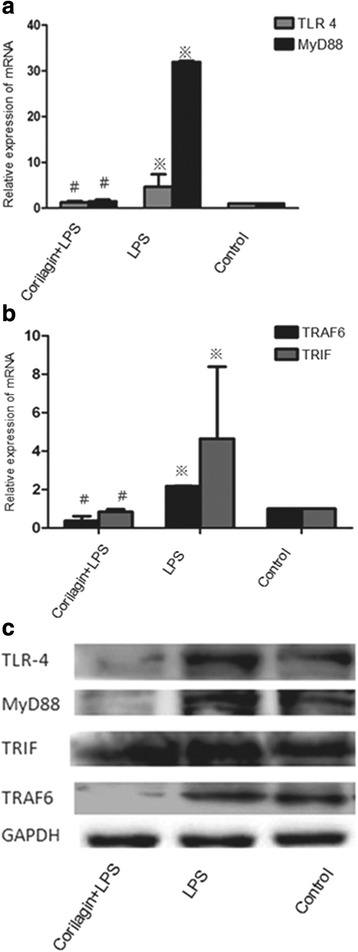
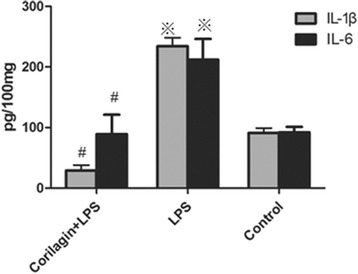
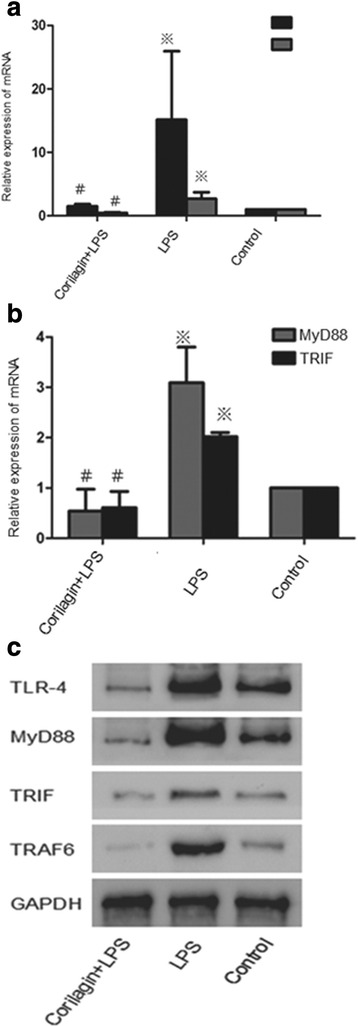
The cellular and animal models of sepsis were established by LPS and then interfered with Corilagin. Real-time PCR and western blot were employed to detect the mRNA and protein expressions of TLR4, MyD88, TRIF and TRAF6. ELISA was used to determine the IL-6 and IL-1β levels in supernatant and serum.
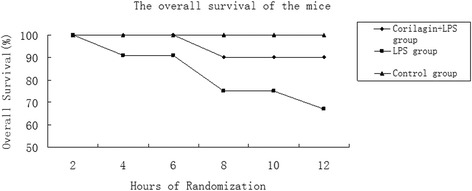
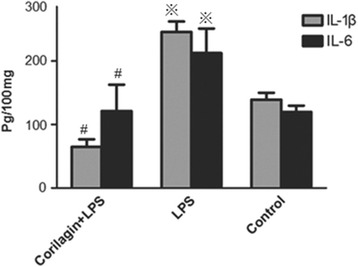
The survival rate was improved in the LPS + Corilagin group, and the mRNA and protein expressions of TLR4, MyD88, TRIF and TRAF6 were significantly decreased than that in the LPS group both in cellular and animal models (P < 0.01). The pro-inflammatory cytokines IL-6 and IL-1β were greatly decreased in the LPS + Corilagin group both in supernatant and serum (P < 0.01).
Corilagin exerts the anti-inflammatory effects by down-regulating the TLR4 signaling molecules to ameliorate the extreme inflammatory status in sepsis.
脓毒症是临床实践中的严重病症之一。近期研究发现,Toll样受体4(TLR4)在脓毒症中起重要作用。在本研究中,我们试图探究柯里拉京在体外和体内对TLR4信号通路的影响。
通过脂多糖(LPS)建立脓毒症细胞和动物模型,随后用柯里拉京进行干预。采用实时荧光定量聚合酶链反应(Real-time PCR)和蛋白质免疫印迹法(western blot)检测TLR4、髓样分化因子88(MyD88)、TIR结构域衔接蛋白诱导干扰素β(TRIF)和肿瘤坏死因子受体相关因子6(TRAF6)的mRNA和蛋白表达。运用酶联免疫吸附测定法(ELISA)测定上清液和血清中白细胞介素-6(IL-6)和白细胞介素-1β(IL-1β)水平。
LPS+柯里拉京组的存活率提高,在细胞和动物模型中,该组TLR4、MyD88、TRIF和TRAF6的mRNA和蛋白表达均显著低于LPS组(P<0.01)。LPS+柯里拉京组上清液和血清中的促炎细胞因子IL-6和IL-1β均大幅降低(P<0.01)。
柯里拉京通过下调TLR4信号分子发挥抗炎作用,以改善脓毒症时的极端炎症状态。