Birken Sarah A, Powell Byron J, Presseau Justin, Kirk M Alexis, Lorencatto Fabiana, Gould Natalie J, Shea Christopher M, Weiner Bryan J, Francis Jill J, Yu Yan, Haines Emily, Damschroder Laura J
Department of Health Policy and Management, Gillings School of Global Public Health, The University of North Carolina at Chapel Hill, 1103E McGavran-Greenberg, 135 Dauer Drive, Campus Box 7411, Chapel Hill, NC, 27599-7411, USA.
Department of Health Policy and Management, Gillings School of Global Public Health, The University of North Carolina at Chapel Hill, 1105C McGavran-Greenberg, 135 Dauer Drive, Campus Box 7411, Chapel Hill, NC, 27599-7411, USA.
Implement Sci. 2017 Jan 5;12(1):2. doi: 10.1186/s13012-016-0534-z.
Over 60 implementation frameworks exist. Using multiple frameworks may help researchers to address multiple study purposes, levels, and degrees of theoretical heritage and operationalizability; however, using multiple frameworks may result in unnecessary complexity and redundancy if doing so does not address study needs. The Consolidated Framework for Implementation Research (CFIR) and the Theoretical Domains Framework (TDF) are both well-operationalized, multi-level implementation determinant frameworks derived from theory. As such, the rationale for using the frameworks in combination (i.e., CFIR + TDF) is unclear. The objective of this systematic review was to elucidate the rationale for using CFIR + TDF by (1) describing studies that have used CFIR + TDF, (2) how they used CFIR + TDF, and (2) their stated rationale for using CFIR + TDF.
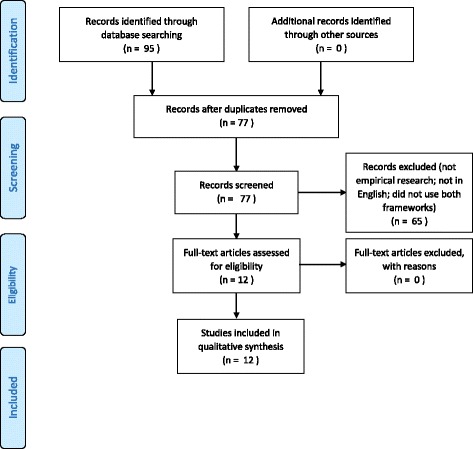
We undertook a systematic review to identify studies that mentioned both the CFIR and the TDF, were written in English, were peer-reviewed, and reported either a protocol or results of an empirical study in MEDLINE/PubMed, PsycInfo, Web of Science, or Google Scholar. We then abstracted data into a matrix and analyzed it qualitatively, identifying salient themes.
We identified five protocols and seven completed studies that used CFIR + TDF. CFIR + TDF was applied to studies in several countries, to a range of healthcare interventions, and at multiple intervention phases; used many designs, methods, and units of analysis; and assessed a variety of outcomes. Three studies indicated that using CFIR + TDF addressed multiple study purposes. Six studies indicated that using CFIR + TDF addressed multiple conceptual levels. Four studies did not explicitly state their rationale for using CFIR + TDF.
Differences in the purposes that authors of the CFIR (e.g., comprehensive set of implementation determinants) and the TDF (e.g., intervention development) propose help to justify the use of CFIR + TDF. Given that the CFIR and the TDF are both multi-level frameworks, the rationale that using CFIR + TDF is needed to address multiple conceptual levels may reflect potentially misleading conventional wisdom. On the other hand, using CFIR + TDF may more fully define the multi-level nature of implementation. To avoid concerns about unnecessary complexity and redundancy, scholars who use CFIR + TDF and combinations of other frameworks should specify how the frameworks contribute to their study.
PROSPERO CRD42015027615.
现有60多种实施框架。使用多个框架可能有助于研究人员实现多个研究目的、涵盖不同层面以及不同程度的理论传承和可操作性;然而,如果这样做无法满足研究需求,使用多个框架可能会导致不必要的复杂性和冗余。实施研究整合框架(CFIR)和理论领域框架(TDF)都是从理论衍生而来的、具有良好操作性的多层次实施决定因素框架。因此,将这两个框架结合使用(即CFIR+TDF)的基本原理尚不清楚。本系统评价的目的是通过(1)描述使用CFIR+TDF的研究、(2)它们如何使用CFIR+TDF以及(3)它们使用CFIR+TDF的既定理由,来阐明使用CFIR+TDF的基本原理。
我们进行了一项系统评价,以识别同时提及CFIR和TDF、用英文撰写、经过同行评审并在MEDLINE/PubMed、PsycInfo、科学引文索引或谷歌学术中报告了实证研究方案或结果的研究。然后,我们将数据提取到一个矩阵中并进行定性分析,确定突出主题。
我们识别出五项方案和七项完成的使用CFIR+TDF的研究。CFIR+TDF应用于多个国家的研究、一系列医疗保健干预措施以及多个干预阶段;采用了多种设计、方法和分析单位;并评估了各种结果。三项研究表明,使用CFIR+TDF实现了多个研究目的。六项研究表明,使用CFIR+TDF涵盖了多个概念层面。四项研究未明确说明使用CFIR+TDF的理由。
CFIR(例如,一套全面的实施决定因素)和TDF(例如,干预措施开发)的作者提出的目的差异有助于证明使用CFIR+TDF的合理性。鉴于CFIR和TDF都是多层次框架,认为需要使用CFIR+TDF来涵盖多个概念层面的基本原理可能反映了潜在的误导性传统观念。另一方面,使用CFIR+TDF可能会更全面地界定实施的多层次性质。为避免对不必要的复杂性和冗余性的担忧,使用CFIR+TDF以及其他框架组合的学者应具体说明这些框架如何有助于他们的研究。
国际前瞻性系统评价注册库CRD42015027615。