Pommé S, Stroh H, Paepen J, Van Ammel R, Marouli M, Altzitzoglou T, Hult M, Kossert K, Nähle O, Schrader H, Juget F, Bailat C, Nedjadi Y, Bochud F, Buchillier T, Michotte C, Courte S, van Rooy M W, van Staden M J, Lubbe J, Simpson B R S, Fazio A, De Felice P, Jackson T W, Van Wyngaardt W M, Reinhard M I, Golya J, Bourke S, Roy T, Galea R, Keightley J D, Ferreira K M, Collins S M, Ceccatelli A, Unterweger M, Fitzgerald R, Bergeron D E, Pibida L, Verheyen L, Bruggeman M, Vodenik B, Korun M, Chisté V, Amiot M-N
European Commission, Joint Research Centre (JRC), Retieseweg 111, B-2440Geel, Belgium.
Physikalisch-Technische Bundesanstalt (PTB), Bundesallee 100, 38116 Braunschweig, Germany.
Phys Lett B. 2016 Oct;761:281-286. doi: 10.1016/j.physletb.2016.08.038. Epub 2016 Aug 24.
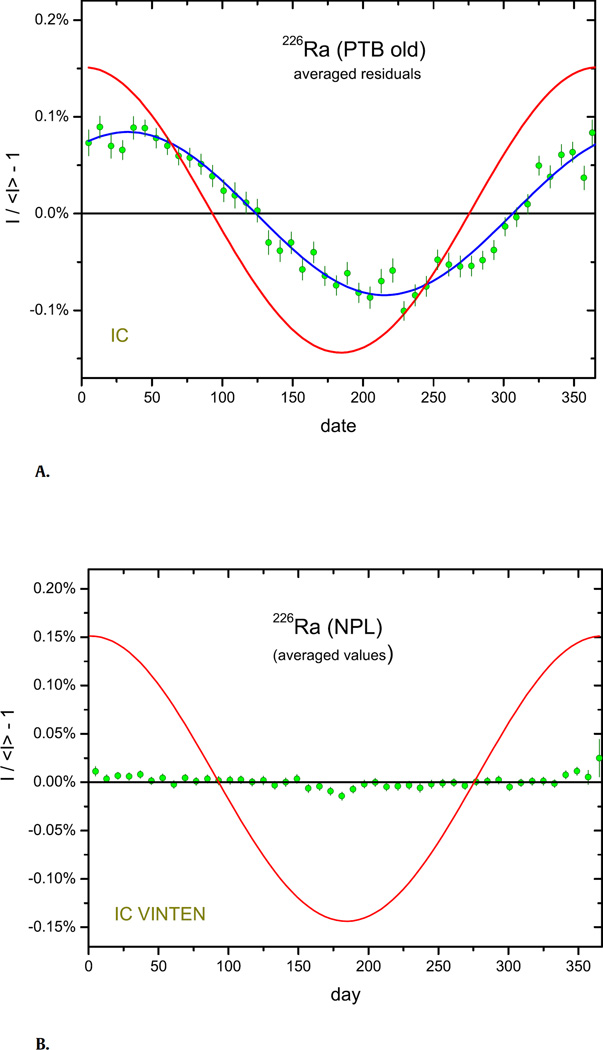
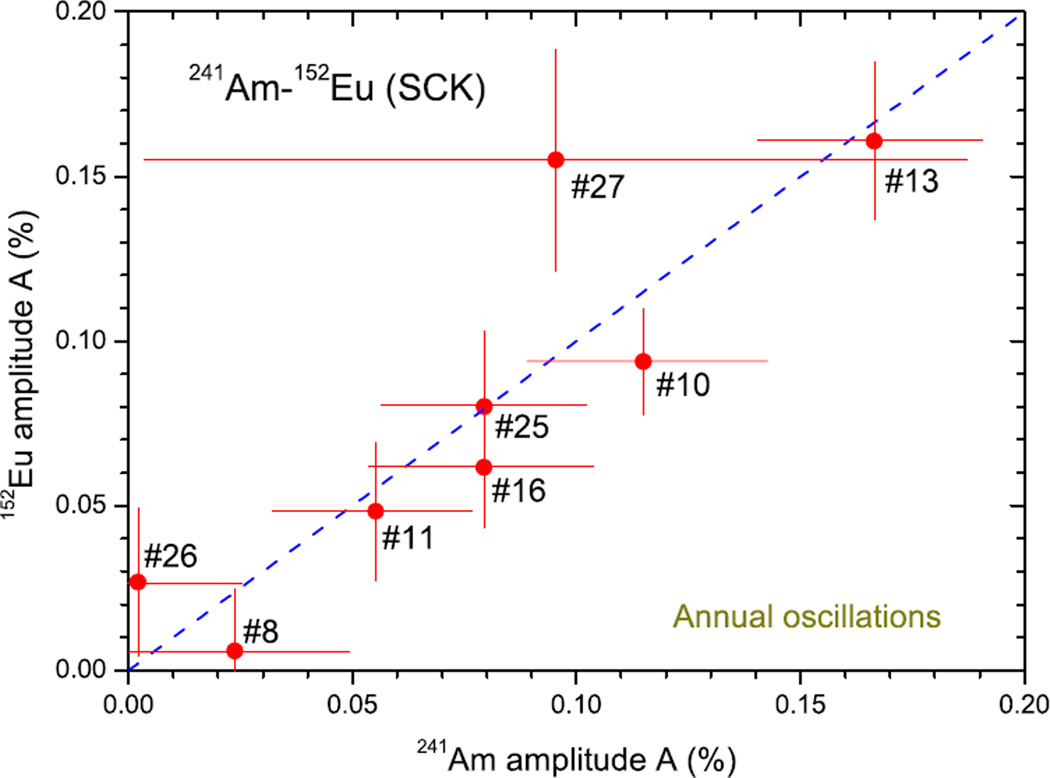
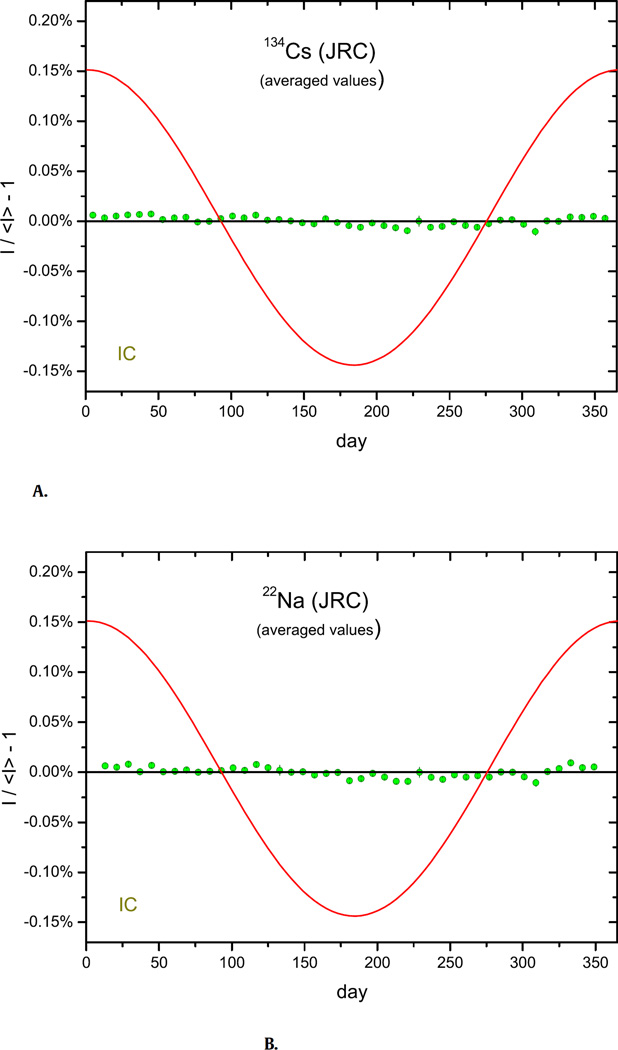
The hypothesis that proximity to the Sun causes variation of decay constants at permille level has been tested and disproved. Repeated activity measurements of mono-radionuclide sources were performed over periods from 200 days up to four decades at 14 laboratories across the globe. Residuals from the exponential nuclear decay curves were inspected for annual oscillations. Systematic deviations from a purely exponential decay curve differ from one data set to another and are attributable to instabilities in the instrumentation and measurement conditions. The most stable activity measurements of alpha, beta-minus, electron capture, and beta-plus decaying sources set an upper limit of 0.0006% to 0.008% to the amplitude of annual oscillations in the decay rate. Oscillations in phase with Earth's orbital distance to the Sun could not be observed within a 10 to 10 range of precision. There are also no apparent modulations over periods of weeks or months. Consequently, there is no indication of a natural impediment against sub-permille accuracy in half-life determinations, renormalisation of activity to a distant reference date, application of nuclear dating for archaeology, geo- and cosmochronology, nor in establishing the SI unit becquerel and seeking international equivalence of activity standards.
关于靠近太阳会导致衰变常数在千分之一水平上发生变化的假设已经得到检验并被否定。全球14个实验室对单一放射性核素源进行了长达200天至40年不等的重复活度测量。检查了指数核衰变曲线的残差是否存在年度振荡。与纯指数衰变曲线的系统偏差因数据集而异,这归因于仪器和测量条件的不稳定性。对α、β⁻、电子俘获和β⁺衰变源进行的最稳定活度测量为衰变率年度振荡的幅度设定了0.0006%至0.008%的上限。在10⁻⁹至10⁻⁶的精度范围内未观察到与地球到太阳的轨道距离同相位的振荡。在数周或数月的时间段内也没有明显的调制现象。因此,没有迹象表明在半衰期测定、将活度重新归一化到遥远的参考日期、在考古学、地质年代学和宇宙年代学中应用核测年以及在建立国际单位制贝可勒尔和寻求活度标准的国际等效性方面存在阻碍亚千分之一精度的自然因素。