Menberu Martha Alemayehu
Department of Medical Microbiology, School of Biomedical and Laboratory Sciences, University of Gondar, Gondar, Ethiopia.
Int J Microbiol. 2016;2016:9058109. doi: 10.1155/2016/9058109. Epub 2016 Dec 12.
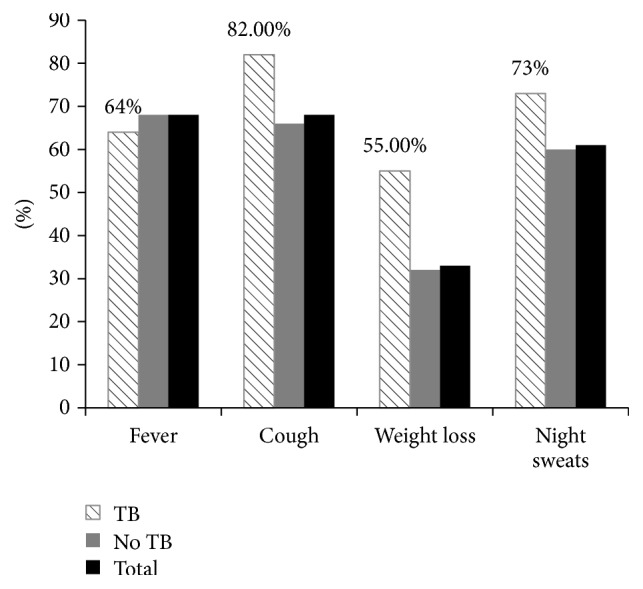
The new WHO 2011 guidelines on TB screening among HIV-infected individuals recommend screening using four TB symptoms (current cough, fever, weight loss, and night sweats). This study aimed to assess the performance of WHO 2011 TB symptom screening algorithm for diagnosing pulmonary TB in HIV patients and identify possible risk factors for TB. Institutional based cross-sectional study was conducted from February 2012 to November 2012. A total of 250 HIV-infected patients aged ≥18 years visiting the University of Gondar Hospital, ART clinic, were enrolled. Information about WHO TB clinical symptoms and other known risk factors for TB was collected using structured questionnaire. Spot-morning-spot sputum samples were collected and direct AFB microscopy, sputum culture, and RD9 molecular typing were performed. Statistical data analysis was performed using SPSS Version 20.0 software. Of 250 study participants, fever was reported in 169 (67.6%), whereas cough and night sweats were reported in 167 (66.8%) and 152 (60.8%), respectively. A total of 11 (4.4%) TB cases were identified. Of these, 82% (9/11) TB patients reported cough, so that the negative predictive value was 98%. In addition, 66% (158/239) TB negative patients reported cough, so that positive predictive value of cough was 5%. According to the new WHOTB symptom screening algorithm, out of 250 HIV-infected persons, 83% (5/6) have been investigated by TB symptom screening and AFB smear microscopy. Therefore, the 2011 WHO TB symptom screening tool for the diagnosis of pulmonary TB is likely to reduce the diagnostic delay and lower TB morbidity and mortality rate particularly in HIV prevalent settings.
世界卫生组织(WHO)2011年关于HIV感染者结核病筛查的新指南建议使用四种结核病症状(当前咳嗽、发热、体重减轻和盗汗)进行筛查。本研究旨在评估WHO 2011年结核病症状筛查算法在诊断HIV患者肺结核方面的性能,并确定结核病的可能危险因素。2012年2月至2012年11月进行了基于机构的横断面研究。共有250名年龄≥18岁、前往贡德尔大学医院抗逆转录病毒治疗门诊就诊的HIV感染者入组。使用结构化问卷收集有关WHO结核病临床症状和其他已知结核病危险因素的信息。采集即时-晨-即时痰标本,并进行直接抗酸杆菌显微镜检查、痰培养和RD9分子分型。使用SPSS 20.0软件进行统计数据分析。在250名研究参与者中,169人(67.6%)报告有发热,而咳嗽和盗汗的报告率分别为167人(66.8%)和152人(60.8%)。共确诊11例(4.4%)结核病病例。其中,82%(9/11)的结核病患者报告有咳嗽,因此阴性预测值为98%。此外,66%(158/239)的结核病阴性患者报告有咳嗽,因此咳嗽的阳性预测值为5%。根据新的WHO结核病症状筛查算法,在250名HIV感染者中,83%(5/6)通过结核病症状筛查和抗酸杆菌涂片显微镜检查进行了调查。因此,2011年WHO用于诊断肺结核的结核病症状筛查工具可能会减少诊断延迟,并降低结核病发病率和死亡率,特别是在HIV流行地区。