School of Cellular and Molecular Medicine, University of Bristol, Bristol BS8 1TD, UK.
Institute of Infection and Immunity, Cardiff University, Cardiff CF14 4XN, UK.
Sci Rep. 2017 Jan 6;7:39392. doi: 10.1038/srep39392.
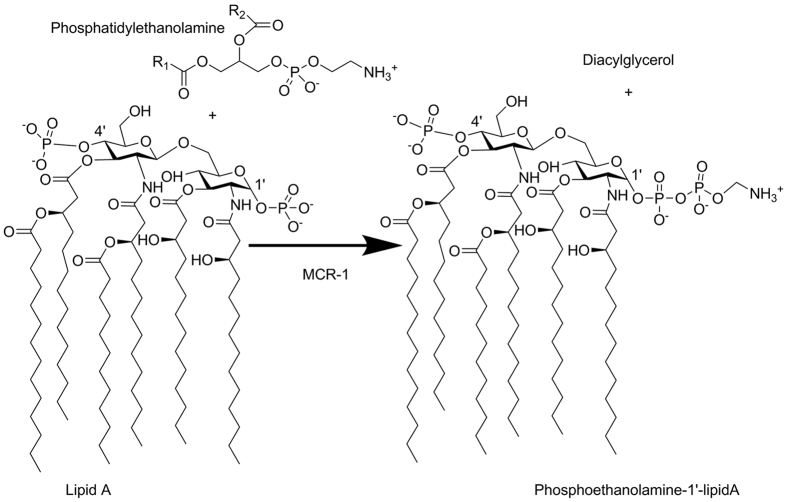
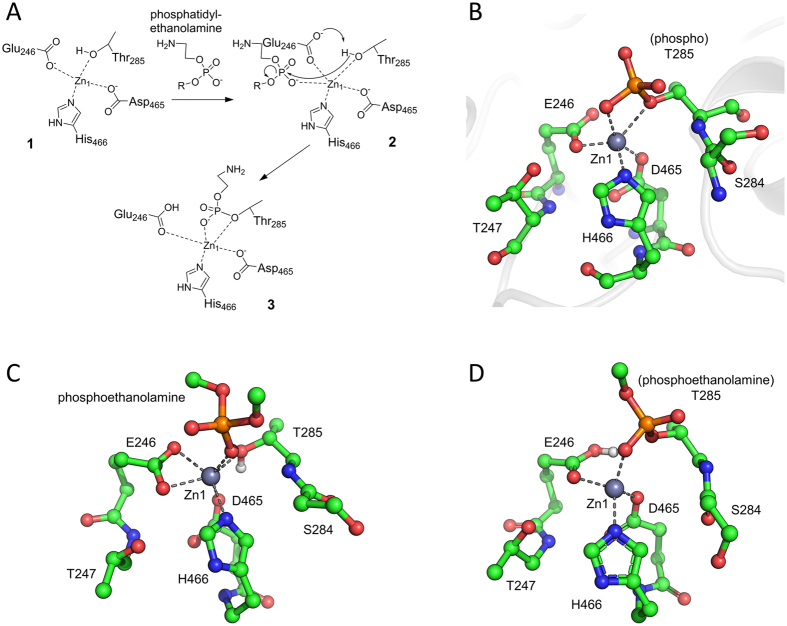
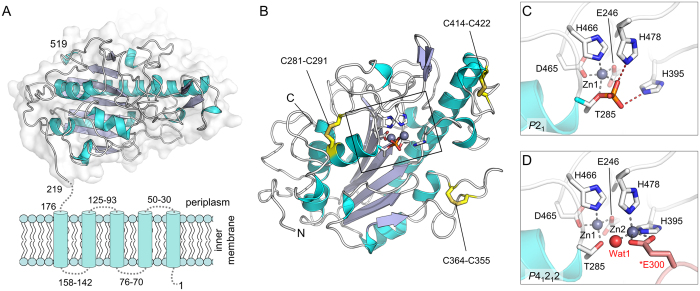
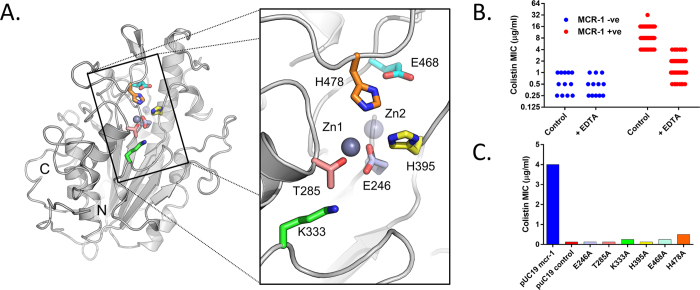
The polymixin colistin is a "last line" antibiotic against extensively-resistant Gram-negative bacteria. Recently, the mcr-1 gene was identified as a plasmid-mediated resistance mechanism in human and animal Enterobacteriaceae, with a wide geographical distribution and many producer strains resistant to multiple other antibiotics. mcr-1 encodes a membrane-bound enzyme catalysing phosphoethanolamine transfer onto bacterial lipid A. Here we present crystal structures revealing the MCR-1 periplasmic, catalytic domain to be a zinc metalloprotein with an alkaline phosphatase/sulphatase fold containing three disulphide bonds. One structure captures a phosphorylated form representing the first intermediate in the transfer reaction. Mutation of residues implicated in zinc or phosphoethanolamine binding, or catalytic activity, restores colistin susceptibility of recombinant E. coli. Zinc deprivation reduces colistin MICs in MCR-1-producing laboratory, environmental, animal and human E. coli. Conversely, over-expression of the disulphide isomerase DsbA increases the colistin MIC of laboratory E. coli. Preliminary density functional theory calculations on cluster models suggest a single zinc ion may be sufficient to support phosphoethanolamine transfer. These data demonstrate the importance of zinc and disulphide bonds to MCR-1 activity, suggest that assays under zinc-limiting conditions represent a route to phenotypic identification of MCR-1 producing E. coli, and identify key features of the likely catalytic mechanism.
黏菌素多粘菌素是一种针对广泛耐药革兰氏阴性菌的“最后一线”抗生素。最近,mcr-1 基因被鉴定为人类和动物肠杆菌科中一种质粒介导的耐药机制,具有广泛的地理分布和许多对多种其他抗生素具有抗性的产毒株。mcr-1 编码一种膜结合酶,催化磷酸乙醇胺转移到细菌脂 A 上。在这里,我们展示了揭示 MCR-1 周质、催化结构域为锌金属蛋白酶的晶体结构,具有碱性磷酸酶/硫酸酯酶折叠,包含三个二硫键。一个结构捕获了代表转移反应第一步的磷酸化形式。突变与锌或磷酸乙醇胺结合或催化活性相关的残基可恢复重组大肠杆菌对粘菌素的敏感性。锌缺乏降低了产 MCR-1 的实验室、环境、动物和人类大肠杆菌中粘菌素的 MIC。相反,二硫键异构酶 DsbA 的过表达增加了实验室大肠杆菌中粘菌素的 MIC。对团簇模型进行的初步密度泛函理论计算表明,单个锌离子可能足以支持磷酸乙醇胺的转移。这些数据表明锌和二硫键对 MCR-1 活性的重要性,表明在锌限制条件下进行测定可能是表型鉴定产 MCR-1 大肠杆菌的一种途径,并确定了可能的催化机制的关键特征。