Lai Cheng-Wei, Chen Hsiao-Ling, Tu Min-Yu, Lin Wei-Yu, Röhrig Theresa, Yang Shang-Hsun, Lan Ying-Wei, Chong Kowit-Yu, Chen Chuan-Mu
Department of Life Sciences, National Chung Hsing University, Taichung, Taiwan.
Agricultural Biotechnology Center, National Chung Hsing University, Taichung, Taiwan.
Oncotarget. 2017 Jan 31;8(5):7357-7369. doi: 10.18632/oncotarget.14458.
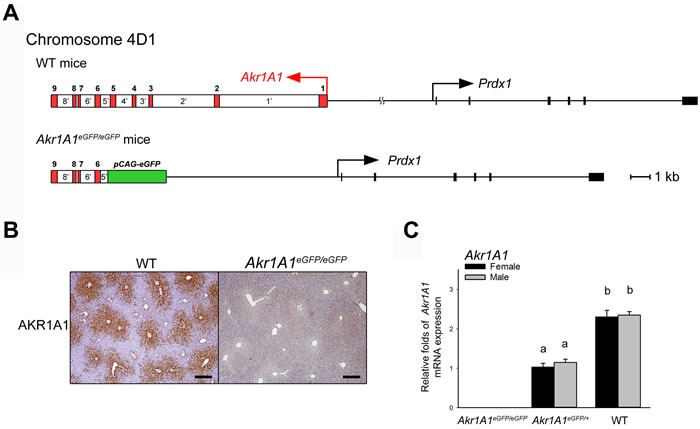
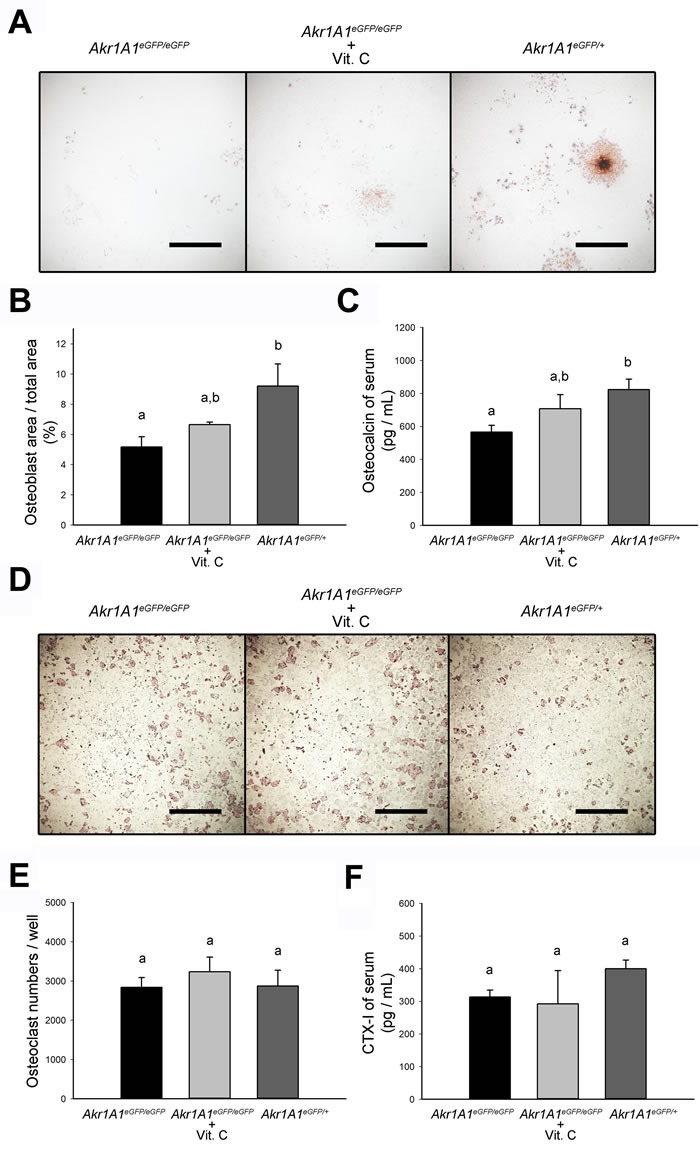
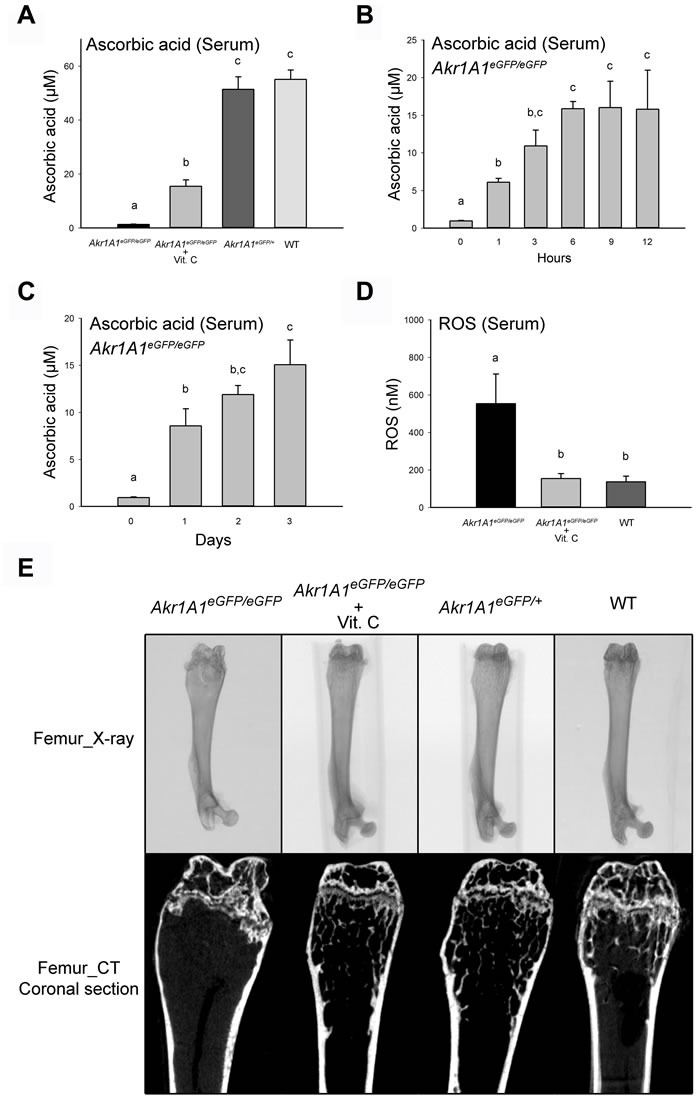
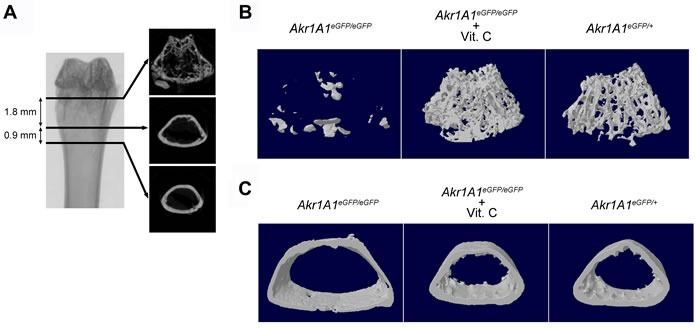
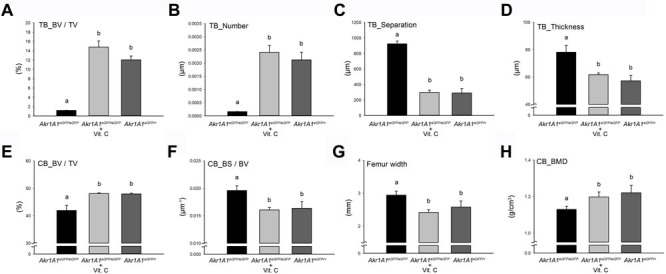
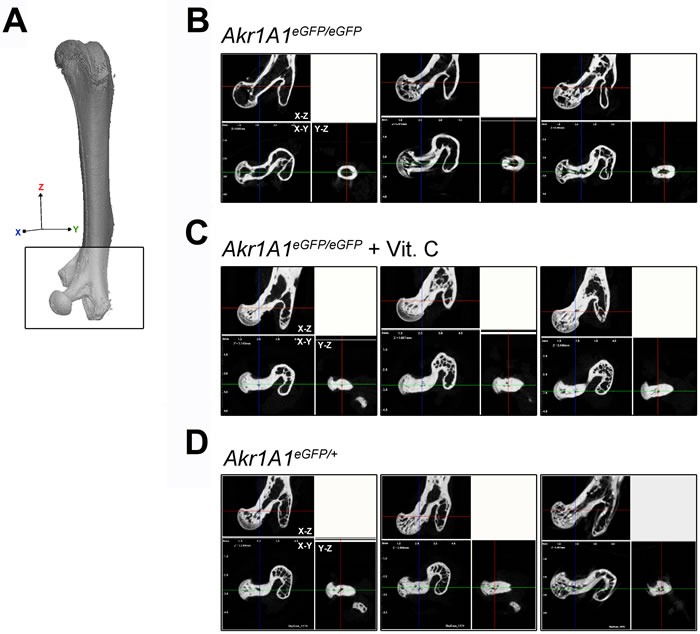
The AKR1A1 protein is a member of the aldo-keto reductase superfamily that is responsible for the conversion of D-glucuronate to L-gulonate in the ascorbic acid (vitamin C) synthesis pathway. In a pCAG-eGFP transgenic mouse line that was produced by pronuclear microinjection, the integration of the transgene resulted in a 30-kb genomic DNA deletion, including the Akr1A1 gene, and thus caused the knockout (KO) of the Akr1A1 gene and targeting of the eGFP gene. The Akr1A1 KO mice (Akr1A1eGFP/eGFP) exhibited insufficient serum ascorbic acid levels, abnormal bone development and osteoporosis. Using micro-CT analysis, the results showed that the microarchitecture of the 12-week-old Akr1A1eGFP/eGFP mouse femur was shorter in length and exhibited less cortical bone thickness, enlargement of the bone marrow cavity and a complete loss of the trabecular bone in the distal femur. The femoral head and neck of the proximal femur also showed a severe loss of bone mass. Based on the decreased levels of serum osteocalcin and osteoblast activity in the Akr1A1eGFP/eGFP mice, the osteoporosis might be caused by impaired bone formation. In addition, administration of ascorbic acid to the Akr1A1eGFP/eGFP mice significantly prevented the condition of osteoporotic femurs and increased bone formation. Therefore, through ascorbic acid administration, the Akr1A1 KO mice exhibited controllable osteoporosis and may serve as a novel model for osteoporotic research.
AKR1A1蛋白是醛糖酮还原酶超家族的成员,在抗坏血酸(维生素C)合成途径中负责将D-葡萄糖醛酸转化为L-古洛糖酸。在通过原核显微注射产生的pCAG-eGFP转基因小鼠品系中,转基因的整合导致了30 kb的基因组DNA缺失,包括Akr1A1基因,从而导致Akr1A1基因敲除(KO)以及eGFP基因的靶向整合。Akr1A1基因敲除小鼠(Akr1A1eGFP/eGFP)表现出血清抗坏血酸水平不足、骨骼发育异常和骨质疏松。使用显微CT分析,结果显示12周龄的Akr1A1eGFP/eGFP小鼠股骨的微观结构长度较短,皮质骨厚度减小,骨髓腔扩大,股骨远端小梁骨完全丧失。股骨近端的股骨头和颈部也显示出严重的骨量流失。基于Akr1A1eGFP/eGFP小鼠血清骨钙素水平降低和成骨细胞活性受损,骨质疏松可能是由骨形成受损引起的。此外,给Akr1A1eGFP/eGFP小鼠施用抗坏血酸可显著预防骨质疏松性股骨的状况并增加骨形成。因此,通过施用抗坏血酸,Akr1A1基因敲除小鼠表现出可控的骨质疏松,可作为骨质疏松研究的新型模型。