Morgan R Garrett, Venturelli Massimo, Gross Cole, Tarperi Cantor, Schena Federico, Reggiani Carlo, Naro Fabio, Pedrinolla Anna, Monaco Lucia, Richardson Russell S, Donato Anthony J
Department of Internal Medicine, Division of Geriatrics, University of Utah School of Medicine, University of Utah, Salt Lake City, Utah, United States of America.
Geriatric Research, Education, and Clinical Center, George E. Wahlen Department of Veterans Affairs Medical Center, Salt Lake City, Utah, United States of America.
PLoS One. 2017 Jan 6;12(1):e0169628. doi: 10.1371/journal.pone.0169628. eCollection 2017.
ALU element instability could contribute to gene function variance in aging, and may partly explain variation in human lifespan.
To assess the role of ALU element instability in human aging and the potential efficacy of ALU element content as a marker of biological aging and survival.
Preliminary cohort study.
We measured two high frequency ALU element subfamilies, ALU-J and ALU-Sx, by a single qPCR assay and compared ALU-J/Sx content in white blood cell (WBCs) and skeletal muscle cell (SMCs) biopsies from twenty-three elderly adults with sixteen healthy sex-balanced young adults; all-cause survival rates of elderly adults predicted by ALU-J/Sx content in both tissues; and cardiovascular disease (CVD)- and cancer-specific survival rates of elderly adults predicted by ALU-J/Sx content in both tissues, as planned subgroup analyses.
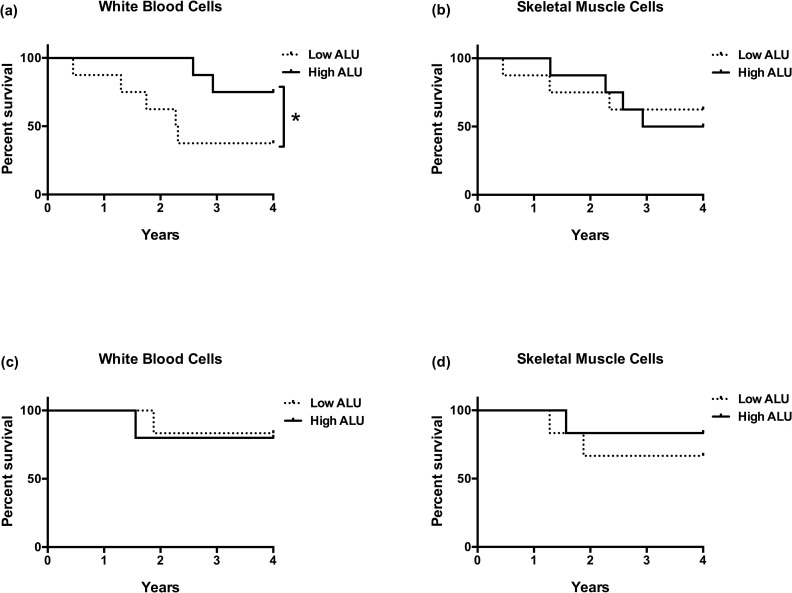
We found greater ALU-J/Sx content variance in WBCs from elderly adults than young adults (P < 0.001) with no difference in SMCs (P = 0.94). Elderly adults with low WBC ALU-J/Sx content had worse four-year all-cause and CVD-associated survival than those with high ALU-J/Sx content (both P = 0.03 and hazard ratios (HR) ≥ 3.40), while WBC ALU-J/Sx content had no influence on cancer-associated survival (P = 0.42 and HR = 0.74). SMC ALU-J/Sx content had no influence on all-cause, CVD- or cancer -associated survival (all P ≥ 0.26; HR ≤ 2.07).
These initial findings demonstrate that ALU element instability occurs with advanced age in WBCs, but not SMCs, and imparts greater risk of all-cause mortality that is likely driven by an increased risk for CVD and not cancer.
ALU元件不稳定性可能导致衰老过程中基因功能的差异,并可能部分解释人类寿命的变化。
评估ALU元件不稳定性在人类衰老中的作用,以及ALU元件含量作为生物衰老和生存标志物的潜在功效。
初步队列研究。
我们通过单一的定量聚合酶链反应(qPCR)测定法测量了两个高频ALU元件亚家族,即ALU-J和ALU-Sx,并比较了23名老年人与16名健康的性别均衡的年轻人的白细胞(WBC)和骨骼肌细胞(SMC)活检中的ALU-J/Sx含量;通过两种组织中的ALU-J/Sx含量预测老年人的全因生存率;以及作为计划中的亚组分析,通过两种组织中的ALU-J/Sx含量预测老年人的心血管疾病(CVD)和癌症特异性生存率。
我们发现老年人白细胞中的ALU-J/Sx含量变异大于年轻人(P < 0.001),而骨骼肌细胞中无差异(P = 0.94)。白细胞ALU-J/Sx含量低的老年人四年全因生存率和与CVD相关的生存率比含量高的老年人差(P均 = 0.03,风险比(HR)≥ 3.40),而白细胞ALU-J/Sx含量对癌症相关生存率无影响(P = 0.42,HR = 0.74)。骨骼肌细胞ALU-J/Sx含量对全因、CVD或癌症相关生存率均无影响(所有P≥0.26;HR≤2.07)。
这些初步发现表明,ALU元件不稳定性在老年人的白细胞中随年龄增长而出现,但在骨骼肌细胞中未出现,并且会增加全因死亡率风险,这可能是由CVD风险增加而非癌症风险增加所驱动。