Zhu Yan-Juan, Zhang Hai-Bo, Liu Yi-Hong, Zhang Fu-Li, Zhu Ya-Zhen, Li Yong, Bai Jian-Ping, Liu Li-Rong, Qu Yan-Chun, Qu Xin, Chen Xian, Li Yan, Zheng Guang-Juan
Oncology Department, The Second Affiliated Hospital of Guangzhou University of Chinese Medicine, Guangdong Provincial Hospital of Chinese Medicine, China.
Pathology Department, The Second Affiliated Hospital of Guangzhou University of Chinese Medicine, Guangdong Provincial Hospital of Chinese Medicine, China.
Oncotarget. 2017 Feb 21;8(8):13195-13205. doi: 10.18632/oncotarget.14490.
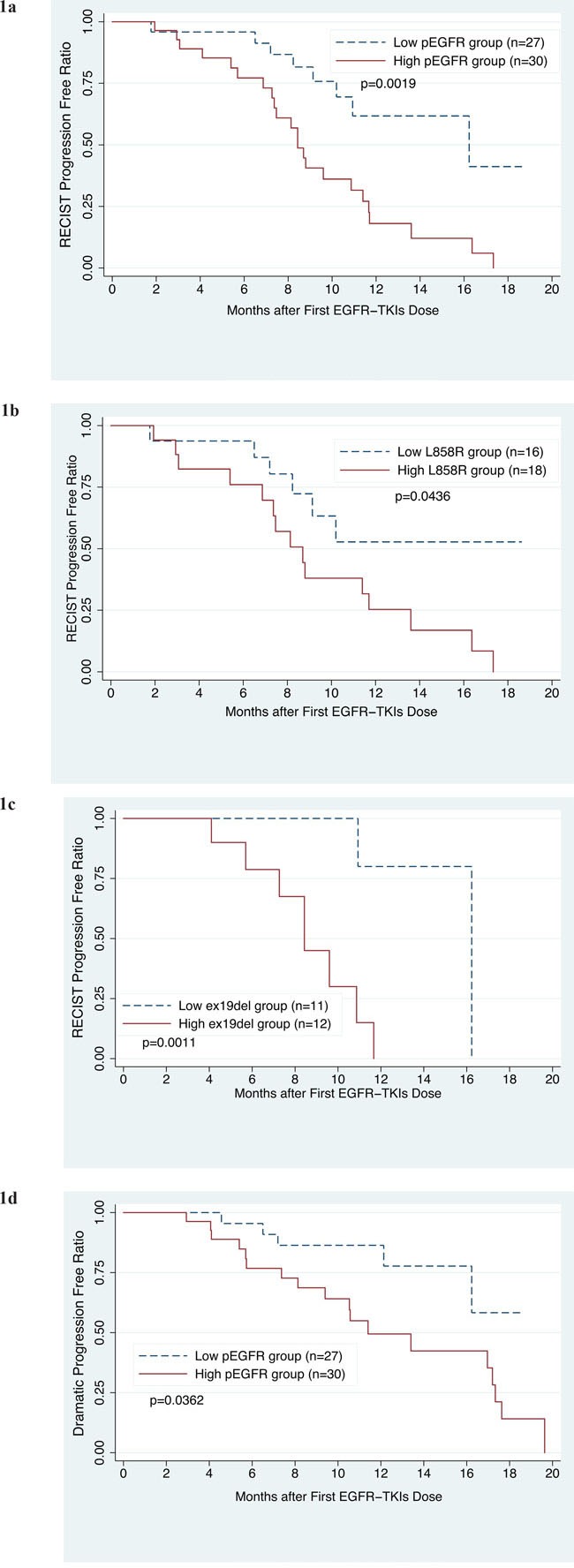
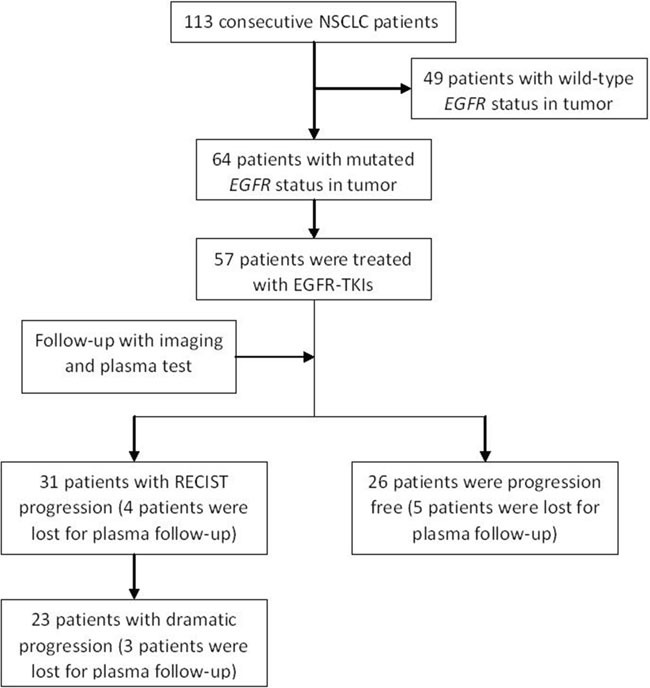
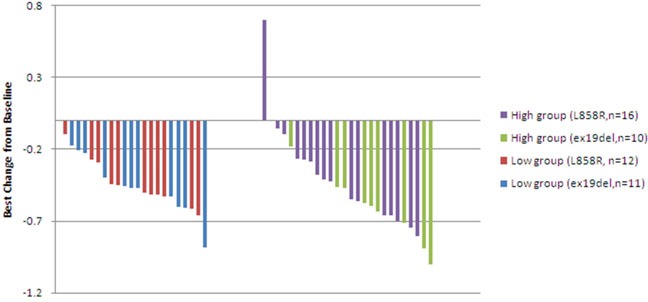
Detection of circulating tumor DNA using droplet digital polymerase chain reaction (ddPCR) is a highly-sensitive, minimally invasive alternative to serial biopsies for assessment and management of cancer. We used ddPCR to assess the utility of measuring plasma concentrations of common epidermal growth factor receptor (EGFR) mutations (L858R, exon 19 deletion, and T790M) in 57 non-small cell lung cancer (NSCLC) patients treated with EGFR tyrosine kinase inhibitors (EGFR-TKIs). High baseline plasma EGFR mutation (pEGFRmut) concentrations were associated with shorter progression-free survival (8.43 months) than low baseline pEGFRmut (16.23 months; p = 0.0019). By contrast, there were no differences in tumor shrinkage or overall survival between groups. During EGFR-TKI treatment, pEGFRmut levels decreased to zero in 89.58% of patients. Twenty-five of the 27 patients who progressed had basal pEGFRmut, and 18 also had circulating T790M. All 20 patients with dramatic progression (according to a categorization system for EGFR-TKIs failure) had basal pEGFRmut, and 13 had T790M mutation at progression. These results support the use of ddPCR for analysis of plasma EGFR mutations for prediction of PFS and to monitor clinical responses to EGFR-TKIs in NSCLC patients.
使用液滴数字聚合酶链反应(ddPCR)检测循环肿瘤DNA是一种高度敏感、微创的替代方法,可用于癌症评估和管理的系列活检。我们使用ddPCR评估了57例接受表皮生长因子受体(EGFR)酪氨酸激酶抑制剂(EGFR-TKIs)治疗的非小细胞肺癌(NSCLC)患者中常见EGFR突变(L858R、外显子19缺失和T790M)血浆浓度测量的效用。高基线血浆EGFR突变(pEGFRmut)浓度与低基线pEGFRmut相比,无进展生存期较短(8.43个月对16.23个月;p = 0.0019)。相比之下,两组之间的肿瘤缩小或总生存期无差异。在EGFR-TKI治疗期间,89.58%的患者pEGFRmut水平降至零。进展的27例患者中有25例有基础pEGFRmut,18例也有循环T790M。所有20例有显著进展的患者(根据EGFR-TKIs失败分类系统)有基础pEGFRmut,13例在进展时有T790M突变。这些结果支持使用ddPCR分析血浆EGFR突变,以预测NSCLC患者的无进展生存期并监测对EGFR-TKIs的临床反应。