Huang Ying-Hsien, Li Sung-Chou, Huang Lien-Hung, Chen Pao-Chun, Lin Yi-Yu, Lin Chiung-Chun, Kuo Ho-Chang
Department of Pediatrics, Kaohsiung Chang Gung Memorial Hospital and Chang Gung University College of Medicine, Kaohsiung, Taiwan.
Kawasaki Disease Center, Kaohsiung Chang Gung Memorial Hospital, Taiwan.
Oncotarget. 2017 Feb 14;8(7):11249-11258. doi: 10.18632/oncotarget.14497.
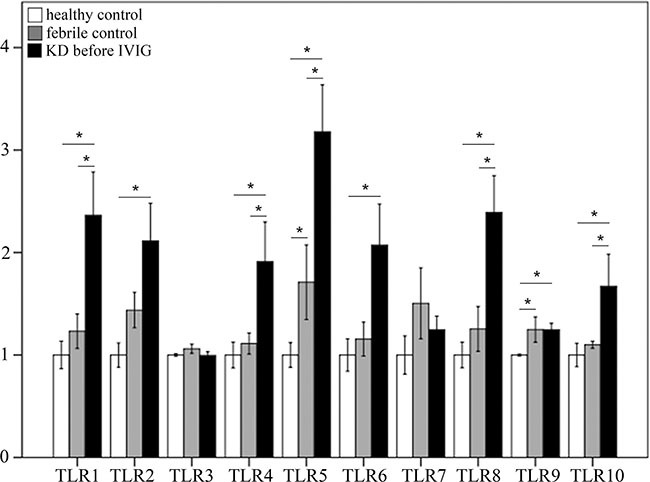
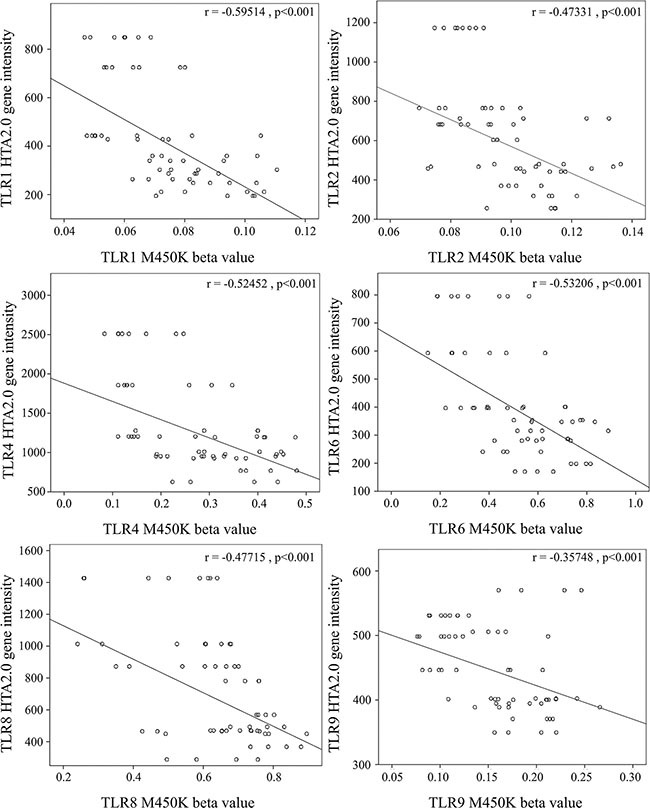
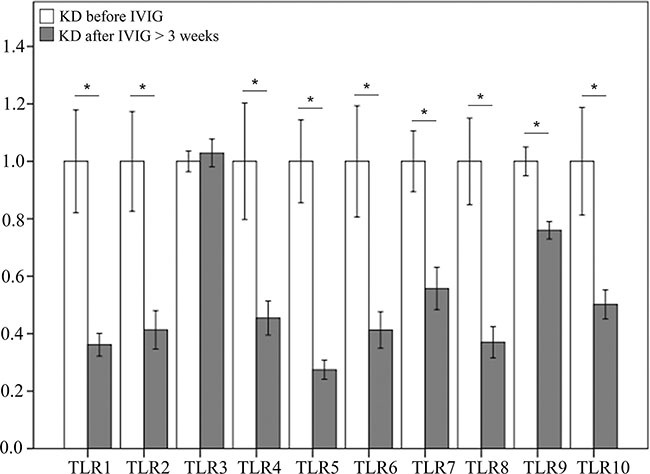
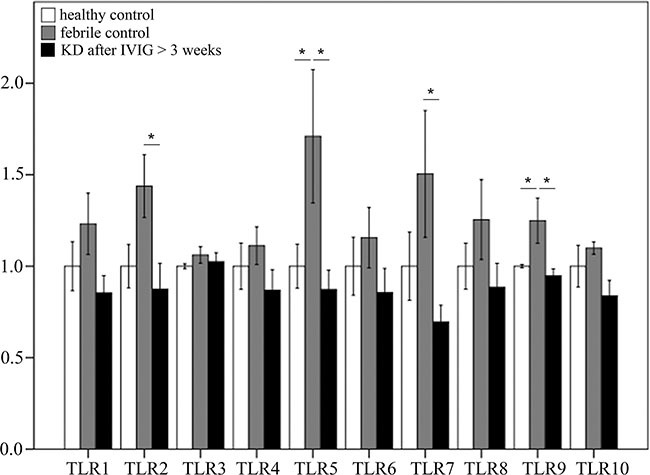
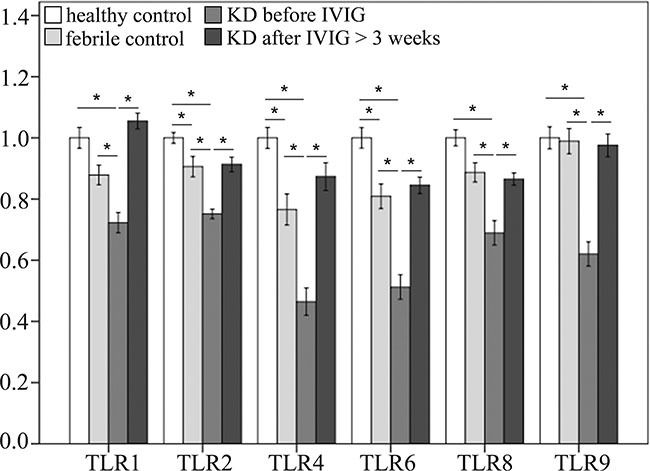
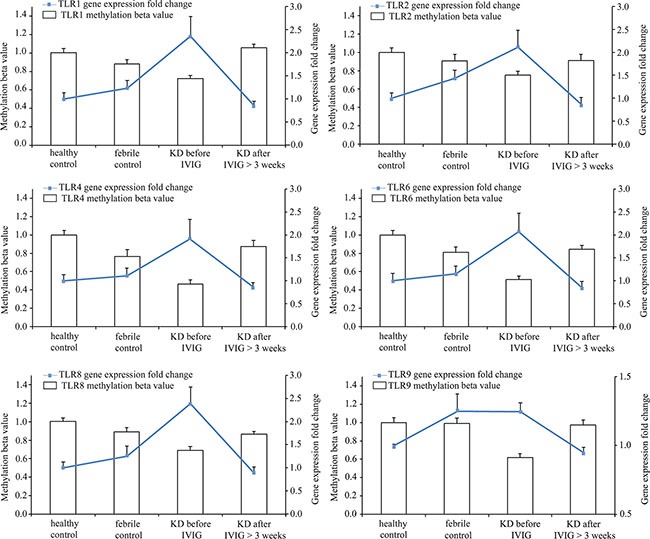
Kawasaki disease (KD) is an acute febrile systemic vasculitis that occurs in children and is characterized by elevated levels of proinflammatory cytokines. Toll-like receptors (TLRs) serve as the sensor arm of the innate immune system and induce proinflammatory cytokine expressions.We recruited a total of 18 paired KD patients, before intravenous immunoglobulin (IVIG) and at least 3 weeks after IVIG treatment, 18 healthy controls, and 18 febrile controls. For TLR genes and their cytosine-phosphate-guanine (CpG) markers, we used Affymetrix GeneChip® Human Transcriptome Array 2.0 and Illumina HumanMethylation450 BeadChip to evaluate gene expression levels and methylation patterns, respectively.KD patients demonstrated a significantly differential expression of TLR mRNA levels compared to both the healthy and febrile controls, with only TLR 3 and 7 not differing between the KD patients and the controls. After patients underwent IVIG treatment, the TLR mRNA levels, except for TLR3, decreased significantly in KD patients. In contrast, the methylation status of the CpG sites of TLR1, 2, 4, 6, 8, and 9 demonstrated an opposite tendency between the two stages of both the KD samples and the controls.TLRs, particularly TLR1, 2, 4, 6, 8, and 9, may stimulate the immunopathogenesis of KD. These results are among the first to use TLRs to prove that a bacterial inflammatory response may trigger KD.
川崎病(KD)是一种发生于儿童的急性发热性全身性血管炎,其特征为促炎细胞因子水平升高。Toll样受体(TLR)作为先天性免疫系统的传感臂,可诱导促炎细胞因子表达。我们共招募了18例KD配对患者,分别在静脉注射免疫球蛋白(IVIG)前和IVIG治疗至少3周后,同时招募了18名健康对照和18名发热对照。对于TLR基因及其胞嘧啶-磷酸-鸟嘌呤(CpG)标记,我们分别使用Affymetrix GeneChip®人类转录组阵列2.0和Illumina HumanMethylation450 BeadChip来评估基因表达水平和甲基化模式。与健康对照和发热对照相比,KD患者的TLR mRNA水平表现出显著差异表达,只有TLR 3和7在KD患者与对照之间无差异。患者接受IVIG治疗后,KD患者中除TLR3外的TLR mRNA水平显著下降。相反,TLR1、2、4、6、8和9的CpG位点甲基化状态在KD样本和对照的两个阶段均呈现相反趋势。TLR,特别是TLR1、2、4、6、8和9,可能刺激KD的免疫发病机制。这些结果是首批利用TLR证明细菌炎症反应可能引发KD的研究之一。