Yuan Yuan, Yost Susan E, Yim John, Yuan Yate-Ching, Solomon Nicola M, Mambetsariev Isa, Pal Sumanta, Frankel Paul, Salgia Ravi, Neuhausen Susan L, Mortimer Joanne
Department of Medical Oncology & Molecular Therapeutics, City of Hope Comprehensive Cancer Center and Beckman Research Institute, Duarte, CA, USA.
Bioinformatics Core Facility, City of Hope Comprehensive Cancer Center and Beckman Research Institute, Duarte, CA, USA.
Oncotarget. 2017 Apr 18;8(16):26414-26423. doi: 10.18632/oncotarget.14476.
Next-Generation Sequencing (NGS) has made genomic mutation-driven therapy feasible for metastatic breast cancer (MBC) patients. We frequently submit tumor tissue from MBC patients for targeted NGS of tumor using the Illumina HiSeq 2000 platform (FoundationOne®, Foundation Medicine, MA). Herein, we report the results and clinical impact of this test in MBC patients.
We identified patients with MBC treated at City of Hope from January 2014 to May 2016 who underwent NGS. Patients' clinical characteristics, response to treatment (clinical assessment of tumor regression), and genomic mutation profiles were reviewed.
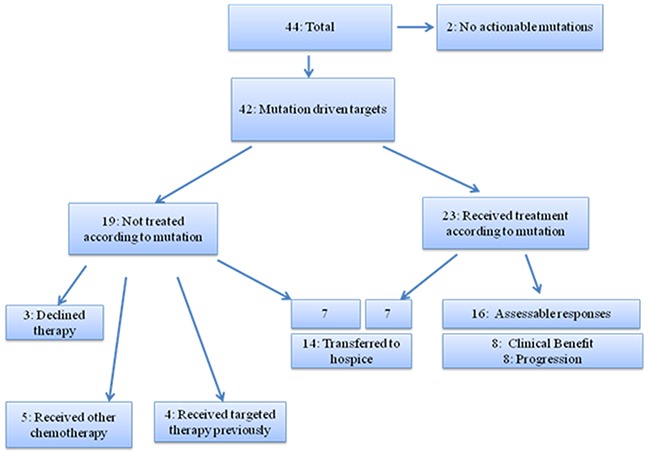
Forty-four patients with MBC underwent NGS: 24 triple negative breast cancer, 16 estrogen receptor positive, and 4 human epidermal growth factor receptor 2 positive patients. Twenty-three patients received more than three lines of chemotherapy prior to NGS. Actionable mutations (potentially responsive to targeted therapies that are on the market or in registered clinical trials) were identified in almost all patients (42/44; 95%) and over half of these 42 patients with actionable mutations (23/42; 55%) initiated mutation-driven targeted therapies. Of these 23 patients, 16/23 (70%) had assessable responses, and 7/23 (30%) were not assessable for response due to short exposure (<2 weeks) or hospice transition. The remaining 19/42 (45%) patients did not initiate targeted therapy.
NGS can identify effective targeted therapy options for MBC patients based on actionable mutations that were not previously offered based on pathology type. NGS should be performed early in patients with good performance status and preferably in clinical settings where genomic mutation-driven therapeutic trials are available.
下一代测序(NGS)已使基因组突变驱动的治疗对转移性乳腺癌(MBC)患者成为可能。我们经常将MBC患者的肿瘤组织提交至使用Illumina HiSeq 2000平台(FoundationOne®,Foundation Medicine,马萨诸塞州)进行肿瘤的靶向NGS检测。在此,我们报告该检测在MBC患者中的结果及临床影响。
我们确定了2014年1月至2016年5月在希望之城接受NGS检测的MBC患者。回顾了患者的临床特征、对治疗的反应(肿瘤消退的临床评估)以及基因组突变谱。
44例MBC患者接受了NGS检测:24例三阴性乳腺癌患者、16例雌激素受体阳性患者和4例人表皮生长因子受体2阳性患者。23例患者在进行NGS检测前接受了三线以上化疗。几乎所有患者(42/44;95%)都检测到了可操作的突变(可能对市场上或注册临床试验中的靶向治疗有反应),在这42例有可操作突变的患者中,超过一半(23/42;55%)开始了突变驱动的靶向治疗。在这23例患者中,16/23(70%)有可评估的反应,7/23(30%)因暴露时间短(<2周)或临终关怀转变而无法评估反应。其余19/42(45%)患者未开始靶向治疗。
NGS可根据可操作的突变,为MBC患者识别有效的靶向治疗方案,而这些方案此前并非基于病理类型提供。对于身体状况良好的患者,应尽早进行NGS检测,最好是在有基因组突变驱动的治疗试验的临床环境中进行。