• 文献检索
  • 文档翻译
  • 深度研究
  • 学术资讯
  • Suppr Zotero 插件Zotero 插件
  • 邀请有礼
  • 套餐&价格
  • 历史记录
应用&插件
Suppr Zotero 插件Zotero 插件浏览器插件Mac 客户端Windows 客户端微信小程序
定价
高级版会员购买积分包购买API积分包
服务
文献检索文档翻译深度研究API 文档MCP 服务
关于我们
关于 Suppr公司介绍联系我们用户协议隐私条款
关注我们

Suppr 超能文献

核心技术专利:CN118964589B侵权必究
粤ICP备2023148730 号-1Suppr @ 2026

文献检索

告别复杂PubMed语法,用中文像聊天一样搜索,搜遍4000万医学文献。AI智能推荐,让科研检索更轻松。

立即免费搜索

文件翻译

保留排版,准确专业,支持PDF/Word/PPT等文件格式,支持 12+语言互译。

免费翻译文档

深度研究

AI帮你快速写综述,25分钟生成高质量综述,智能提取关键信息,辅助科研写作。

立即免费体验

不同经证实的患者健康状况下Facebook发帖模式的差异:一项前瞻性队列研究。

Variations in Facebook Posting Patterns Across Validated Patient Health Conditions: A Prospective Cohort Study.

作者信息

Smith Robert J, Crutchley Patrick, Schwartz H Andrew, Ungar Lyle, Shofer Frances, Padrez Kevin A, Merchant Raina M

机构信息

Penn Medicine Social Media and Health Innovation Lab, Penn Medicine Center for Health Care Innovation, University of Pennsylvania, Philadelphia, PA, United States.

Positive Psychology Center, Department of Psychology, University of Pennsylvania, Philadelphia, PA, United States.

出版信息

J Med Internet Res. 2017 Jan 6;19(1):e7. doi: 10.2196/jmir.6486.

DOI:10.2196/jmir.6486
PMID:28062392
原文链接:https://pmc.ncbi.nlm.nih.gov/articles/PMC5251170/
Abstract

BACKGROUND

Social media is emerging as an insightful platform for studying health. To develop targeted health interventions involving social media, we sought to identify the patient demographic and disease predictors of frequency of posting on Facebook.

OBJECTIVE

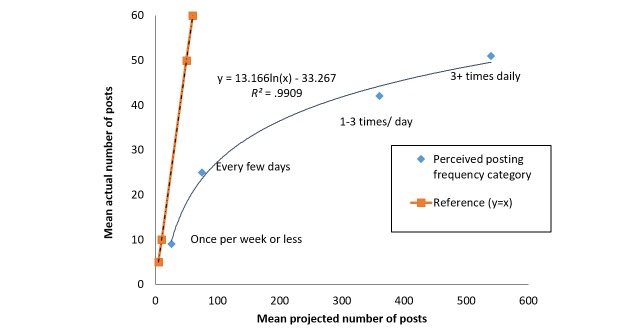
The aims were to explore the language topics correlated with frequency of social media use across a cohort of social media users within a health care setting, evaluate the differences in the quantity of social media postings across individuals with different disease diagnoses, and determine if patients could accurately predict their own levels of social media engagement.

METHODS

Patients seeking care at a single, academic, urban, tertiary care emergency department from March to October 2014 were queried on their willingness to share data from their Facebook accounts and electronic medical records (EMRs). For each participant, the total content of Facebook posts was extracted. Using the latent Dirichlet allocation natural language processing technique, Facebook language topics were correlated with frequency of Facebook use. The mean number of Facebook posts over 6 months prior to enrollment was then compared across validated health outcomes in the sample.

RESULTS

A total of 695 patients consented to provide access to their EMR and social media data. Significantly correlated language topics among participants with the highest quartile of posts contained health terms, such as "cough," "headaches," and "insomnia." When adjusted for demographics, individuals with a history of depression had significantly higher posts (mean 38, 95% CI 28-50) than individuals without a history of depression (mean 22, 95% CI 19-26, P=.001). Except for depression, across prevalent health outcomes in the sample (hypertension, diabetes, asthma), there were no significant posting differences between individuals with or without each condition.

CONCLUSIONS

High-frequency posters in our sample were more likely to post about health and to have a diagnosis of depression. The direction of causality between depression and social media use requires further evaluation. Our findings suggest that patients with depression may be appropriate targets for health-related interventions on social media.

摘要

背景

社交媒体正成为一个研究健康问题的有见地的平台。为了开展涉及社交媒体的针对性健康干预措施,我们试图确定在脸书上发帖频率的患者人口统计学特征和疾病预测因素。

目的

旨在探讨在医疗环境中的一群社交媒体用户中,与社交媒体使用频率相关的语言主题,评估不同疾病诊断的个体在社交媒体发帖数量上的差异,并确定患者是否能够准确预测自己的社交媒体参与水平。

方法

对2014年3月至10月在一家单一的学术性城市三级护理急诊科寻求治疗的患者询问其是否愿意分享脸书账户和电子病历(EMR)的数据。对于每位参与者,提取脸书帖子的全部内容。使用潜在狄利克雷分配自然语言处理技术,将脸书语言主题与脸书使用频率相关联。然后在样本中根据经过验证的健康结果比较入组前6个月脸书帖子的平均数量。

结果

共有695名患者同意提供对其电子病历和社交媒体数据的访问权限。发帖量处于最高四分位数的参与者之间显著相关的语言主题包含健康术语,如“咳嗽”“头痛”和“失眠”。在对人口统计学因素进行调整后,有抑郁症病史的个体的发帖量(平均38,95%可信区间28 - 50)显著高于无抑郁症病史的个体(平均22,95%可信区间19 - 26,P = 0.001)。除抑郁症外,在样本中的常见健康结果(高血压、糖尿病、哮喘)方面,有或无每种疾病的个体之间在发帖量上没有显著差异。

结论

我们样本中的高频发帖者更有可能发布有关健康的内容并且被诊断为患有抑郁症。抑郁症与社交媒体使用之间的因果关系方向需要进一步评估。我们的研究结果表明,抑郁症患者可能是社交媒体上与健康相关干预措施的合适目标人群。
https://cdn.ncbi.nlm.nih.gov/pmc/blobs/140e/5251170/b3b5ad7c8117/jmir_v19i1e7_fig4.jpg

相似文献

1
Variations in Facebook Posting Patterns Across Validated Patient Health Conditions: A Prospective Cohort Study.不同经证实的患者健康状况下Facebook发帖模式的差异:一项前瞻性队列研究。
J Med Internet Res. 2017 Jan 6;19(1):e7. doi: 10.2196/jmir.6486.
2
Linking social media and medical record data: a study of adults presenting to an academic, urban emergency department.关联社交媒体与病历数据:一项针对前往城市学术急诊科就诊的成年人的研究。
BMJ Qual Saf. 2016 Jun;25(6):414-23. doi: 10.1136/bmjqs-2015-004489. Epub 2015 Oct 13.
3
Facebook language predicts depression in medical records.脸书的语言可预测病历中的抑郁症状。
Proc Natl Acad Sci U S A. 2018 Oct 30;115(44):11203-11208. doi: 10.1073/pnas.1802331115. Epub 2018 Oct 15.
4
Predicting the Transition From Depression to Suicidal Ideation Using Facebook Data Among Indian-Bangladeshi Individuals: Protocol for a Cohort Study.利用 Facebook 数据预测印度裔孟加拉人从抑郁到自杀意念的转变:一项队列研究方案。
JMIR Res Protoc. 2024 Oct 7;13:e55511. doi: 10.2196/55511.
5
Exploring Hospitals' Use of Facebook: Thematic Analysis.探索医院对脸书的使用:主题分析
J Med Internet Res. 2018 May 16;20(5):e190. doi: 10.2196/jmir.9549.
6
Outcomes in Child Health: Exploring the Use of Social Media to Engage Parents in Patient-Centered Outcomes Research.儿童健康成果:探索利用社交媒体让家长参与以患者为中心的成果研究。
J Med Internet Res. 2017 Mar 16;19(3):e78. doi: 10.2196/jmir.6655.
7
Social Media for Academic Neurosurgical Programs: The University of Toronto Experience.学术神经外科项目的社交媒体应用:多伦多大学的经验
World Neurosurg. 2016 Sep;93:449-57. doi: 10.1016/j.wneu.2016.06.134. Epub 2016 Jul 14.
8
What People "Like": Analysis of Social Media Strategies Used by Food Industry Brands, Lifestyle Brands, and Health Promotion Organizations on Facebook and Instagram.人们“喜欢”的内容:对食品行业品牌、生活方式品牌以及健康促进组织在脸书和照片墙上使用的社交媒体策略的分析
J Med Internet Res. 2018 Jun 14;20(6):e10227. doi: 10.2196/10227.
9
Harnessing Facebook for Smoking Reduction and Cessation Interventions: Facebook User Engagement and Social Support Predict Smoking Reduction.利用脸书进行减少吸烟和戒烟干预:脸书用户参与度和社会支持可预测吸烟量减少。
J Med Internet Res. 2017 May 23;19(5):e168. doi: 10.2196/jmir.6681.
10
Facebook Groups as a Powerful and Dynamic Tool in Medical Education: Mixed-Method Study.脸书群组作为医学教育中强大而动态的工具:混合方法研究
J Med Internet Res. 2017 Dec 22;19(12):e408. doi: 10.2196/jmir.7990.

引用本文的文献

1
Deep Learning for Identification of Alcohol-Related Content on Social Media (Reddit and Twitter): Exploratory Analysis of Alcohol-Related Outcomes.社交媒体(Reddit 和 Twitter)上的酒精相关内容的深度学习识别:酒精相关结果的探索性分析。
J Med Internet Res. 2021 Sep 15;23(9):e27314. doi: 10.2196/27314.
2
Displayed Depression Symptoms on Facebook at Two Time Points: Content Analysis.两个时间点在脸书上呈现的抑郁症状:内容分析
JMIR Form Res. 2021 May 31;5(5):e20179. doi: 10.2196/20179.
3
Responses to Concerning Posts on Social Media and Their Implications for Suicide Prevention Training for Military Veterans: Qualitative Study.

本文引用的文献

1
Linking social media and medical record data: a study of adults presenting to an academic, urban emergency department.关联社交媒体与病历数据:一项针对前往城市学术急诊科就诊的成年人的研究。
BMJ Qual Saf. 2016 Jun;25(6):414-23. doi: 10.1136/bmjqs-2015-004489. Epub 2015 Oct 13.
2
Disease detection or public opinion reflection? Content analysis of tweets, other social media, and online newspapers during the measles outbreak in The Netherlands in 2013.疾病检测还是民意反映?2013年荷兰麻疹疫情期间推文、其他社交媒体及在线报纸的内容分析
J Med Internet Res. 2015 May 26;17(5):e128. doi: 10.2196/jmir.3863.
3
Development of a Twitter-based intervention for smoking cessation that encourages high-quality social media interactions via automessages.
社交媒体上令人担忧的帖子的回应及其对退伍军人自杀预防培训的影响:定性研究。
J Med Internet Res. 2020 Oct 30;22(10):e22076. doi: 10.2196/22076.
4
Studying social media language changes associated with pregnancy status, trimester, and parity from medical records.从病历中研究与怀孕状况、孕期和生育次数相关的社交媒体语言变化。
Womens Health (Lond). 2020 Jan-Dec;16:1745506520949392. doi: 10.1177/1745506520949392.
5
Predicting eating disorders from Internet activity.从互联网活动预测进食障碍。
Int J Eat Disord. 2020 Sep;53(9):1526-1533. doi: 10.1002/eat.23338. Epub 2020 Jul 24.
6
Perspectives to social media usage of depressed patients and caregivers affecting to change the health behavior of patients in terms of information and perceived privacy risks.从信息和感知隐私风险的角度看抑郁症患者及其照料者使用社交媒体对改变患者健康行为的影响。
Heliyon. 2020 Jun 24;6(6):e04244. doi: 10.1016/j.heliyon.2020.e04244. eCollection 2020 Jun.
7
Comparison of Social Media, Syndromic Surveillance, and Microbiologic Acute Respiratory Infection Data: Observational Study.社交媒体、症状监测和微生物学急性呼吸道感染数据的比较:观察性研究。
JMIR Public Health Surveill. 2020 Apr 24;6(2):e14986. doi: 10.2196/14986.
8
Infodemiology and Infoveillance: Scoping Review.信息流行病学与信息监测:范围综述
J Med Internet Res. 2020 Apr 28;22(4):e16206. doi: 10.2196/16206.
9
Incorporating Information From Electronic and Social Media Into Psychiatric and Psychotherapeutic Patient Care: Survey Among Clinicians.将电子和社交媒体信息纳入精神科及心理治疗患者护理:临床医生调查
J Med Internet Res. 2019 Jul 12;21(7):e13218. doi: 10.2196/13218.
10
A systematic literature review of machine learning in online personal health data.机器学习在在线个人健康数据中的系统文献综述。
J Am Med Inform Assoc. 2019 Jun 1;26(6):561-576. doi: 10.1093/jamia/ocz009.
开发一种基于推特的戒烟干预措施,通过自动消息鼓励高质量的社交媒体互动。
J Med Internet Res. 2015 Feb 23;17(2):e50. doi: 10.2196/jmir.3772.
4
Psychological language on Twitter predicts county-level heart disease mortality.推特上的心理语言可预测县级心脏病死亡率。
Psychol Sci. 2015 Feb;26(2):159-69. doi: 10.1177/0956797614557867. Epub 2015 Jan 20.
5
The Efficacy of a Walking Intervention Using Social Media to Increase Physical Activity: A Randomized Trial.使用社交媒体的步行干预对增加身体活动的效果:一项随机试验。
J Phys Act Health. 2015 Jun 16;12 Suppl 1:S18-25. doi: 10.1123/jpah.2014-0279.
6
The accuracy of patient-reported measures for GI symptoms: a comparison of real time and retrospective reports.患者报告的胃肠道症状测量的准确性:实时报告与回顾性报告的比较。
Neurogastroenterol Motil. 2014 Dec;26(12):1802-11. doi: 10.1111/nmo.12466.
7
The 1% rule in four digital health social networks: an observational study.四个数字健康社交网络中的1%规则:一项观察性研究。
J Med Internet Res. 2014 Feb 4;16(2):e33. doi: 10.2196/jmir.2966.
8
Tracking suicide risk factors through Twitter in the US.通过推特追踪美国的自杀风险因素。
Crisis. 2014;35(1):51-9. doi: 10.1027/0227-5910/a000234.
9
Personality, gender, and age in the language of social media: the open-vocabulary approach.社交媒体语言中的个性、性别和年龄:开放词汇方法。
PLoS One. 2013 Sep 25;8(9):e73791. doi: 10.1371/journal.pone.0073791. eCollection 2013.
10
Activities on Facebook reveal the depressive state of users.脸书上的活动揭示了用户的抑郁状态。
J Med Internet Res. 2013 Oct 1;15(10):e217. doi: 10.2196/jmir.2718.