• 文献检索
  • 文档翻译
  • 深度研究
  • 学术资讯
  • Suppr Zotero 插件Zotero 插件
  • 邀请有礼
  • 套餐&价格
  • 历史记录
应用&插件
Suppr Zotero 插件Zotero 插件浏览器插件Mac 客户端Windows 客户端微信小程序
定价
高级版会员购买积分包购买API积分包
服务
文献检索文档翻译深度研究API 文档MCP 服务
关于我们
关于 Suppr公司介绍联系我们用户协议隐私条款
关注我们

Suppr 超能文献

核心技术专利:CN118964589B侵权必究
粤ICP备2023148730 号-1Suppr @ 2026

文献检索

告别复杂PubMed语法,用中文像聊天一样搜索,搜遍4000万医学文献。AI智能推荐,让科研检索更轻松。

立即免费搜索

文件翻译

保留排版,准确专业,支持PDF/Word/PPT等文件格式,支持 12+语言互译。

免费翻译文档

深度研究

AI帮你快速写综述,25分钟生成高质量综述,智能提取关键信息,辅助科研写作。

立即免费体验

儿童健康成果:探索利用社交媒体让家长参与以患者为中心的成果研究。

Outcomes in Child Health: Exploring the Use of Social Media to Engage Parents in Patient-Centered Outcomes Research.

作者信息

Dyson Michele P, Shave Kassi, Fernandes Ricardo M, Scott Shannon D, Hartling Lisa

机构信息

Alberta Research Centre for Health Evidence, Department of Pediatrics, University of Alberta, Edmonton, AB, Canada.

Clinical Pharmacology Unit, Instituto de Medicina Molecular, University of Lisbon, Lisbon, Portugal.

出版信息

J Med Internet Res. 2017 Mar 16;19(3):e78. doi: 10.2196/jmir.6655.

DOI:10.2196/jmir.6655
PMID:28302593
原文链接:https://pmc.ncbi.nlm.nih.gov/articles/PMC5374273/
Abstract

BACKGROUND

With the rapid growth of technology and its improved accessibility globally, social media is gaining an increasingly important role in health care. Patients are frequently engaging with social media to access information, share content, and interact with others in online health communities. However, the use of social media as a stakeholder engagement strategy has been minimally explored, and effective methods for involving participants in research on the identification of patient-centered outcomes remain unknown.

OBJECTIVE

The aim of this study was to evaluate the process of using social media to engage parents in identifying patient-centered outcomes, using acute respiratory infections in children as an example to gauge feasibility.

METHODS

We conducted a process evaluation of a two-phase Web-based strategy to engage parents in research on patient-centered outcomes. In the first phase, we developed a website and study-specific Facebook and Twitter accounts to recruit parents to complete a Web-based survey identifying patient-centered outcomes. In the second phase, we used Facebook to host discussion with parents based on the survey results. The reach of social media as an engagement strategy and the characteristics of the population recruited were assessed.

RESULTS

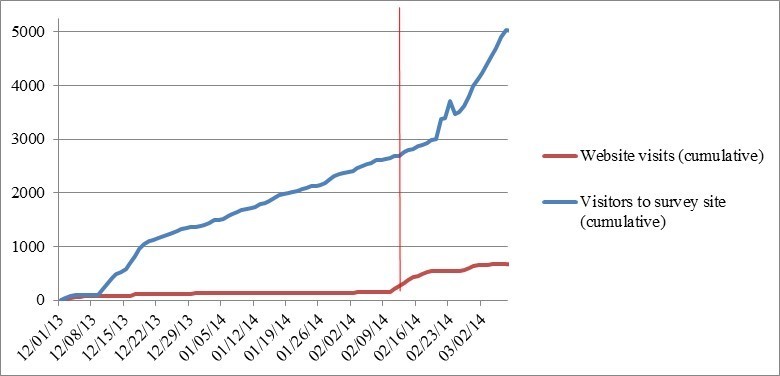
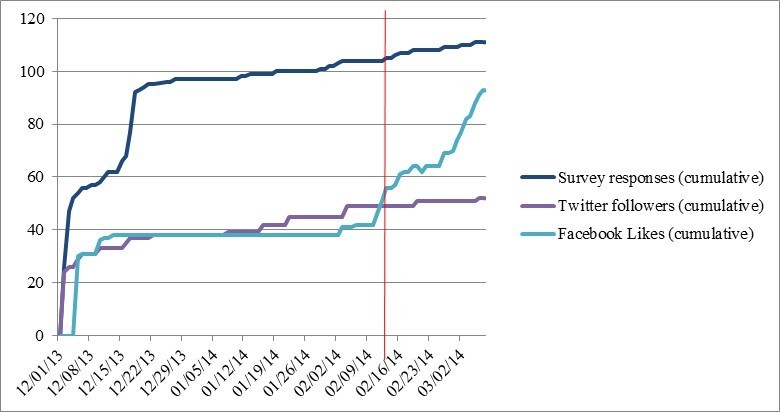
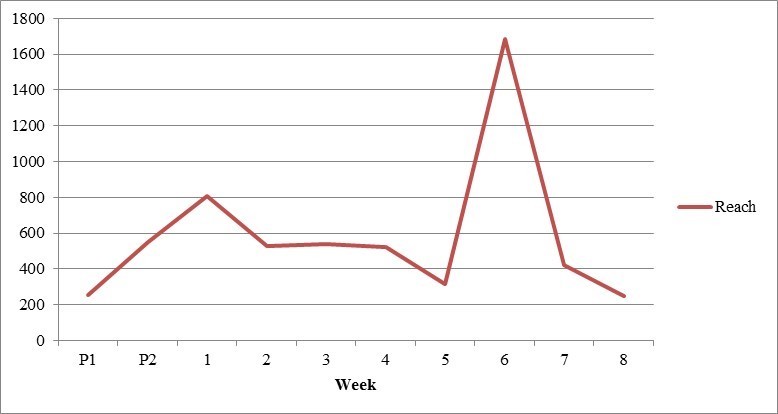
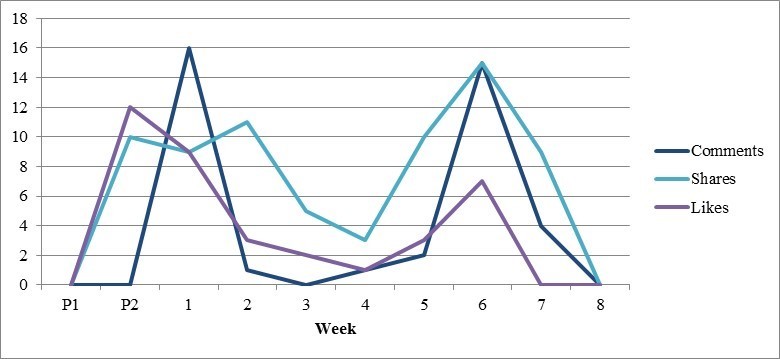
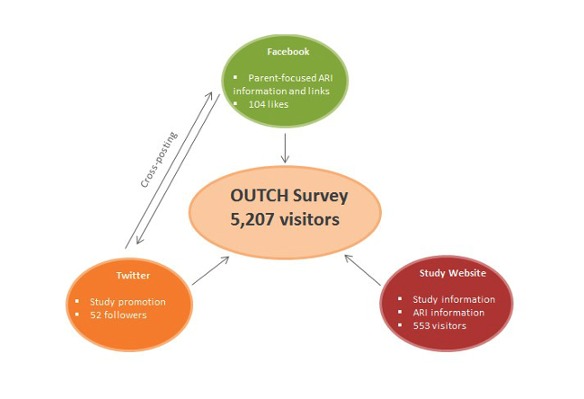
During the first phase, there were 5027 visits to the survey site, 110 participants completed the survey, 553 unique users visited the study website (675 visits), the Facebook page received 104 likes, and the Twitter account gained 52 followers over the 14-week study period. Most survey respondents identified Facebook (51.8%, 57/110) or a friend (45.5%, 50/110) as their source of referral. It was found that 70.0% (77/110) of respondents resided in Canada, in urban centers (92.7%, 102/110), and 88.2% (97/110) had a college or university degree or higher. The median year of birth was 1978 and 90.0% (99/110) were female. Most survey responses (88.2%, 97/110) were completed during the first month of the study. In the second phase, 4 parents participated in the discussion, our Facebook page gained 43 followers, and our posts reached 5866 users. Mirroring the first phase, most followers were female (79%, 34/43), between 35 and 44 years (49%, 21/43), and resided in Canada (98%, 42/43). User engagement was variable, with no clear patterns emerging in timing, topic, or type of post.

CONCLUSIONS

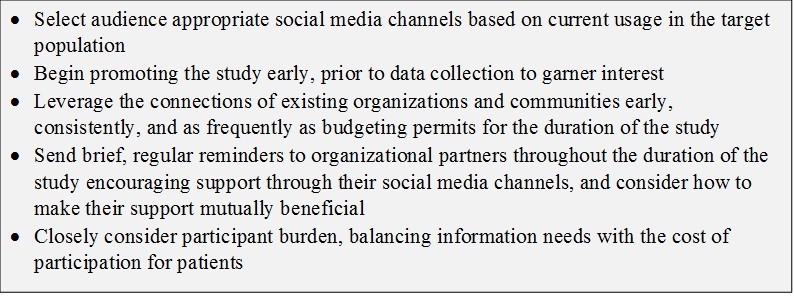
Most participants were highly educated, urban dwelling, and female, limiting diversity and representativeness. The source of referral for most survey respondents was through Facebook or a friend, suggesting the importance of personal connections in the dissemination and uptake of information. User engagement with the Facebook-based discussion threads was inconsistent and difficult to initiate. Although there is substantial interest in the use of social media as a component of an effective patient engagement strategy, challenges regarding participant engagement, representativeness, obtaining buy-in, and resources required must be carefully considered.
https://cdn.ncbi.nlm.nih.gov/pmc/blobs/9a19/5374273/a5765225a5d7/jmir_v19i3e78_fig6.jpg
https://cdn.ncbi.nlm.nih.gov/pmc/blobs/9a19/5374273/338fc9599088/jmir_v19i3e78_fig1.jpg
https://cdn.ncbi.nlm.nih.gov/pmc/blobs/9a19/5374273/d4b1d4aa077e/jmir_v19i3e78_fig2.jpg
https://cdn.ncbi.nlm.nih.gov/pmc/blobs/9a19/5374273/c982d72189d2/jmir_v19i3e78_fig3.jpg
https://cdn.ncbi.nlm.nih.gov/pmc/blobs/9a19/5374273/272ab864be2f/jmir_v19i3e78_fig4.jpg
https://cdn.ncbi.nlm.nih.gov/pmc/blobs/9a19/5374273/860f9ec125a2/jmir_v19i3e78_fig5.jpg
https://cdn.ncbi.nlm.nih.gov/pmc/blobs/9a19/5374273/a5765225a5d7/jmir_v19i3e78_fig6.jpg
https://cdn.ncbi.nlm.nih.gov/pmc/blobs/9a19/5374273/338fc9599088/jmir_v19i3e78_fig1.jpg
https://cdn.ncbi.nlm.nih.gov/pmc/blobs/9a19/5374273/d4b1d4aa077e/jmir_v19i3e78_fig2.jpg
https://cdn.ncbi.nlm.nih.gov/pmc/blobs/9a19/5374273/c982d72189d2/jmir_v19i3e78_fig3.jpg
https://cdn.ncbi.nlm.nih.gov/pmc/blobs/9a19/5374273/272ab864be2f/jmir_v19i3e78_fig4.jpg
https://cdn.ncbi.nlm.nih.gov/pmc/blobs/9a19/5374273/860f9ec125a2/jmir_v19i3e78_fig5.jpg
https://cdn.ncbi.nlm.nih.gov/pmc/blobs/9a19/5374273/a5765225a5d7/jmir_v19i3e78_fig6.jpg
摘要

背景

随着技术的迅速发展及其在全球范围内可及性的提高,社交媒体在医疗保健领域正发挥着越来越重要的作用。患者经常使用社交媒体获取信息、分享内容,并在在线健康社区中与他人互动。然而,将社交媒体作为利益相关者参与策略的应用却鲜有探索,且让参与者参与以患者为中心的结局识别研究的有效方法仍不为人知。

目的

本研究旨在评估利用社交媒体让家长参与识别以患者为中心的结局的过程,以儿童急性呼吸道感染为例来衡量其可行性。

方法

我们对一项分两阶段的基于网络的策略进行了过程评估,该策略旨在让家长参与以患者为中心的结局研究。在第一阶段,我们创建了一个网站以及特定研究的脸书和推特账号,以招募家长完成一项基于网络的调查,识别以患者为中心的结局。在第二阶段,我们利用脸书根据调查结果与家长进行讨论。评估了社交媒体作为一种参与策略的覆盖面以及所招募人群的特征。

结果

在第一阶段,调查网站有5027次访问,110名参与者完成了调查,553名独立用户访问了研究网站(675次访问),在为期14周的研究期间,脸书页面获得了104个赞,推特账号增加了52名关注者。大多数调查受访者将脸书(51.8%,57/110)或朋友(45.5%,50/110)作为其推荐来源。结果发现,70.0%(77/110)的受访者居住在加拿大,在城市中心(92.7%,102/110),88.2%(97/110)拥有大专或以上学历。出生年份中位数为1978年,90.0%(99/110)为女性。大多数调查回复(88.2%,97/110)在研究的第一个月内完成。在第二阶段,4名家长参与了讨论,我们的脸书页面增加了43名关注者,我们的帖子覆盖了5866名用户。与第一阶段类似,大多数关注者为女性(79%,34/43),年龄在35至44岁之间(49%,21/43),居住在加拿大(98%,42/43)。用户参与情况各不相同,在发布时间、主题或类型方面没有明显模式。

结论

大多数参与者受过高等教育、居住在城市且为女性,这限制了多样性和代表性。大多数调查受访者的推荐来源是脸书或朋友,这表明人际关系在信息传播和接受方面的重要性。用户对基于脸书的讨论线程的参与不一致且难以启动。尽管人们对将社交媒体作为有效患者参与策略的一个组成部分有浓厚兴趣,但在参与者参与、代表性、获得支持以及所需资源等方面的挑战必须仔细考虑。

相似文献

1
Outcomes in Child Health: Exploring the Use of Social Media to Engage Parents in Patient-Centered Outcomes Research.儿童健康成果:探索利用社交媒体让家长参与以患者为中心的成果研究。
J Med Internet Res. 2017 Mar 16;19(3):e78. doi: 10.2196/jmir.6655.
2
Social Media for the Dissemination of Cochrane Child Health Evidence: Evaluation Study.用于传播考克兰儿童健康证据的社交媒体:评估研究
J Med Internet Res. 2017 Sep 1;19(9):e308. doi: 10.2196/jmir.7819.
3
Online reach and engagement of a child nutrition peer-education program (PICNIC): insights from social media and web analytics.儿童营养同伴教育计划(PICNIC)的在线覆盖范围和参与度:社交媒体和网络分析的见解。
BMC Public Health. 2022 Apr 26;22(1):836. doi: 10.1186/s12889-022-13252-3.
4
Using Paid and Free Facebook Methods to Recruit Australian Parents to an Online Survey: An Evaluation.运用付费和免费的脸书方法招募澳大利亚家长参与在线调查:一项评估。
J Med Internet Res. 2019 Mar 6;21(3):e11206. doi: 10.2196/11206.
5
Knowledge Exchange and Discovery in the Age of Social Media: The Journey From Inception to Establishment of a Parent-Led Web-Based Research Advisory Community for Childhood Disability.社交媒体时代的知识交流与发现:从创立到建立一个由家长主导的基于网络的儿童残疾研究咨询社区的历程。
J Med Internet Res. 2016 Nov 11;18(11):e293. doi: 10.2196/jmir.5994.
6
Examining the Influence on Perceptions of Endometriosis via Analysis of Social Media Posts: Cross-sectional Study.通过社交媒体帖子分析探讨对子宫内膜异位症认知的影响:横断面研究
JMIR Form Res. 2022 Mar 18;6(3):e31135. doi: 10.2196/31135.
7
Factors Engaging Users of Diabetes Social Media Channels on Facebook, Twitter, and Instagram: Observational Study.社交媒体在糖尿病管理中的应用:基于 Facebook、Twitter 和 Instagram 的用户参与因素观察性研究
J Med Internet Res. 2020 Sep 29;22(9):e21204. doi: 10.2196/21204.
8
Social networking sites: emerging and essential tools for communication in dermatology.社交网站:皮肤科交流的新兴和必要工具。
JAMA Dermatol. 2014 Jan;150(1):56-60. doi: 10.1001/jamadermatol.2013.6340.
9
Social Media Programs for Outreach and Recruitment Supporting Aging and Alzheimer Disease and Related Dementias Research: Longitudinal Descriptive Study.社交媒体项目在老龄化和阿尔茨海默病及相关痴呆症研究中的推广和招募作用:纵向描述性研究。
JMIR Aging. 2024 Jul 9;7:e51520. doi: 10.2196/51520.
10
How U.S. children's hospitals use social media: A mixed methods study.美国儿童医院如何利用社交媒体:一项混合方法研究。
Healthc (Amst). 2016 Mar;4(1):15-21. doi: 10.1016/j.hjdsi.2015.12.004. Epub 2015 Dec 22.

引用本文的文献

1
Exploring the use of social media and online methods to engage persons with lived experience and healthcare professionals in creating research agendas: Lessons from a pediatric cancer research priority-setting partnership.探索利用社交媒体和在线方法,让有实际经验的人和医疗保健专业人员参与制定研究议程:儿科癌症研究优先事项设定伙伴关系的经验教训。
PLOS Digit Health. 2024 Jan 8;3(1):e0000181. doi: 10.1371/journal.pdig.0000181. eCollection 2024 Jan.
2
"Be sweet to babies": Use of Facebook as a method of knowledge dissemination and data collection in the reduction of neonatal pain.“善待婴儿”:利用脸书作为知识传播和数据收集的一种方式以减轻新生儿疼痛
Paediatr Neonatal Pain. 2020 May 2;2(3):93-100. doi: 10.1002/pne2.12022. eCollection 2020 Sep.
3

本文引用的文献

1
The Unintended Consequences of Social Media in Healthcare: New Problems and New Solutions.社交媒体在医疗保健领域的意外后果:新问题与新解决方案
Yearb Med Inform. 2016 Nov 10(1):47-52. doi: 10.15265/IY-2016-009.
2
Social media use in healthcare: A systematic review of effects on patients and on their relationship with healthcare professionals.社交媒体在医疗保健中的应用:对患者及其与医疗保健专业人员关系影响的系统评价
BMC Health Serv Res. 2016 Aug 26;16(1):442. doi: 10.1186/s12913-016-1691-0.
3
Health and social media: perfect storm of information.
Using Social Media to Engage Knowledge Users in Health Research Priority Setting: Scoping Review.利用社交媒体吸引知识用户参与健康研究重点制定:范围综述。
J Med Internet Res. 2022 Feb 21;24(2):e29821. doi: 10.2196/29821.
4
Using Social Media as a Research Tool for a Bespoke Web-Based Platform for Stakeholders of Children With Congenital Anomalies: Development Study.将社交媒体用作针对先天性异常儿童利益相关者的定制网络平台的研究工具:发展研究
JMIR Pediatr Parent. 2021 Nov 15;4(4):e18483. doi: 10.2196/18483.
5
Survey of nutrition knowledge of Kuwaiti health influencers in social media.科威特社交媒体上健康影响者的营养知识调查。
Acta Biomed. 2020 Nov 10;91(4):e2020100. doi: 10.23750/abm.v91i4.8252.
6
Validation of a Questionnaire Developed to Evaluate a Pediatric eHealth Website for Parents.验证一个为家长开发的评估儿科电子健康网站的问卷。
Int J Environ Res Public Health. 2020 Apr 13;17(8):2671. doi: 10.3390/ijerph17082671.
7
Increasing the Impact of JMIR Journals in the Attention Economy.增强JMIR期刊在注意力经济中的影响力。
J Med Internet Res. 2019 Oct 31;21(10):e16172. doi: 10.2196/16172.
8
Glucocorticoids for croup in children.用于儿童哮吼的糖皮质激素。
Cochrane Database Syst Rev. 2018 Aug 22;8(8):CD001955. doi: 10.1002/14651858.CD001955.pub4.
9
Recruiting and retaining participants in e-Delphi surveys for core outcome set development: Evaluating the COMiT'ID study.电子德尔菲法调查中核心结局集开发的参与者招募和保留:评估 COMiT'ID 研究。
PLoS One. 2018 Jul 30;13(7):e0201378. doi: 10.1371/journal.pone.0201378. eCollection 2018.
10
Which outcomes are important to patients and families who have experienced paediatric acute respiratory illness? Findings from a mixed methods sequential exploratory study.经历儿科急性呼吸道疾病的患者及其家属重视哪些结果?一项混合方法序贯探索性研究的结果。
BMJ Open. 2017 Dec 14;7(12):e018199. doi: 10.1136/bmjopen-2017-018199.
健康与社交媒体:信息的完美风暴。
Healthc Inform Res. 2015 Apr;21(2):67-73. doi: 10.4258/hir.2015.21.2.67. Epub 2015 Apr 30.
4
Facebook as a recruitment tool for adolescent health research: a systematic review.脸书作为青少年健康研究的招募工具:一项系统综述。
Acad Pediatr. 2014 Sep-Oct;14(5):439-447.e4. doi: 10.1016/j.acap.2014.05.049.
5
The PCORI perspective on patient-centered outcomes research.患者为中心的结果研究的PCORI视角。
JAMA. 2014 Oct 15;312(15):1513-4. doi: 10.1001/jama.2014.11100.
6
A systematic review of the use and effectiveness of social media in child health.社交媒体在儿童健康中的使用和效果的系统评价。
BMC Pediatr. 2014 Jun 2;14:138. doi: 10.1186/1471-2431-14-138.
7
Would you tell everyone this? Facebook conversations as health promotion interventions.你会把这个告诉所有人吗?将脸书对话作为健康促进干预措施。
J Med Internet Res. 2014 Apr 11;16(4):e108. doi: 10.2196/jmir.3231.
8
Patient engagement in research: a systematic review.患者参与研究:一项系统评价。
BMC Health Serv Res. 2014 Feb 26;14:89. doi: 10.1186/1472-6963-14-89.
9
Trending now: future directions in digital media for the public health sector.当前趋势:公共卫生领域数字媒体的未来发展方向。
J Public Health (Oxf). 2014 Dec;36(4):527-34. doi: 10.1093/pubmed/fdt125. Epub 2014 Jan 26.
10
Electronic surveys: how to maximise success.电子调查:如何实现最大成功率
Nurse Res. 2014 Jan;21(3):24-6. doi: 10.7748/nr2014.01.21.3.24.e1205.