Praestegaard Camilla, Jensen Allan, Jensen Signe M, Nielsen Thor S S, Webb Penelope M, Nagle Christina M, DeFazio Anna, Høgdall Estrid, Rossing Mary Anne, Doherty Jennifer A, Wicklund Kristine G, Goodman Marc T, Modugno Francesmary, Moysich Kirsten, Ness Roberta B, Edwards Robert, Matsuo Keitaro, Hosono Satoyo, Goode Ellen L, Winham Stacey J, Fridley Brooke L, Cramer Daniel W, Terry Kathryn L, Schildkraut Joellen M, Berchuck Andrew, Bandera Elisa V, Paddock Lisa E, Massuger Leon F, Wentzensen Nicolas, Pharoah Paul, Song Honglin, Whittemore Alice, McGuire Valerie, Sieh Weiva, Rothstein Joseph, Anton-Culver Hoda, Ziogas Argyrios, Menon Usha, Gayther Simon A, Ramus Susan J, Gentry-Maharaj Alexandra, Wu Anna H, Pearce Celeste L, Pike Malcolm, Lee Alice W, Sutphen Rebecca, Chang-Claude Jenny, Risch Harvey A, Kjaer Susanne K
Virus, Lifestyle and Genes, Danish Cancer Society Research Center, Copenhagen, Denmark.
Statistics, Bioinformatics and Registry, Danish Cancer Society Research Center, Copenhagen, Denmark.
Int J Cancer. 2017 Jun 1;140(11):2422-2435. doi: 10.1002/ijc.30600. Epub 2017 Jan 24.
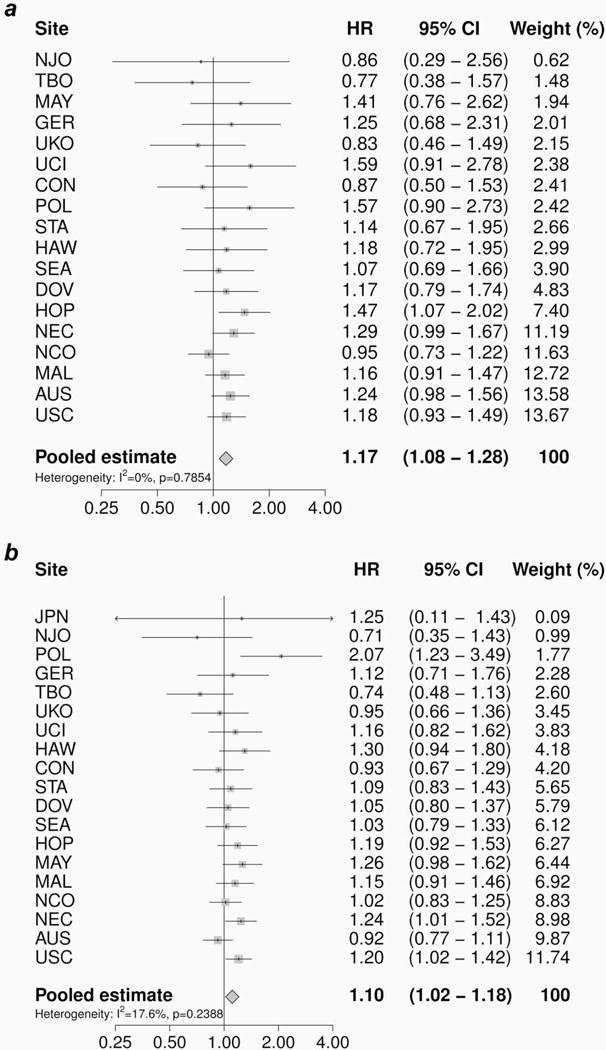
Cigarette smoking is associated with an increased risk of developing mucinous ovarian tumors but whether it is associated with ovarian cancer survival overall or for the different histotypes is unestablished. Furthermore, it is unknown whether the association between cigarette smoking and survival differs according to strata of ovarian cancer stage at diagnosis. In a large pooled analysis, we evaluated the association between various measures of cigarette smoking and survival among women with epithelial ovarian cancer. We obtained data from 19 case-control studies in the Ovarian Cancer Association Consortium (OCAC), including 9,114 women diagnosed with ovarian cancer. Cox regression models were used to estimate adjusted study-specific hazard ratios (HRs), which were combined into pooled hazard ratios (pHR) with corresponding 95% confidence intervals (CIs) under random effects models. Overall, 5,149 (57%) women died during a median follow-up period of 7.0 years. Among women diagnosed with ovarian cancer, both current (pHR = 1.17, 95% CI: 1.08-1.28) and former smokers (pHR = 1.10, 95% CI: 1.02-1.18) had worse survival compared with never smoking women. In histotype-stratified analyses, associations were observed for mucinous (current smoking: pHR = 1.91, 95% CI: 1.01-3.65) and serous histotypes (current smoking: pHR = 1.11, 95% CI: 1.00-1.23; former smoking: pHR = 1.12, 95% CI: 1.04-1.20). Further, our results suggested that current smoking has a greater impact on survival among women with localized than disseminated disease. The identification of cigarette smoking as a modifiable factor associated with survival has potential clinical importance as a focus area to improve ovarian cancer prognosis.
吸烟与黏液性卵巢肿瘤发病风险增加相关,但吸烟是否与卵巢癌总体生存率或不同组织学类型的生存率相关尚不确定。此外,吸烟与生存率之间的关联是否因诊断时卵巢癌分期的不同而有所差异也不清楚。在一项大型汇总分析中,我们评估了吸烟的各种指标与上皮性卵巢癌女性生存率之间的关联。我们从卵巢癌协会联盟(OCAC)的19项病例对照研究中获取了数据,其中包括9114名被诊断为卵巢癌的女性。采用Cox回归模型估计调整后的特定研究风险比(HRs),并在随机效应模型下将其合并为汇总风险比(pHR)及相应的95%置信区间(CIs)。总体而言,5149名(57%)女性在中位随访期7.0年期间死亡。在被诊断为卵巢癌的女性中,与从不吸烟的女性相比,当前吸烟者(pHR = 1.17,95% CI:1.08 - 1.28)和既往吸烟者(pHR = 1.10,95% CI:1.02 - 1.18)的生存率均较差。在组织学类型分层分析中,黏液性组织学类型(当前吸烟:pHR = 1.91,95% CI:1.01 - 3.65)和浆液性组织学类型(当前吸烟:pHR = 1.11,95% CI:1.00 - 1.23;既往吸烟:pHR = 1.12,95% CI:1.04 - 1.20)均观察到关联。此外,我们的结果表明,当前吸烟对局限性疾病女性生存率的影响大于播散性疾病女性。将吸烟确定为与生存率相关的可改变因素,作为改善卵巢癌预后的重点领域具有潜在的临床重要性。