Gaalema Diann E, Elliott Rebecca J, Morford Zachary H, Higgins Stephen T, Ades Philip A
Vermont Center on Behavior and Health, University of Vermont, Burlington, VT; Department of Psychiatry, University of Vermont, Burlington, VT; Department of Psychological Science, University of Vermont, Burlington, VT.
Vermont Center on Behavior and Health, University of Vermont, Burlington, VT; Department of Psychiatry, University of Vermont, Burlington, VT.
Prog Cardiovasc Dis. 2017 Jun-Jul;60(1):159-168. doi: 10.1016/j.pcad.2017.01.001. Epub 2017 Jan 5.
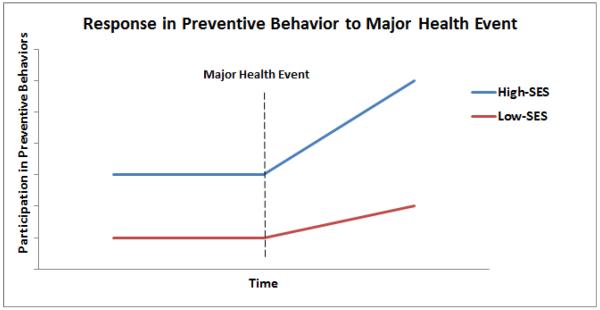
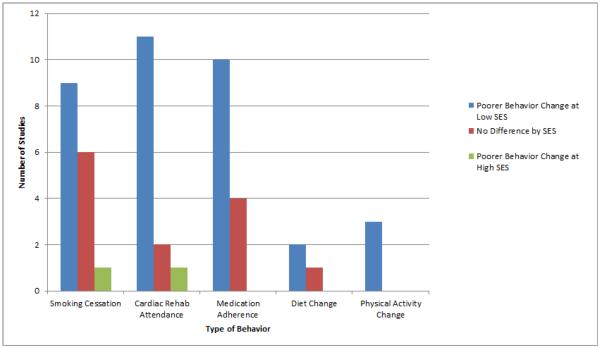
Failure to change risk behaviors following myocardial infarction (MI) increases the likelihood of recurrent MI and death. Lower-socioeconomic status (SES) patients are more likely to engage in high-risk behaviors prior to MI. Less well known is whether propensity to change risk behaviors after MI also varies inversely with SES. We performed a systematized literature review addressing changes in risk behaviors following MI as a function of SES. 2160 abstracts were reviewed and 44 met eligibility criteria. Behaviors included smoking cessation, cardiac rehabilitation (CR), medication adherence, diet, and physical activity (PA). For each behavior, lower-SES patients were less likely to change after MI. Overall, lower-SES patients were 2 to 4 times less likely to make needed behavior changes (OR's 0.25-0.56). Lower-SES populations are less successful at changing risk behaviors post-MI. Increasing their participation in CR/secondary prevention programs, which address multiple risk behaviors, including increasing PA and exercise, should be a priority of healthy lifestyle medicine (HLM).
心肌梗死(MI)后未能改变风险行为会增加复发性心肌梗死和死亡的可能性。社会经济地位较低(SES)的患者在心肌梗死之前更有可能从事高风险行为。鲜为人知的是,心肌梗死后改变风险行为的倾向是否也与社会经济地位呈负相关。我们进行了一项系统的文献综述,探讨心肌梗死后风险行为的变化与社会经济地位的关系。共审查了2160篇摘要,44篇符合纳入标准。行为包括戒烟、心脏康复(CR)、药物依从性、饮食和体育活动(PA)。对于每种行为,社会经济地位较低的患者在心肌梗死后改变的可能性较小。总体而言,社会经济地位较低的患者做出所需行为改变的可能性要低2至4倍(OR为0.25 - 0.56)。社会经济地位较低的人群在心肌梗死后改变风险行为方面不太成功。增加他们对心脏康复/二级预防项目的参与,这些项目针对多种风险行为,包括增加体育活动和锻炼,应该是健康生活方式医学(HLM)的一个优先事项。