Argueta Donovan A, DiPatrizio Nicholas V
University of California Riverside, Riverside, CA, USA.
University of California Riverside, Riverside, CA, USA; School of Medicine, Riverside, CA, USA; Division of Biomedical Sciences, Riverside, CA, USA.
Physiol Behav. 2017 Mar 15;171:32-39. doi: 10.1016/j.physbeh.2016.12.044. Epub 2017 Jan 5.
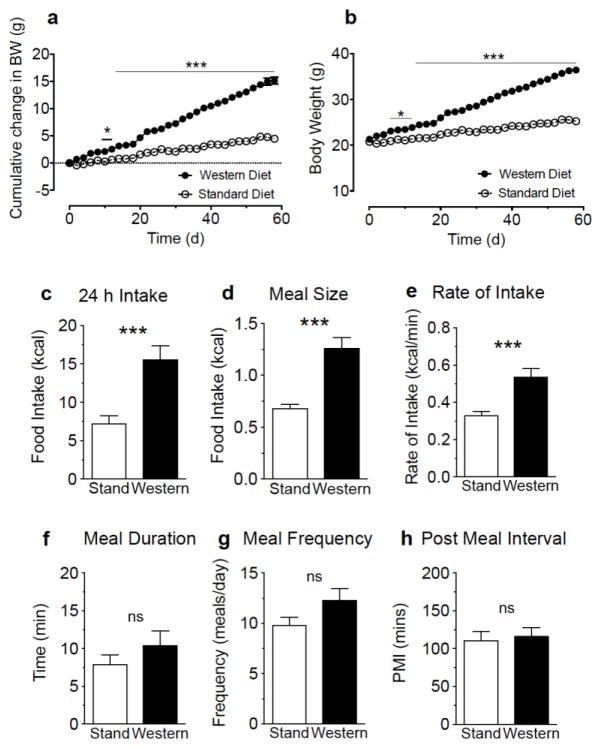
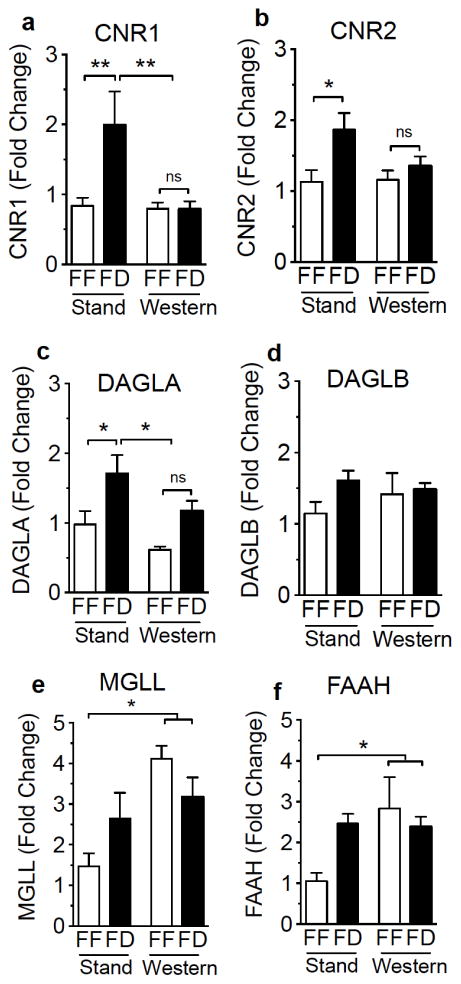
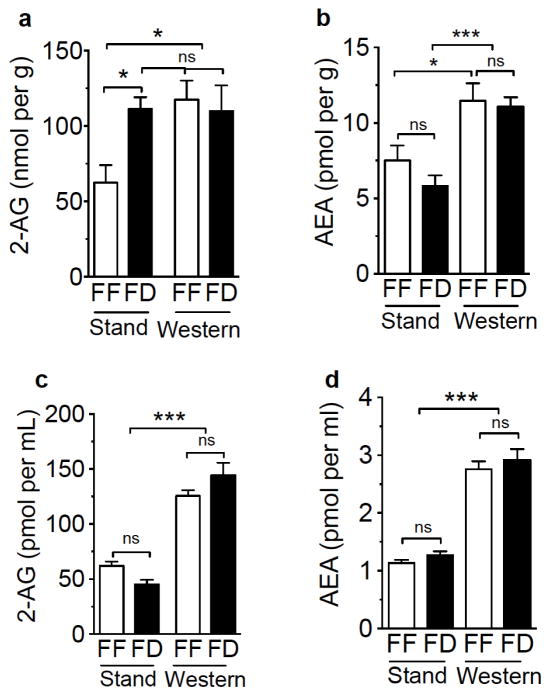
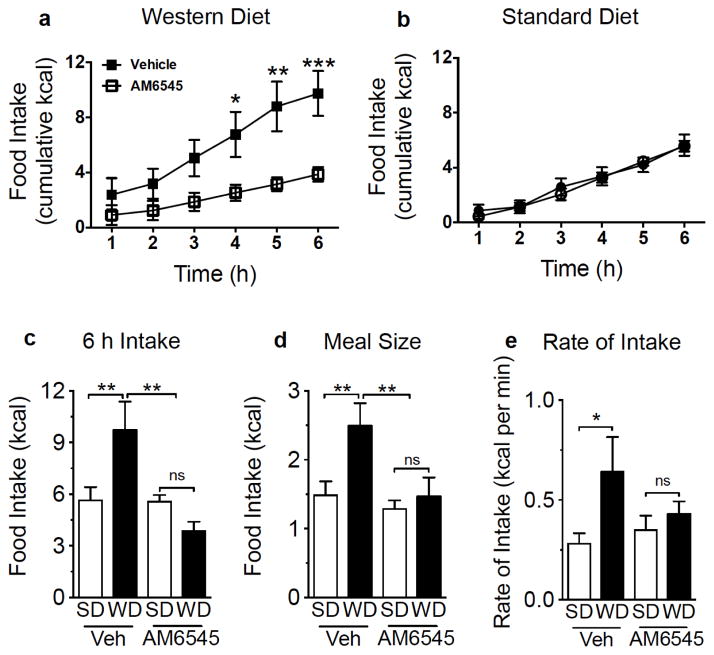
The endocannabinoid system in the brain and periphery plays a major role in controlling food intake and energy balance. We reported that tasting dietary fats was met with increased levels of the endocannabinoids, 2-arachidonoyl-sn-glycerol (2-AG) and anandamide, in the rat upper small intestine, and pharmacological inhibition of this local signaling event dose-dependently blocked sham feeding of fats. We now investigated the contribution of peripheral endocannabinoid signaling in hyperphagia associated with chronic consumption of a western-style diet in mice ([WD] i.e., high fat and sucrose). Feeding patterns were assessed in male C57BL/6Tac mice maintained for 60days on WD or a standard rodent chow (SD), and the role for peripheral endocannabinoid signaling at CBRs in controlling food intake was investigated via pharmacological interventions. In addition, levels of the endocannabinoids, 2-AG and anandamide, in the upper small intestine and circulation of mice were analyzed via liquid chromatography coupled to tandem mass spectrometry to evaluate diet-related changes in endocannabinoid signaling and the potential impact on food intake. Mice fed WD for 60days exhibited large increases in body weight, daily caloric intake, average meal size, and rate of feeding when compared to control mice fed SD. Inhibiting peripheral CBRs with the peripherally-restricted neutral cannabinoid CB receptor antagonist, AM6545 (10mg/kg), significantly reduced intake of WD during a 6h test, but failed to modify intake of SD in mice. AM6545 normalized intake of WD, average meal size, and rate of feeding to levels found in SD control mice. These results suggest that endogenous activity at peripheral CBRs in WD mice is critical for driving hyperphagia. In support of this hypothesis, levels of 2-AG and anandamide in both, jejunum mucosa and plasma, of ad-libitum fed WD mice increased when compared to SC mice. Furthermore, expression of genes for primary components of the endocannabinoid system (i.e., cannabinoid receptors, and endocannabinoid biosynthetic and degradative enzymes) was dysregulated in WD mice when compared to SC mice. Our results suggest that hyperphagia associated with WD-induced obesity is driven by enhanced endocannabinoid signaling at peripheral CBRs.
大脑和外周的内源性大麻素系统在控制食物摄入和能量平衡方面发挥着重要作用。我们报道,在大鼠上段小肠中,品尝膳食脂肪会使内源性大麻素2-花生四烯酸甘油酯(2-AG)和花生四烯乙醇胺的水平升高,对这一局部信号事件的药理学抑制会剂量依赖性地阻断脂肪的假饲。我们现在研究了外周内源性大麻素信号在与小鼠长期食用西式饮食(即高脂肪和高蔗糖饮食,[WD])相关的食欲亢进中的作用。对维持60天WD或标准啮齿动物饲料(SD)的雄性C57BL/6Tac小鼠的进食模式进行评估,并通过药理学干预研究外周内源性大麻素信号在控制食物摄入方面在中枢杏仁核中的作用。此外,通过液相色谱-串联质谱分析小鼠上段小肠和循环中的内源性大麻素2-AG和花生四烯乙醇胺水平,以评估与饮食相关的内源性大麻素信号变化及其对食物摄入的潜在影响。与喂食SD的对照小鼠相比,喂食WD 60天的小鼠体重、每日热量摄入、平均餐量和进食速率大幅增加。用外周限制的中性大麻素CB受体拮抗剂AM6545(10mg/kg)抑制外周中枢杏仁核,在6小时测试期间显著减少了WD的摄入量,但未能改变小鼠对SD的摄入量。AM6545使WD的摄入量、平均餐量和进食速率恢复到SD对照小鼠的水平。这些结果表明,WD小鼠外周中枢杏仁核的内源性活性对于驱动食欲亢进至关重要。支持这一假设的是,与喂食SD的小鼠相比,自由进食WD的小鼠空肠黏膜和血浆中的2-AG和花生四烯乙醇胺水平均升高。此外,与喂食SD的小鼠相比,WD小鼠内源性大麻素系统主要成分(即大麻素受体、内源性大麻素生物合成和降解酶)的基因表达失调。我们的结果表明,与WD诱导的肥胖相关的食欲亢进是由外周中枢杏仁核处增强的内源性大麻素信号驱动的。