Biosciences, College of Health, Medicine and Life Sciences, Brunel University London, Uxbridge UB8 3PH, UK.
Department of Biochemistry, University of Oxford, South Parks Road, Oxford OX1 3QU, UK.
Viruses. 2021 May 2;13(5):824. doi: 10.3390/v13050824.
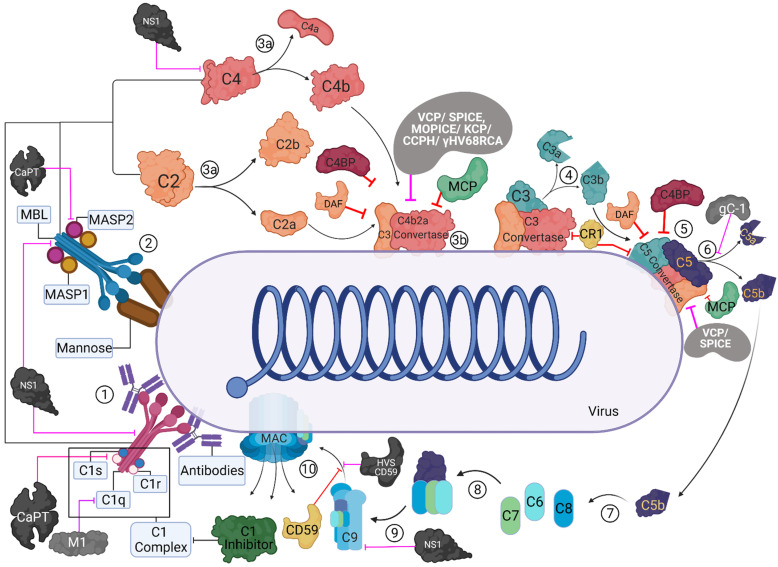
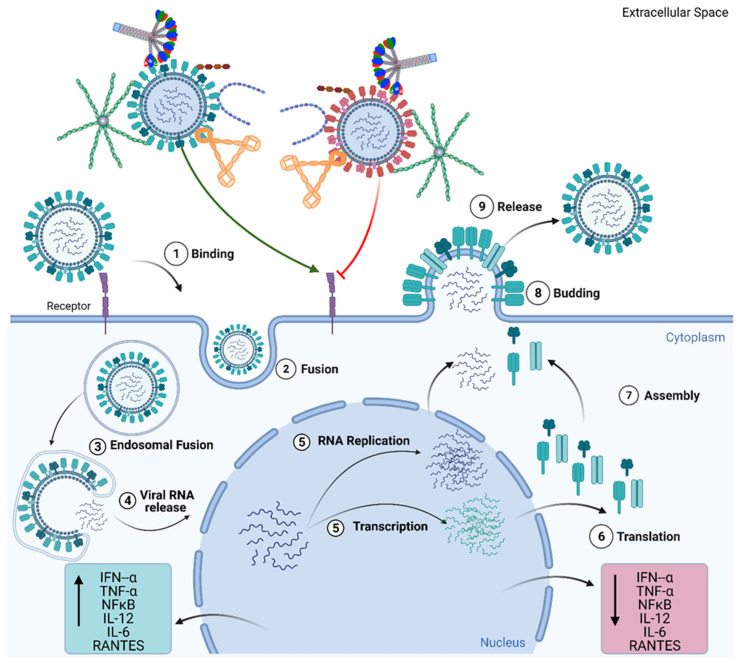
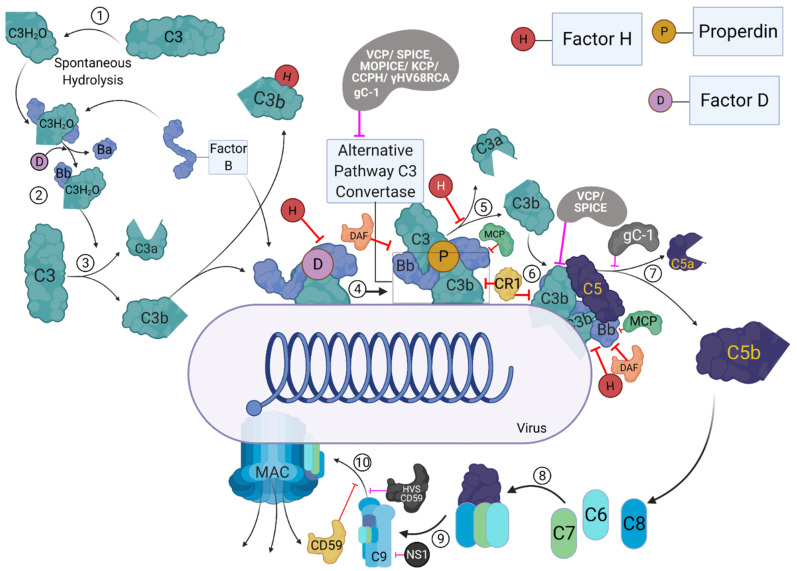
The complement system represents a crucial part of innate immunity. It contains a diverse range of soluble activators, membrane-bound receptors, and regulators. Its principal function is to eliminate pathogens via activation of three distinct pathways: classical, alternative, and lectin. In the case of viruses, the complement activation results in effector functions such as virion opsonisation by complement components, phagocytosis induction, virolysis by the membrane attack complex, and promotion of immune responses through anaphylatoxins and chemotactic factors. Recent studies have shown that the addition of individual complement components can neutralise viruses without requiring the activation of the complement cascade. While the complement-mediated effector functions can neutralise a diverse range of viruses, numerous viruses have evolved mechanisms to subvert complement recognition/activation by encoding several proteins that inhibit the complement system, contributing to viral survival and pathogenesis. This review focuses on these complement-dependent and -independent interactions of complement components (especially C1q, C4b-binding protein, properdin, factor H, Mannose-binding lectin, and Ficolins) with several viruses and their consequences.
补体系统是先天免疫系统的重要组成部分。它包含多种可溶性激活物、膜结合受体和调节剂。其主要功能是通过激活三种不同途径(经典途径、替代途径和凝集素途径)来消除病原体。在病毒感染的情况下,补体的激活会导致效应功能,如补体成分对病毒粒子的调理作用、吞噬作用的诱导、膜攻击复合物导致的病毒溶解,以及通过过敏毒素和趋化因子促进免疫反应。最近的研究表明,单独添加补体成分就可以中和病毒,而无需激活补体级联反应。虽然补体介导的效应功能可以中和多种病毒,但许多病毒已经进化出机制来规避补体的识别/激活,通过编码几种抑制补体系统的蛋白来实现,这有助于病毒的存活和发病机制。本文重点讨论了补体成分(特别是 C1q、C4 结合蛋白、备解素、因子 H、甘露聚糖结合凝集素和纤维胶凝蛋白)与几种病毒的补体依赖性和非依赖性相互作用及其后果。