Dinglas Victor D, Aronson Friedman Lisa, Colantuoni Elizabeth, Mendez-Tellez Pedro A, Shanholtz Carl B, Ciesla Nancy D, Pronovost Peter J, Needham Dale M
1Outcomes After Critical Illness and Surgery (OACIS) Group, Johns Hopkins University, Baltimore, MD. 2Division of Pulmonary and Critical Care Medicine, Department of Medicine, School of Medicine, Johns Hopkins University, Baltimore, MD. 3Department of Biostatistics, Bloomberg School of Public Health, Johns Hopkins University, Baltimore, MD. 4Department of Anesthesiology and Critical Care Medicine, School of Medicine, Johns Hopkins University, Baltimore, MD. 5Division of Pulmonary and Critical Care Medicine, Department of Medicine, University of Maryland, Baltimore, MD. 6Department of Physical Medicine and Rehabilitation, School of Medicine, Johns Hopkins University, Baltimore, MD.
Crit Care Med. 2017 Mar;45(3):446-453. doi: 10.1097/CCM.0000000000002208.
To longitudinally evaluate the association of post-ICU muscle weakness and associated trajectories of weakness over time with 5-year survival.
Longitudinal prospective cohort study over 5 years of follow-up.
Thirteen ICUs in four hospitals in Baltimore, MD.
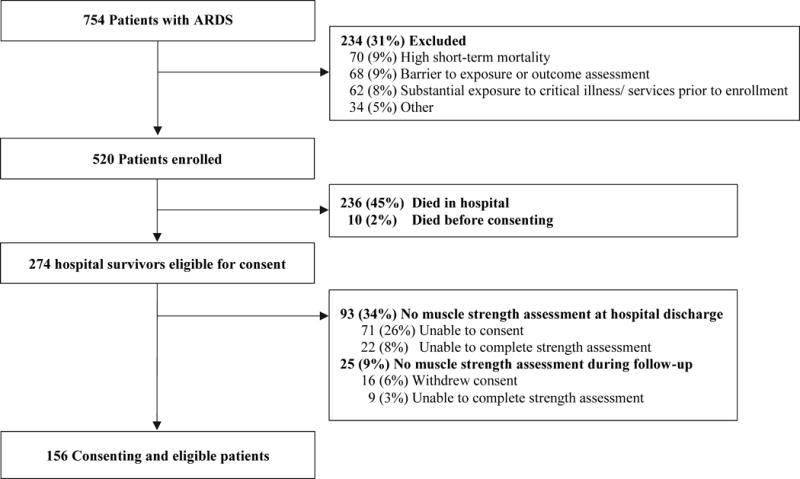
One hundred fifty-six acute respiratory distress syndrome survivors.
None.
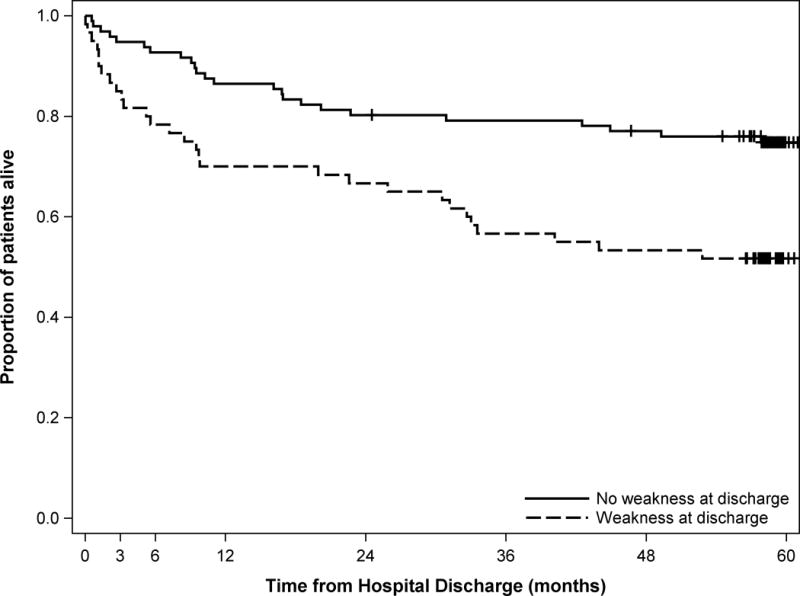
Strength was evaluated with standardized manual muscle testing using the Medical Research Council sum score (range, 0-60; higher is better), with post-ICU weakness defined as sum score less than 48. Muscle strength was assessed at hospital discharge and at 3, 6, 12, 24, 36, and 48 months after acute respiratory distress syndrome. At discharge, 38% of patients had muscle weakness. Every one point increase in sum score at discharge was associated with improved survival (hazard ratio [95% CI], 0.96 [0.94-0.98]), with similar findings longitudinally (0.95 [0.93-0.98]). Having weakness at discharge was associated with worse 5-year survival (1.75 [1.01-3.03]), but the association was attenuated (1.54 [0.82-2.89]) when evaluated longitudinally over follow-up. Persisting and resolving trajectories of muscle weakness, occurring in 50% of patients during follow-up, were associated with worse survival (3.01 [1.12-8.04]; and 3.14 [1.40-7.03], respectively) compared to a trajectory of maintaining no muscle weakness.
At hospital discharge, greater than one third of acute respiratory distress syndrome survivors had muscle weakness. Greater strength at discharge and throughout follow-up was associated with improved 5-year survival. In patients with post-ICU weakness, both persisting and resolving trajectories were commonly experienced and associated with worse survival during follow-up.
纵向评估重症监护病房(ICU)后肌肉无力以及随时间变化的相关无力轨迹与5年生存率之间的关联。
为期5年随访的纵向前瞻性队列研究。
马里兰州巴尔的摩市四家医院的13个ICU。
156名急性呼吸窘迫综合征幸存者。
无。
采用医学研究委员会总评分(范围为0 - 60分,分数越高越好)通过标准化徒手肌力测试评估肌力,将ICU后肌无力定义为总评分低于48分。在急性呼吸窘迫综合征患者出院时以及出院后3、6、12、24、36和48个月评估肌肉力量。出院时,38%的患者存在肌肉无力。出院时总评分每增加1分与生存率提高相关(风险比[95%置信区间],0.96[0.94 - 0.98]),纵向研究也有类似结果(0.95[0.93 - 0.98])。出院时存在肌无力与5年生存率较差相关(1.75[1.01 - 3.03]),但在随访期间进行纵向评估时,这种关联减弱(1.54[0.82 - 2.89])。在随访期间,50%患者出现的持续和缓解的肌肉无力轨迹与生存率较差相关(分别为3.01[1.12 - 8.04];和3.14[1.40 - 7.03]),而无肌肉无力维持轨迹的患者情况则不同。
急性呼吸窘迫综合征幸存者出院时,超过三分之一的患者存在肌肉无力。出院时及整个随访期间更强的肌力与5年生存率提高相关。在ICU后肌无力患者中,持续和缓解的轨迹较为常见,且与随访期间较差的生存率相关。