Department of Anesthesia & Operative Intensive Care, University Hospital Regensburg, Regensburg.
Department of Anesthesia and Operative Intensive Care Medicine, Charitè Universitätsmedizin Berlin, Campus Virchow Klinikum and Campus Charitè Mitte, Berlin.
Curr Opin Crit Care. 2018 Feb;24(1):35-40. doi: 10.1097/MCC.0000000000000476.
To review the current research data on long-term outcome and health-related quality of life in survivors of the acute respiratory distress syndrome (ARDS) and to compare these findings with those from non-ARDS patients surviving critical illness.
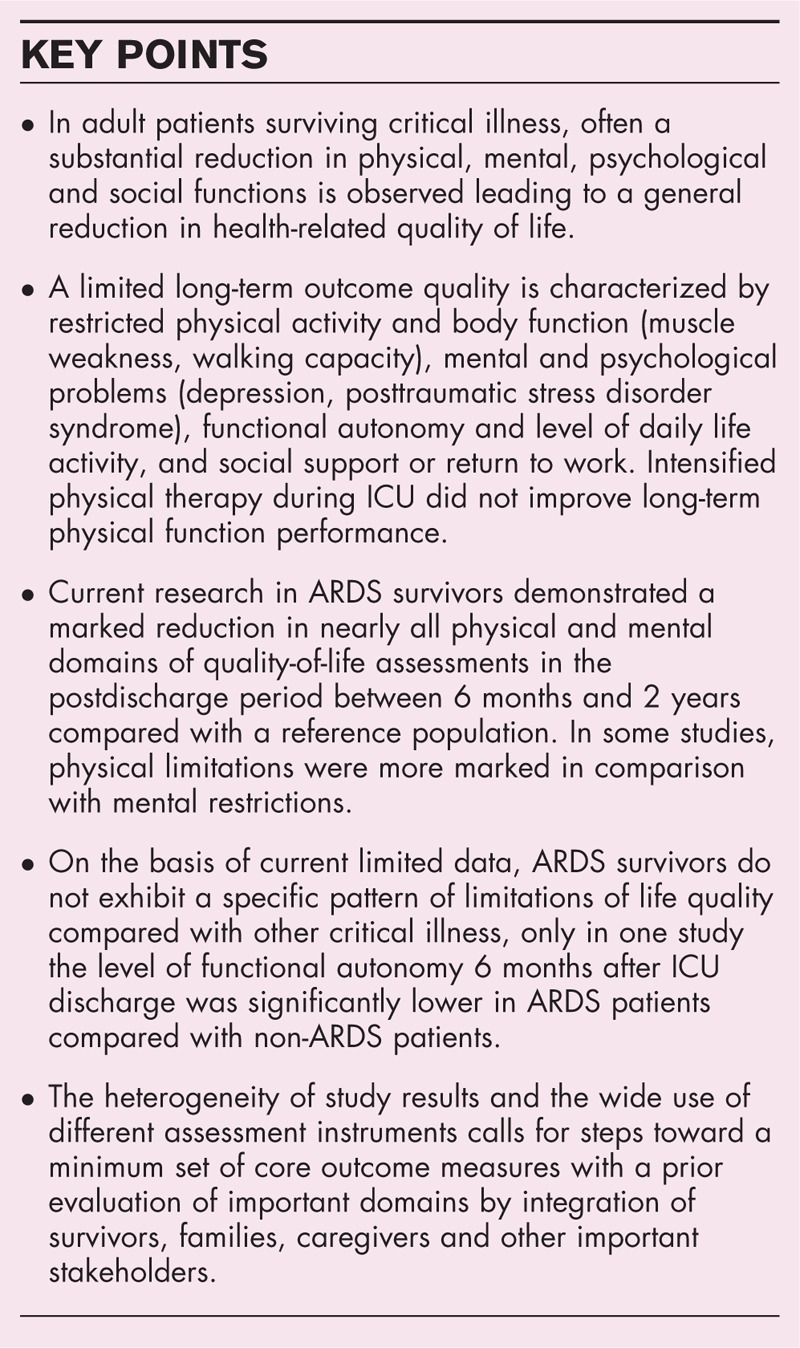
Between 6 months and 2 years after discharge from ICU, survivors of ARDS present with substantial impairments of the levels of body function (muscle strength, walking capacity and/or physical activity (physical SF-36 score). In contrast to non-ARDS patients from surgical ICUs, a standardized intensified physical therapy during early course of illness in ARDS patients could not show an improvement of long-term physical function performance. Furthermore, a substantial part of further ARDS patients suffer from depression (26-33%), anxiety (38-44%) or posttraumatic stress disorder (22-24%). In general, the level of functional autonomy and daily life activities was reduced, and in one study, 6 months after ICU-discharge this level was significantly lower in ARDS patients compared with non-ARDS patients. In a recent study, 44% of ARDS survivors were jobless 1 year after critical illness, whereas half of previously employed patients returned to work within 4 months after hospital discharge. General health-related quality of life was significantly reduced compared with a matched population in all studies.
Surviving ARDS is associated with a long-term substantial reduction in health-related quality of life and such a reduction does not differ from findings in patients surviving other critical illness. In further research, a special attention should be paid to prevention measures of the 'post intensive care syndrome' as well as to patient important domains, which might better explain the patient's and families' demands.
综述急性呼吸窘迫综合征(ARDS)幸存者的长期预后和健康相关生活质量的研究数据,并将这些发现与非 ARDS 重症患者的研究结果进行比较。
ARDS 幸存者在 ICU 出院后 6 个月至 2 年内,身体功能(肌肉力量、步行能力和/或体力活动(身体 SF-36 评分)水平明显受损。与来自外科 ICU 的非 ARDS 患者不同,ARDS 患者在疾病早期接受标准化强化体能治疗并不能改善长期体能表现。此外,相当一部分进一步的 ARDS 患者患有抑郁症(26-33%)、焦虑症(38-44%)或创伤后应激障碍(22-24%)。总的来说,功能自主性和日常生活活动水平降低,在一项研究中,ARDS 患者在 ICU 出院后 6 个月的功能自主性和日常生活活动水平明显低于非 ARDS 患者。最近的一项研究发现,ARDS 幸存者中有 44%在重症后 1 年失业,而之前就业的患者中有一半在出院后 4 个月内重返工作岗位。与所有研究中的匹配人群相比,一般健康相关生活质量明显降低。
ARDS 的存活与健康相关生活质量的长期显著降低有关,这种降低与其他重症患者的发现没有区别。在进一步的研究中,应特别关注“重症后综合征”的预防措施以及患者重要领域,这可能更好地解释患者和家属的需求。