Pierre Alexandre, Favory Raphael, Bourel Claire, Howsam Michael, Romien Raphael, Lancel Steve, Preau Sebastien
Univ. Lille, Inserm, CHU Lille, Institut Pasteur de Lille, U1167 - RID-AGE - Facteurs de Risque Et Déterminants Moléculaires Des Maladies Liées Au Vieillissement, 59000, Lille, France.
Division of Intensive Care, Hôpital Roger Salengro, CHU de Lille, 59000, Lille, France.
Crit Care. 2025 Jun 17;29(1):248. doi: 10.1186/s13054-025-05462-z.
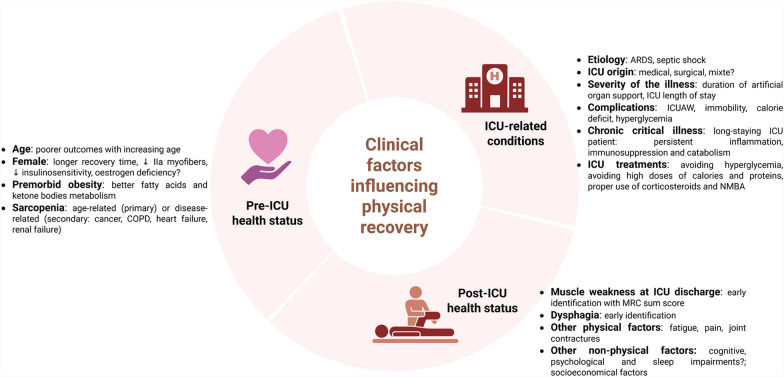
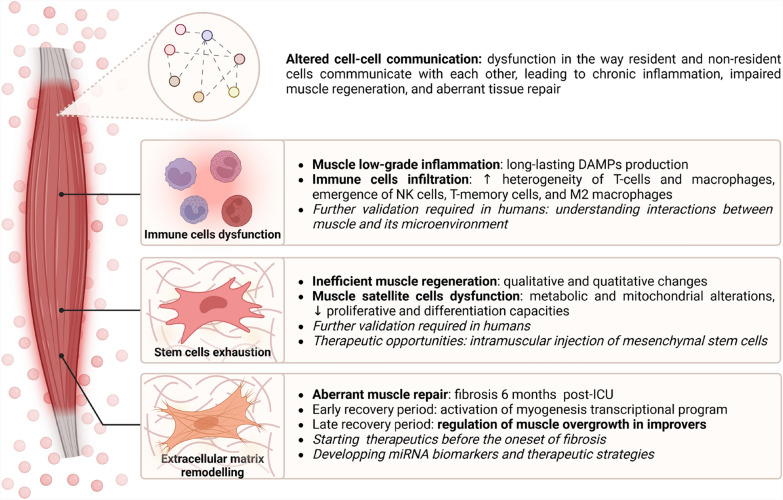
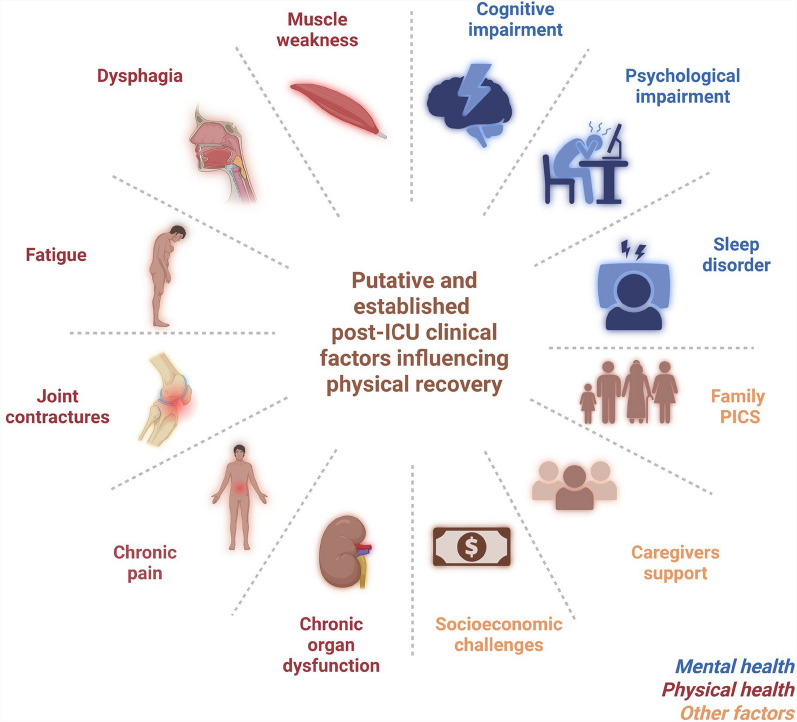
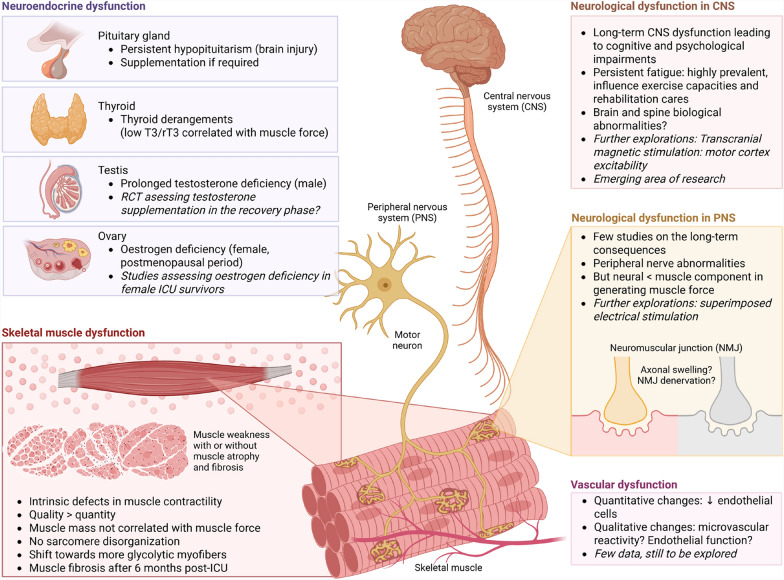
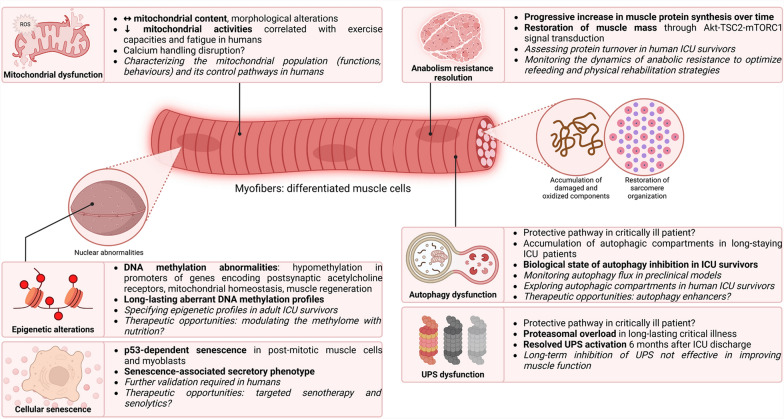
Survivors of intensive care unit (ICU) are increasingly numerous because of better hospital care. However, several consequences of an ICU stay, known as post-intensive care syndrome, worsen long-term prognoses. A predominant feature in survivors is reduced muscle strength, mass, and physical function. This leads to lower exercise capacity, long-lasting physical disability, higher mortality risk, and subsequent health costs. While ICU-acquired muscle weakness has been extensively studied these past decades, underlying mechanisms of post-ICU muscle weakness remain poorly understood, and there is still no evidence-based treatment for improving long-term physical outcomes. One hypothesis, among others, could be that the pathophysiology is dynamic over time, differing between the acute ICU and post-ICU recovery periods. This narrative review aims to address the clinical, physiological and biological determinants of persistent muscle dysfunction in ICU survivors, with particular attention to the molecular, cellular and systemic mechanisms involved. Specifically, pre-ICU health factors such as obesity and sarcopenia, ICU-related complications and treatments, and post-ICU management all influence recovery. Dysfunctions in the neuroendocrine, vascular, neurological, and muscle systems contribute as physiological determinants of the muscle weakness. Complex and multifaceted biological mechanisms drive the post-ICU muscle dysfunction with mitochondrial and autophagy dysfunction, epigenetic modifications, cellular senescence, muscle inflammation with altered cell-cell communication, including dysfunction of immune cells, stem cell exhaustion and extracellular matrix remodelling. The review also sheds light on new and innovative therapeutic approaches and discusses future research directions. Emphasis is placed on the potential for multi-approach treatments that integrate nutritional, physical, and biological interventions. Addressing these aspects in a holistic and dynamic manner, from ICU to post-ICU phases, may provide avenues for mitigating the long-term burden of muscle weakness and physical disability in ICU survivors.
由于医院护理水平的提高,重症监护病房(ICU)的幸存者越来越多。然而,ICU住院会带来一些后果,即所谓的重症监护后综合征,会使长期预后恶化。幸存者的一个主要特征是肌肉力量、质量和身体功能下降。这会导致运动能力降低、长期身体残疾、更高的死亡风险以及后续的医疗费用。尽管在过去几十年里,ICU获得性肌无力已得到广泛研究,但ICU后肌无力的潜在机制仍知之甚少,而且目前仍没有基于证据的治疗方法来改善长期身体状况。其中一个假设可能是,病理生理学随时间变化,在急性ICU期和ICU后恢复期有所不同。本叙述性综述旨在探讨ICU幸存者持续性肌肉功能障碍的临床、生理和生物学决定因素,特别关注其中涉及的分子、细胞和全身机制。具体而言,ICU前的健康因素,如肥胖和肌肉减少症、与ICU相关的并发症和治疗,以及ICU后的管理都会影响恢复。神经内分泌、血管、神经和肌肉系统的功能障碍是肌肉无力的生理决定因素。复杂且多方面的生物学机制导致了ICU后的肌肉功能障碍,包括线粒体和自噬功能障碍、表观遗传修饰、细胞衰老、伴有细胞间通讯改变的肌肉炎症(包括免疫细胞功能障碍)、干细胞耗竭和细胞外基质重塑。该综述还介绍了新的创新治疗方法,并讨论了未来的研究方向。重点是综合营养、物理和生物干预的多方法治疗的潜力。从ICU到ICU后阶段,以整体和动态的方式解决这些问题,可能为减轻ICU幸存者肌肉无力和身体残疾的长期负担提供途径。