Nunes-Silva J G, Nunes V S, Schwartz R P, Mlss Trecco S, Evazian D, Correa-Giannella M L, Nery M, Queiroz M S
Nutrition and Dietetics Division, Central Institute of Clinics Hospital, University of São Paulo Medical School, São Paulo, Brazil.
Lipids Laboratory (LIM-10), Endocrinology and Metabolism Division of Hospital das Clinicas, Faculty of Medical Sciences, University of Sao Paulo, São Paulo, Brazil.
Nutr Diabetes. 2017 Jan 9;7(1):e239. doi: 10.1038/nutd.2016.43.
Type 1 diabetes mellitus (T1DM) and celiac disease (CD) are autoimmune diseases and have similar genetic patterns. T1DM treatment is based on diet, physical activity and insulin therapy, whereas CD depends on dietary changes with restriction of wheat, rye and barley. The aim of the study was to evaluate the quality of life (QoL) of individuals with the association of T1DM and CD, to characterize their nutritional status and to compare it with those with only one disease and healthier controls.
SUBJECTS/METHODS: Sixty patients controlled by sex, age and body mass index (BMI) were stratified by previous diagnosis in: T1DM and CD (DMCD group); T1DM (DM group); CD (CD group); or healthy participants (HC). The SF-36 questionnaire was applied to assess psychological well being and results were compared with glycemic control and presence of complications related to diabetes, adhesion to gluten-free diet (GFD). Nutritional status and body mass composition were determined by BMI, waist circumference, bioimpedance, general laboratory tests and whole-body densitometry.
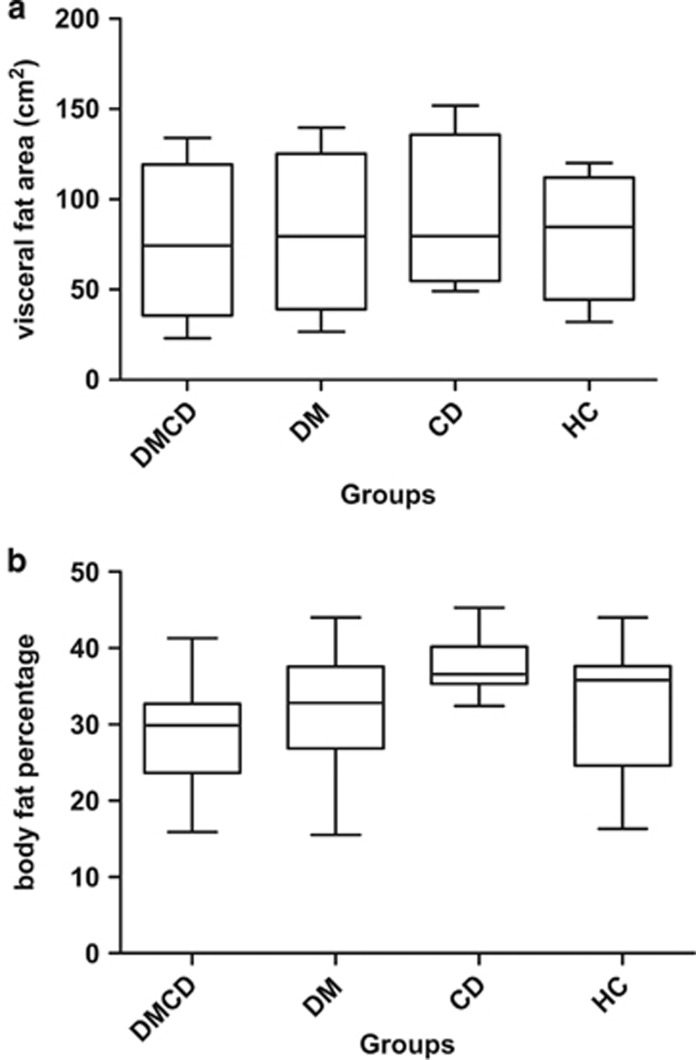
The time of diagnosis of T1DM was similar between DMCD and DM groups; however, the duration of CD was significantly higher in the CD group compared with DMCD. The SF-36 analysis revealed statistically significant differences between DM and HC groups in two domains: general health (P=0.042) and energy/vitality (P=0.012). QoL was also correlated with compliance to a GFD, and scores were similar in both groups: DMCD and CD. Forty percent of individuals in the CD group had visceral fat area above 100 cm, as opposed to 20% in the other groups.
Individuals of DMCD group had similar scores to DM, CD and HC on QoL, as well as on their nutritional status and bone metabolism. Thereby, we should conclude that the association of T1DM and CD did not deteriorate their health status.
1型糖尿病(T1DM)和乳糜泻(CD)均为自身免疫性疾病,具有相似的遗传模式。T1DM的治疗基于饮食、体育活动和胰岛素治疗,而CD则依赖于限制小麦、黑麦和大麦的饮食改变。本研究的目的是评估T1DM与CD并存个体的生活质量(QoL),描述其营养状况,并与仅患一种疾病的个体及健康对照进行比较。
受试者/方法:根据性别、年龄和体重指数(BMI)进行匹配的60例患者,根据先前诊断分为:T1DM与CD并存组(DMCD组);T1DM组(DM组);CD组(CD组);或健康参与者(HC)。应用SF-36问卷评估心理健康状况,并将结果与血糖控制情况、糖尿病相关并发症的存在情况、无麸质饮食(GFD)的依从性进行比较。通过BMI、腰围、生物电阻抗、常规实验室检查和全身密度测定来确定营养状况和身体成分。
DMCD组和DM组T1DM的诊断时间相似;然而,CD组CD的病程明显长于DMCD组。SF-36分析显示,DM组和HC组在两个领域存在统计学显著差异:总体健康(P=0.042)和精力/活力(P=0.012)。QoL也与GFD的依从性相关,DMCD组和CD组的得分相似。CD组40%的个体内脏脂肪面积超过100 cm²,而其他组为20%。
DMCD组个体在QoL、营养状况和骨代谢方面的得分与DM组、CD组和HC组相似。因此,我们可以得出结论,T1DM与CD并存并未恶化他们的健康状况。