Department of Organization and Consumption Economics, Faculty of Human Nutrition and Consumer Sciences, Warsaw University of Life Sciences (SGGW-WULS), 159C Nowoursynowska Street, 02-787 Warsaw, Poland.
Department of Dietetics, Faculty of Human Nutrition and Consumer Sciences, Warsaw University of Life Sciences (SGGW-WULS), 159C Nowoursynowska Street, 02-787 Warsaw, Poland.
Nutrients. 2018 Oct 3;10(10):1414. doi: 10.3390/nu10101414.
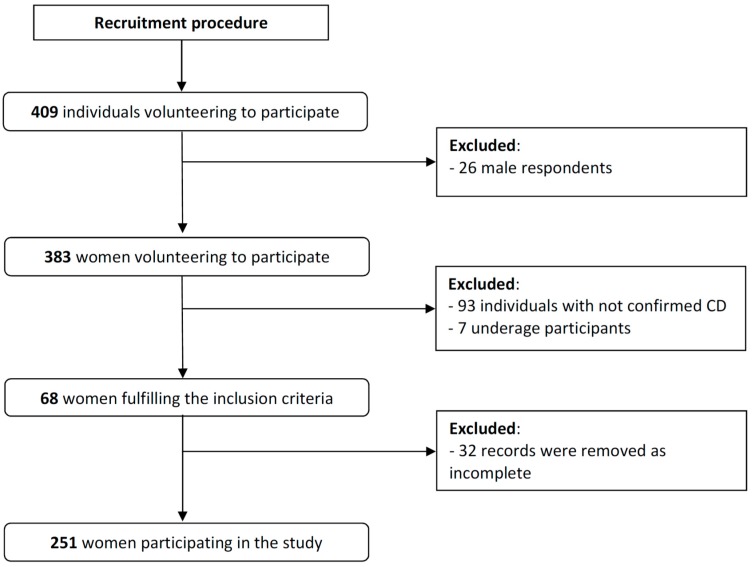
The gluten-free diet is effective in the majority of celiac disease (CD) patients, but it is burdensome and may influence quality of life (QoL). The aim of the study was to analyze the social and emotional fears and worries influencing the QoL of female CD patients following a gluten-free (GF) diet, as well as to indicate the sociodemographic interfering factors. The study was conducted on a group of 251 female CD patients, while emotional, social and worries subscales of the Celiac Disease Questionnaire (CDQ) were applied, as well as purchase-related emotions and behaviors were assessed. Respondents declaring worse economic status obtained significantly lower scores in the emotional, social and worries subscales of the CDQ than respondents declaring better economic status, while for other factors (CD duration, GFD adherence, BMI, place of residence and educational level) no significant association was stated in the multi-factor analysis. Moreover, respondents declaring worse economic status more often declared that a bad mood affected their purchase decisions than did respondents declaring better economic status. It was stated, that the economic status of CD patient could be one of the most important factors influencing their social and emotional fears and worries. It may be supposed that low economic status may lead some CD patients to choose to relieve stress by purchasing GF products instead of other products.
无麸质饮食在大多数乳糜泻(CD)患者中是有效的,但它很繁琐,可能会影响生活质量(QoL)。本研究的目的是分析影响遵循无麸质(GF)饮食的 CD 女性患者生活质量的社会和情绪恐惧和担忧,以及指出社会人口统计学的干扰因素。该研究在 251 名女性 CD 患者中进行,同时应用乳糜泻问卷(CDQ)的情绪、社会和担忧子量表,并评估与购买相关的情绪和行为。与报告经济状况较好的患者相比,报告经济状况较差的患者在 CDQ 的情绪、社会和担忧子量表中的得分明显较低,而对于其他因素(CD 持续时间、GFD 依从性、BMI、居住地和教育水平),在多因素分析中未表明存在显著关联。此外,报告经济状况较差的患者比报告经济状况较好的患者更常表示情绪不佳会影响他们的购买决策。研究表明,CD 患者的经济状况可能是影响其社会和情绪恐惧和担忧的最重要因素之一。可以假设,较低的经济状况可能会导致一些 CD 患者选择通过购买 GF 产品而不是其他产品来缓解压力。