de Lange Katrina M, Moutsianas Loukas, Lee James C, Lamb Christopher A, Luo Yang, Kennedy Nicholas A, Jostins Luke, Rice Daniel L, Gutierrez-Achury Javier, Ji Sun-Gou, Heap Graham, Nimmo Elaine R, Edwards Cathryn, Henderson Paul, Mowat Craig, Sanderson Jeremy, Satsangi Jack, Simmons Alison, Wilson David C, Tremelling Mark, Hart Ailsa, Mathew Christopher G, Newman William G, Parkes Miles, Lees Charlie W, Uhlig Holm, Hawkey Chris, Prescott Natalie J, Ahmad Tariq, Mansfield John C, Anderson Carl A, Barrett Jeffrey C
Wellcome Trust Sanger Institute, Wellcome Trust Genome Campus, Hinxton, UK.
Inflammatory Bowel Disease Research Group, Addenbrooke's Hospital, Cambridge, UK.
Nat Genet. 2017 Feb;49(2):256-261. doi: 10.1038/ng.3760. Epub 2017 Jan 9.
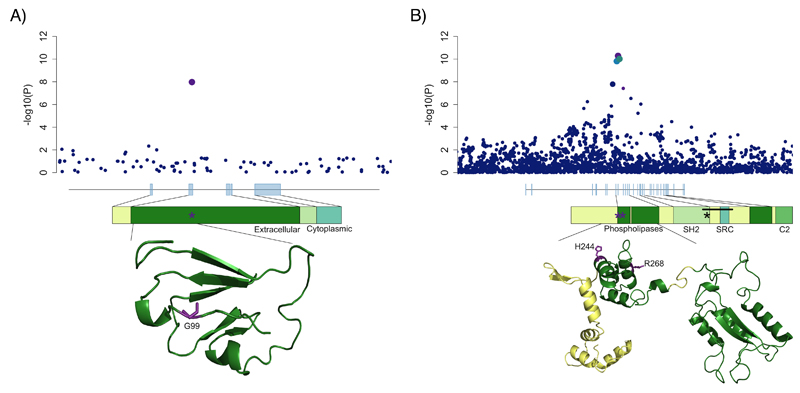
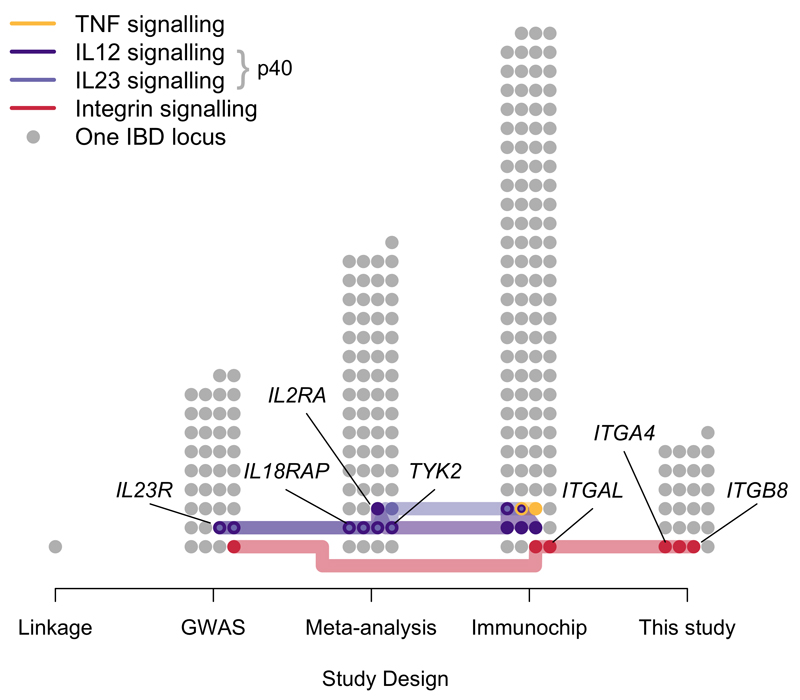
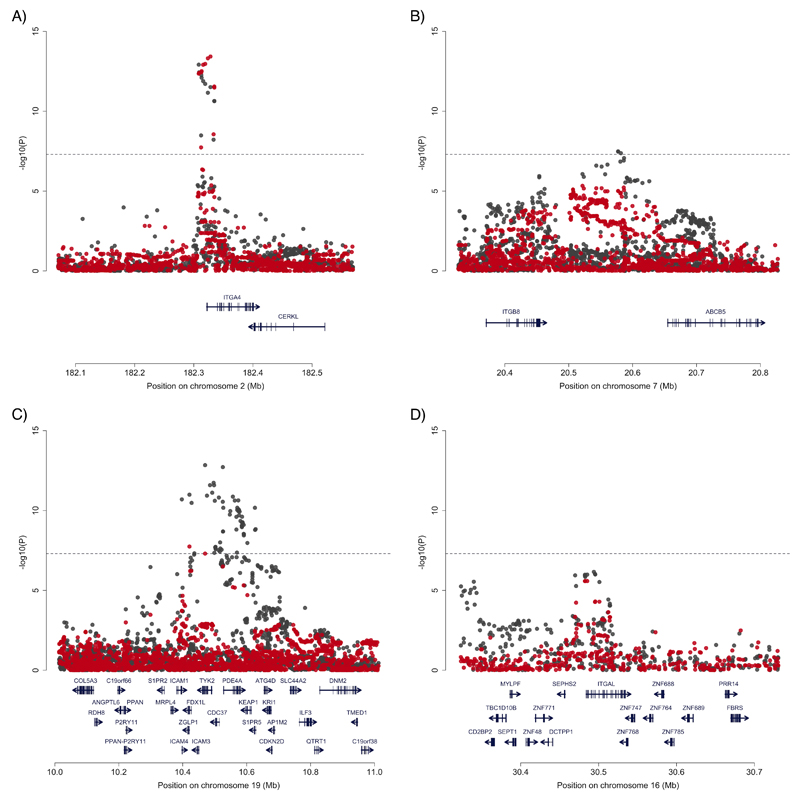
Genetic association studies have identified 215 risk loci for inflammatory bowel disease, thereby uncovering fundamental aspects of its molecular biology. We performed a genome-wide association study of 25,305 individuals and conducted a meta-analysis with published summary statistics, yielding a total sample size of 59,957 subjects. We identified 25 new susceptibility loci, 3 of which contain integrin genes that encode proteins in pathways that have been identified as important therapeutic targets in inflammatory bowel disease. The associated variants are correlated with expression changes in response to immune stimulus at two of these genes (ITGA4 and ITGB8) and at previously implicated loci (ITGAL and ICAM1). In all four cases, the expression-increasing allele also increases disease risk. We also identified likely causal missense variants in a gene implicated in primary immune deficiency, PLCG2, and a negative regulator of inflammation, SLAMF8. Our results demonstrate that new associations at common variants continue to identify genes relevant to therapeutic target identification and prioritization.
基因关联研究已经确定了215个炎症性肠病的风险位点,从而揭示了其分子生物学的基本方面。我们对25305名个体进行了全基因组关联研究,并与已发表的汇总统计数据进行了荟萃分析,总样本量达到59957名受试者。我们确定了25个新的易感位点,其中3个包含整合素基因,这些基因在已被确定为炎症性肠病重要治疗靶点的通路中编码蛋白质。相关变异与其中两个基因(ITGA4和ITGB8)以及先前涉及的位点(ITGAL和ICAM1)对免疫刺激的表达变化相关。在所有这四种情况下,增加表达的等位基因也会增加疾病风险。我们还在一个与原发性免疫缺陷相关的基因PLCG2和一个炎症负调节因子SLAMF8中确定了可能的因果错义变异。我们的结果表明,常见变异的新关联继续识别与治疗靶点识别和优先级相关的基因。