McCowan Lesley M E, Thompson John M D, Taylor Rennae S, Baker Philip N, North Robyn A, Poston Lucilla, Roberts Claire T, Simpson Nigel A B, Walker James J, Myers Jenny, Kenny Louise C
Department of Obstetrics and Gynaecology, University of Auckland, Auckland, New Zealand.
South Auckland Clinical School, Middlemore Hospital, Department of Paediatrics: Child and Youth Health, University of Auckland, Auckland, New Zealand.
PLoS One. 2017 Jan 9;12(1):e0169311. doi: 10.1371/journal.pone.0169311. eCollection 2017.
Most small for gestational age pregnancies are unrecognised before birth, resulting in substantial avoidable perinatal mortality and morbidity. Our objective was to develop multivariable prediction models for small for gestational age combining clinical risk factors and biomarkers at 15±1 weeks' with ultrasound parameters at 20±1 weeks' gestation.
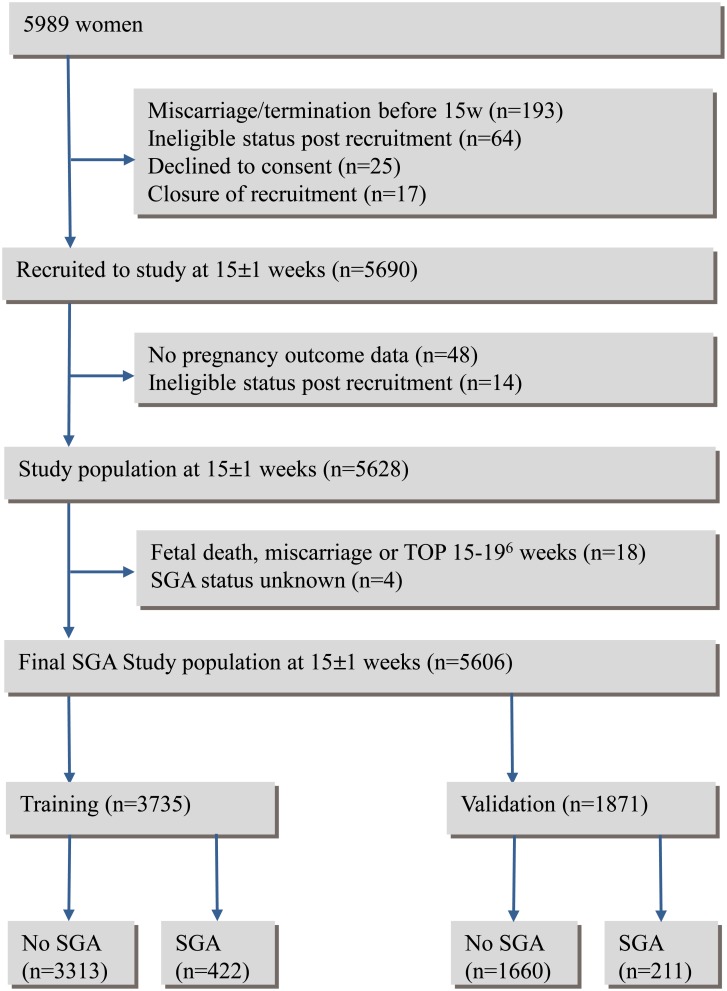
Data from 5606 participants in the Screening for Pregnancy Endpoints (SCOPE) cohort study were divided into Training (n = 3735) and Validation datasets (n = 1871). The primary outcomes were All-SGA (small for gestational age with birthweight <10th customised centile), Normotensive-SGA (small for gestational age with a normotensive mother) and Hypertensive-SGA (small for gestational age with an hypertensive mother). The comparison group comprised women without the respective small for gestational age phenotype. Multivariable analysis was performed using stepwise logistic regression beginning with clinical variables, and subsequent additions of biomarker and then ultrasound (biometry and Doppler) variables. Model performance was assessed in Training and Validation datasets by calculating area under the curve.
633 (11.2%) infants were All-SGA, 465(8.2%) Normotensive-SGA and 168 (3%) Hypertensive-SGA. Area under the curve (95% Confidence Intervals) for All-SGA using 15±1 weeks' clinical variables, 15±1 weeks' clinical+ biomarker variables and clinical + biomarkers + biometry /Doppler at 20±1 weeks' were: 0.63 (0.59-0.67), 0.64 (0.60-0.68) and 0.69 (0.66-0.73) respectively in the Validation dataset; Normotensive-SGA results were similar: 0.61 (0.57-0.66), 0.61 (0.56-0.66) and 0.68 (0.64-0.73) with small increases in performance in the Training datasets. Area under the curve (95% Confidence Intervals) for Hypertensive-SGA were: 0.76 (0.70-0.82), 0.80 (0.75-0.86) and 0.84 (0.78-0.89) with minimal change in the Training datasets.
Models for prediction of small for gestational age, which combine biomarkers, clinical and ultrasound data from a cohort of low-risk nulliparous women achieved modest performance. Incorporation of biomarkers into the models resulted in no improvement in performance of prediction of All-SGA and Normotensive-SGA but a small improvement in prediction of Hypertensive-SGA. Our models currently have insufficient reliability for application in clinical practice however, they have potential utility in two-staged screening tests which include third trimester biomarkers and or fetal biometry.
大多数小于胎龄儿在出生前未被识别,导致大量可避免的围产期死亡率和发病率。我们的目标是开发小于胎龄儿的多变量预测模型,该模型结合孕15±1周时的临床危险因素和生物标志物以及孕20±1周时的超声参数。
妊娠结局筛查(SCOPE)队列研究中5606名参与者的数据被分为训练数据集(n = 3735)和验证数据集(n = 1871)。主要结局为全小于胎龄儿(出生体重低于第10定制百分位数的小于胎龄儿)、血压正常的小于胎龄儿(母亲血压正常的小于胎龄儿)和高血压相关的小于胎龄儿(母亲患有高血压的小于胎龄儿)。对照组包括没有相应小于胎龄儿表型的女性。多变量分析使用逐步逻辑回归进行,首先纳入临床变量,随后添加生物标志物变量,然后是超声(生物测量和多普勒)变量。通过计算曲线下面积在训练数据集和验证数据集中评估模型性能。
633名(11.2%)婴儿为全小于胎龄儿,465名(8.2%)为血压正常的小于胎龄儿,168名(3%)为高血压相关的小于胎龄儿。在验证数据集中,使用孕15±1周临床变量、孕15±1周临床+生物标志物变量以及孕20±1周临床+生物标志物+生物测量/多普勒对全小于胎龄儿进行预测的曲线下面积(95%置信区间)分别为:0.63(0.59 - 0.67)、0.64(0.60 - 0.68)和0.69(0.66 - 0.73);血压正常的小于胎龄儿的结果类似:0.61(0.57 - 0.66)、0.61(0.56 - 0.66)和0.68(0.64 - 0.73)——在训练数据集中性能略有提高。高血压相关的小于胎龄儿的曲线下面积(95%置信区间)为:0.76(0.70 - 0.82)、0.80(0.75 - 0.86)和0.84(0.78 - 0.89)——在训练数据集中变化最小。
结合生物标志物、临床和超声数据,针对一组低风险初产妇开发的小于胎龄儿预测模型表现一般。将生物标志物纳入模型对全小于胎龄儿和血压正常的小于胎龄儿的预测性能没有改善,但对高血压相关的小于胎龄儿的预测有小幅改善。我们的模型目前在临床实践中的可靠性不足,然而,它们在包括孕晚期生物标志物和/或胎儿生物测量的两阶段筛查试验中具有潜在用途。