Guan Yongjuan, Liang Guanxiang, Martin Graeme B, Guan Le Luo
UWA Institute of Agriculture and School of Animal Biology, University of Western Australia, 35 Stirling Highway, Crawley, WA, 6009, Australia.
, Present address: 304 Rosenthal, 3800 Spruce Street, Philadelphia, PA, 19104, USA.
BMC Genomics. 2017 Jan 10;18(1):64. doi: 10.1186/s12864-016-3385-8.
The effects of nutrition on testis mass in the sexually mature male have long been known, however, the cellular and molecular processes of the testis response to nutrition was not fully understood.
We tested whether the defects in spermatogenesis and increases in germ cell apoptosis in the testis that are induced by under-nutrition are associated with changes in mRNA expression and pre-mRNA alternative splicing using groups of 8 male sheep fed for a 10% increase or 10% decrease in body mass over 65 days.
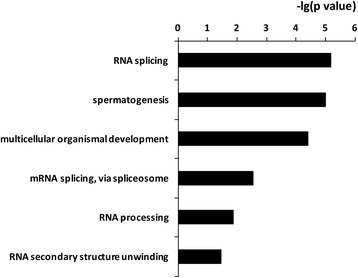
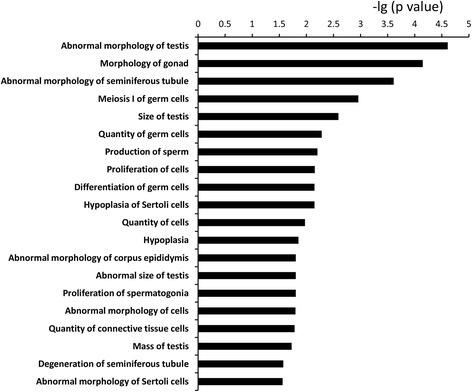
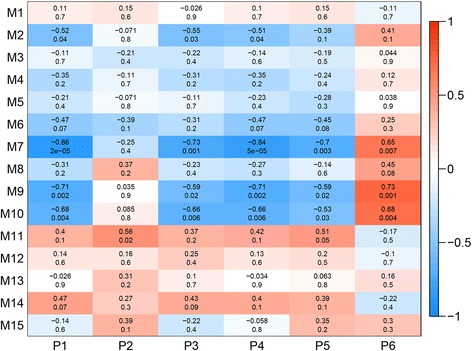
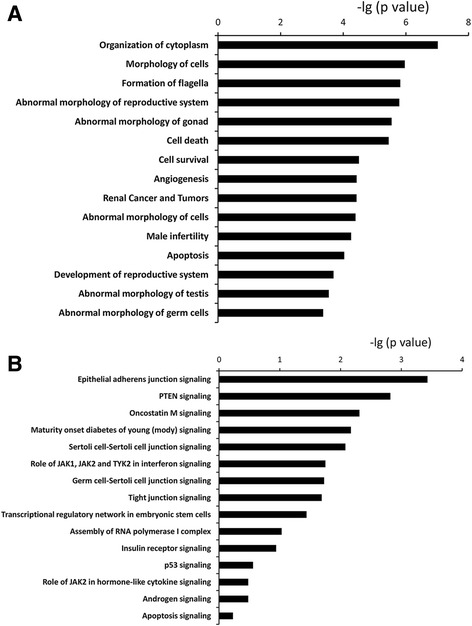
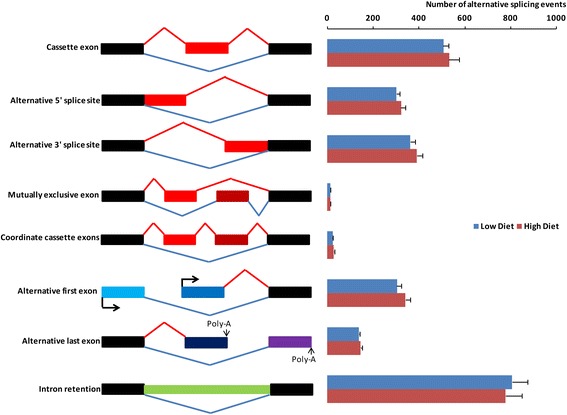
We identified 2,243 mRNAs, including TP53 and Claudin 11, that were differentially expressed in testis from underfed and well-fed sheep (FDR < 0.1), and found that their expression changed in parallel with variations in germ cell numbers, testis size, and spermatogenesis. Furthermore, pairs of 269 mRNAs and 48 miRNAs were identified on the basis of target prediction. The regulatory effect of miRNAs on mRNA expression, in combination with functional analysis, suggests that these miRNAs are involved in abnormal reproductive morphology, apoptosis and male infertility. Nutrition did not affect the total number of alternative splicing events, but affected 206 alternative splicing events. A total of 159 genes, including CREM, SPATA6, and DDX4, were differentially spliced between dietary treatments, with functions related to RNA splicing and spermatogenesis. In addition, three gene modules were positively correlated with spermatogenesis-related phenotypic traits and negatively related to apoptosis-related phenotypic traits. Among these gene modules, seven (CFLAR, PTPRC, F2R, MAP3K1, EPHA7, APP, BCAP31) were also differentially expressed between nutritional treatments, indicating their potential as markers of spermatogenesis or apoptosis.
Our findings on significant changes in mRNAs and pre-mRNA alternative splicing under-nutrition suggest that they may partly explain the disruption of spermatogenesis and the increase germ cell apoptosis. However, more research is required to verify their causal effects in regulating spermatogenesis and germ cell apoptosis.
营养对性成熟雄性动物睾丸质量的影响早已为人所知,然而,睾丸对营养反应的细胞和分子过程尚未完全明确。
我们将8只雄性绵羊分为两组,分别在65天内使其体重增加或减少10%,以此测试营养不良诱导的睾丸生精缺陷和生殖细胞凋亡增加是否与mRNA表达变化和前体mRNA可变剪接有关。
我们鉴定出2243种mRNA,包括TP53和Claudin 11,在营养不良和营养良好的绵羊睾丸中差异表达(FDR<0.1),发现它们的表达变化与生殖细胞数量、睾丸大小和生精过程的变化平行。此外,基于靶标预测鉴定出269对mRNA和48对miRNA。miRNA对mRNA表达的调控作用,结合功能分析,表明这些miRNA参与了异常生殖形态、凋亡和男性不育。营养不影响可变剪接事件的总数,但影响了206个可变剪接事件。共有159个基因,包括CREM、SPATA6和DDX4,在不同饮食处理间差异剪接,其功能与RNA剪接和生精过程有关。此外,三个基因模块与生精相关表型性状呈正相关,与凋亡相关表型性状呈负相关。在这些基因模块中,有七个(CFLAR、PTPRC、F2R、MAP3K1、EPHA7、APP、BCAP31)在营养处理间也差异表达,表明它们可能作为生精或凋亡的标志物。
我们关于营养不良状态下mRNA和前体mRNA可变剪接显著变化的研究结果表明,它们可能部分解释了生精过程的破坏和生殖细胞凋亡的增加。然而,需要更多研究来验证它们在调节生精过程和生殖细胞凋亡中的因果作用。