Department of Agricultural, Food and Nutritional Science, University of Alberta, Edmonton, AB, Canada.
BMC Genomics. 2014 Jun 9;15(1):452. doi: 10.1186/1471-2164-15-452.
Salmonella enterica serovar Typhimurium is a gram-negative bacterium that can colonise the gut of humans and several species of food producing farm animals to cause enteric or septicaemic salmonellosis. While many studies have looked into the host genetic response to Salmonella infection, relatively few have used correlation of shedding traits with gene expression patterns to identify genes whose variable expression among different individuals may be associated with differences in Salmonella clearance and resistance. Here, we aimed to identify porcine genes and gene co-expression networks that differentiate distinct responses to Salmonella challenge with respect to faecal Salmonella shedding.
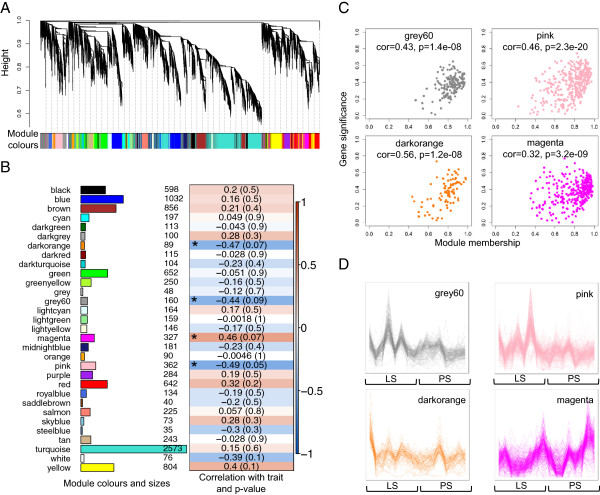
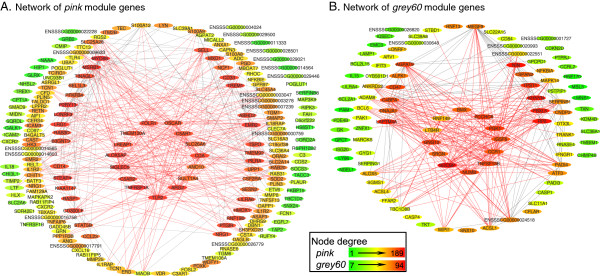
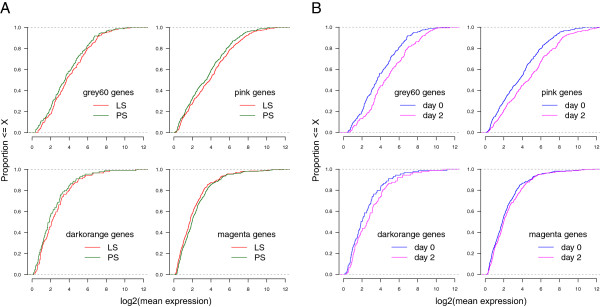
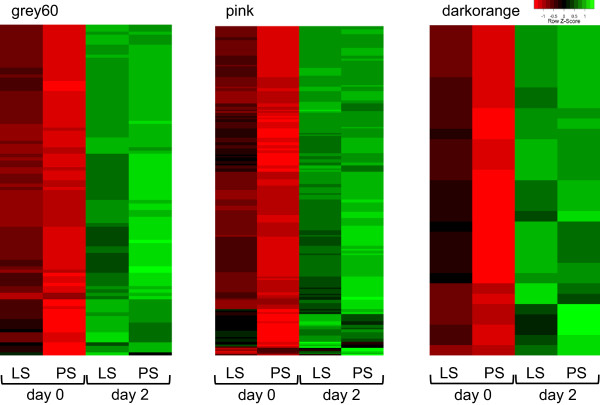
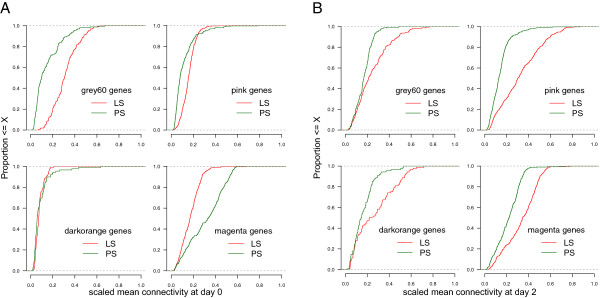
Peripheral blood transcriptome profiles from 16 pigs belonging to extremes of the trait of faecal Salmonella shedding counts recorded up to 20 days post-inoculation (low shedders (LS), n = 8; persistent shedders (PS), n = 8) were generated using RNA-sequencing from samples collected just before (day 0) and two days after (day 2) Salmonella inoculation. Weighted gene co-expression network analysis (WGCNA) of day 0 samples identified four modules of co-expressed genes significantly correlated with Salmonella shedding counts upon future challenge. Two of those modules consisted largely of innate immunity related genes, many of which were significantly up-regulated at day 2 post-inoculation. The connectivity at both days and the mean gene-wise expression levels at day 0 of the genes within these modules were higher in networks constructed using LS samples alone than those using PS alone. Genes within these modules include those previously reported to be involved in Salmonella resistance such as SLC11A1 (formerly NRAMP1), TLR4, CD14 and CCR1 and those for which an association with Salmonella is novel, for example, SIGLEC5, IGSF6 and TNFSF13B.
Our analysis integrates gene co-expression network analysis, gene-trait correlations and differential expression to provide new candidate regulators of Salmonella shedding in pigs. The comparatively higher expression (also confirmed in an independent dataset) and the significantly higher connectivity of genes within the Salmonella shedding associated modules in LS compared to PS even before Salmonella challenge may be factors that contribute to the decreased faecal Salmonella shedding observed in LS following challenge.
肠炎沙门氏菌血清型鼠伤寒是一种革兰氏阴性细菌,可定植于人类和几种生产食用动物的肠道,引起肠型或败血型沙门氏菌病。虽然许多研究都着眼于宿主对沙门氏菌感染的遗传反应,但相对较少的研究将脱落性状与基因表达模式相关联,以鉴定在不同个体中表达可变的基因,这些基因可能与沙门氏菌清除和抗性的差异有关。在这里,我们旨在确定猪的基因和基因共表达网络,这些基因和基因共表达网络可区分粪便沙门氏菌脱落方面对沙门氏菌挑战的不同反应。
从接种后 20 天内粪便沙门氏菌脱落计数记录处于极端值的 16 头猪(低脱落者(LS),n=8;持续脱落者(PS),n=8)的外周血转录组谱通过 RNA-seq 从接种前一天(第 0 天)和接种后两天(第 2 天)采集的样本中生成。对第 0 天样本的加权基因共表达网络分析(WGCNA)鉴定了四个与未来挑战时沙门氏菌脱落计数显著相关的共表达基因模块。其中两个模块主要由先天免疫相关基因组成,其中许多基因在接种后第 2 天显著上调。在使用 LS 样本构建的网络中,这些模块的连通性以及第 0 天的平均基因表达水平都高于单独使用 PS 样本构建的网络。这些模块中的基因包括先前报道与沙门氏菌抗性相关的基因,如 SLC11A1(以前称为 NRAMP1)、TLR4、CD14 和 CCR1,以及与沙门氏菌相关的新基因,例如 SIGLEC5、IGSF6 和 TNFSF13B。
我们的分析将基因共表达网络分析、基因-性状相关性和差异表达相结合,为猪沙门氏菌脱落的新候选调控因子提供了依据。在 LS 中,与 PS 相比,即使在沙门氏菌挑战之前,与沙门氏菌脱落相关模块中的基因表达水平(也在独立数据集得到证实)和连通性更高,这可能是 LS 接种后粪便沙门氏菌脱落减少的因素之一。