Zhao Yuan, Sautter Jessica M, Qiu Li, Gu Danan
Ginling College and School of Geography Science, Nanjing Normal University, Nanjing, China.
Department of Behavioral and Social Sciences, University of the Sciences, Philadelphia, PA, USA.
BMC Geriatr. 2017 Jan 9;17(1):12. doi: 10.1186/s12877-016-0406-z.
Self-perceived uselessness is associated with poor health and high mortality among older adults in China. However, it is unclear which demographic, psychosocial, behavioral and health factors are associated with self-perceived uselessness.
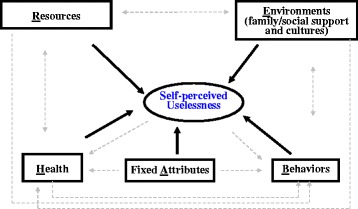
Data came from four waves (2005, 2008, 2011 and 2014) of the largest nationwide longitudinal survey of the population aged 65 and older in China (26,624 individuals contributed 48,476 observations). This study aimed to systematically investigate factors associated with self-perceived uselessness based on the proposed REHAB framework that includes resources (R), environments (E), health (H), fixed attributes (A) and behaviors (B). Self-perceived uselessness was measured by a single item: "with age, do you feel more useless?" and coded by frequency: high (always and often), moderate (sometimes) and low (seldom and never). Multinomial logistic regression models with low frequency as the reference category were employed to identify REHAB risk factors associated with self-perceived uselessness.
Most factors in the REHAB framework were associated with self-perceived uselessness, although some social environmental factors in the full model were not significant. Specifically, more socioeconomic resources were associated with reduced relative risk ratio (RRR) of high or moderate frequency of self-perceived uselessness relative to low frequency. More environmental family/social support was associated with lower RRR of high frequency of self-perceived uselessness. Cultural factors such as coresidence with children and intergenerational transfer were associated with reduced RRR of high frequency of self-perceived uselessness. Indicators of poor health status such as disability and loneliness were associated with greater RRR of high or moderate frequency of self-perceived uselessness. Fixed attributes of older age and Han ethnicity were associated with increased RRR of high frequency of self-perceived uselessness; whereas optimism and self-control were associated with reduced RRR. Behaviors including regular consumption of alcohol, regular exercise, social participation and leisure activities were associated with reduced RRR of high frequency of self-perceived uselessness.
Self-perceived uselessness was associated with a wide range of factors in the REHAB framework. The findings could have important implications for China to develop and target community health programs to improve self-perceived usefulness among older adults.
在中国,老年人自我感知到的无用感与健康状况不佳及高死亡率相关。然而,尚不清楚哪些人口统计学、心理社会、行为和健康因素与自我感知到的无用感有关。
数据来自中国针对65岁及以上人群开展的最大规模全国性纵向调查的四个阶段(2005年、2008年、2011年和2014年)(26,624人贡献了48,476次观察结果)。本研究旨在基于提出的REHAB框架系统地调查与自我感知到的无用感相关的因素,该框架包括资源(R)、环境(E)、健康(H)、固定属性(A)和行为(B)。自我感知到的无用感通过一个单项问题进行测量:“随着年龄增长,你是否觉得自己更没用?”并按频率编码:高(总是和经常)、中(有时)和低(很少和从不)。采用以低频为参照类别的多项逻辑回归模型来确定与自我感知到的无用感相关的REHAB风险因素。
REHAB框架中的大多数因素都与自我感知到的无用感相关,尽管完整模型中的一些社会环境因素并不显著。具体而言,更多的社会经济资源与自我感知到的无用感高频率或中等频率相对于低频率的相对风险比(RRR)降低相关。更多的环境家庭/社会支持与自我感知到的无用感高频率的较低RRR相关。与子女同住和代际转移等文化因素与自我感知到的无用感高频率的RRR降低相关。残疾和孤独等健康状况不佳的指标与自我感知到的无用感高频率或中等频率的更大RRR相关。老年和汉族等固定属性与自我感知到的无用感高频率的RRR增加相关;而乐观和自我控制与RRR降低相关。包括经常饮酒、经常锻炼、社会参与和休闲活动在内的行为与自我感知到的无用感高频率的RRR降低相关。
自我感知到的无用感与REHAB框架中的广泛因素相关。这些发现可能对中国制定和实施社区健康项目以提高老年人的自我感知有用性具有重要意义。