Deng Xia, Zheng Zhen, Lin Baochai, Su Huafang, Chen Hanbin, Fei Shaoran, Fei Zhenghua, Zhao Lihao, Jin Xiance, Xie Cong-Ying
Department of Radiotherapy and Chemotherapy, the First Affiliated Hospital of Wenzhou Medical University, No.2 Fuxue Lane, Wenzhou, 325000, China.
Zhejiang Provincial Key Laboratory of Aging and Neurological Disorder Research, Wenzhou, 325000, China.
BMC Cancer. 2017 Jan 10;17(1):42. doi: 10.1186/s12885-016-3017-3.
Brain metastasis (BM) is a poor prognostic factor for non-small-cell lung cancer (NSCLC). The efficacy and roles of combining temozolomide (TMZ) with whole brain radiotherapy (WBRT) in protection neurocognitive function (NCF) and improvement quality of life (QOL) were investigated and compared with WBRT alone in the treatment of NSCLC patients with BM.
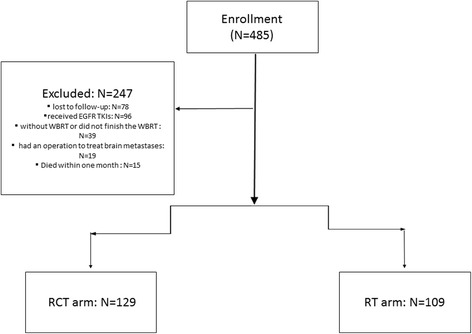
A total of 238 NSCLC patients with BM were reviewed and categorized into WBRT plus TMZ (RCT) arm and WBRT alone (RT), respectively. The efficacy was evaluated with Pearson chi-square or Fisher's exact tests, Log-rank test and Cox proportional hazards model. NCF was assessed by using revised Hopkins Verbal Learning Test (HVLT-R), Controlled Oral Word Association (COWA) test and Trail-making Test (TMT). QOL was assessed by the Functional Assessment of Cancer Treatment-Lung (FACT-L) Chinese version 4.0 questionnaire.
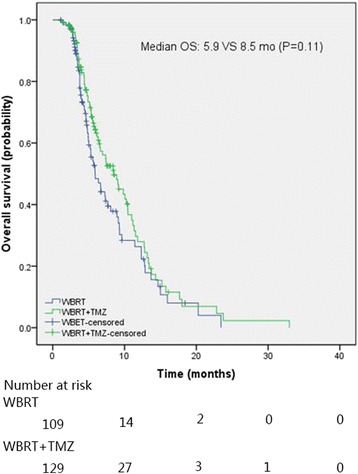
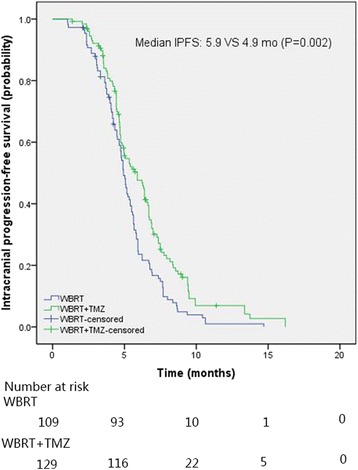
The average intracranial objective response (ORR) and disease control rate (DCR) for all the patients were 26.9 and 95.8%, respectively. The intracranial ORR and DCR for RCT and RT arm were 34.9% vs. 20.2% (p = 0.01) and 98.4% vs. 92.7% (p = 0.03), respectively. The median intracranial progression-free survival (PFS) and overall survival (OS) of NSCLC patients with BM were 5.2 and 7.3 months, respectively. The median PFS of RCT arm was significantly longer than that of RT arm (5.9 vs. 4.9 months, p = 0.002). The median OS of the RCT arm was also slightly longer than that of the RT arm (8.5 vs. 5.9 months), but without statistical significance (p = 0.11). Multivariate analysis indicated that TMZ was a significant factor for PFS. Statistically significant differences on NCF and QOL were observed between CRT and RT arms at 5 months. RCT showed a trend of toxicities increase compared with RT, however, the toxicities were tolerable and manageable.
Adding TMZ to WBRT in the treatment of NSCLC patients with BM could improve the intracranial ORR, DCR, and median PFS compared with WBRT alone. Although no remarkable difference on median OS was found, adding TMZ could prevent NCF and QOL from worsening. The side effects increased by adding TMZ, but the difference was not statistical significance and toxicities were well tolerated.
脑转移(BM)是非小细胞肺癌(NSCLC)的不良预后因素。研究了替莫唑胺(TMZ)联合全脑放疗(WBRT)在保护神经认知功能(NCF)和改善生活质量(QOL)方面的疗效和作用,并与单纯WBRT治疗NSCLC脑转移患者进行比较。
回顾了238例NSCLC脑转移患者,并分别分为WBRT联合TMZ(RCT)组和单纯WBRT(RT)组。采用Pearson卡方检验或Fisher精确检验、Log-rank检验和Cox比例风险模型评估疗效。使用修订的霍普金斯言语学习测试(HVLT-R)、受控口语联想(COWA)测试和连线测试(TMT)评估NCF。通过癌症治疗功能评估-肺癌(FACT-L)中文版4.0问卷评估QOL。
所有患者的平均颅内客观缓解率(ORR)和疾病控制率(DCR)分别为26.9%和95.8%。RCT组和RT组的颅内ORR分别为34.9%和20.2%(p = 0.01),DCR分别为98.4%和92.7%(p = 0.03)。NSCLC脑转移患者的颅内无进展生存期(PFS)和总生存期(OS)中位数分别为5.2个月和7.3个月。RCT组的PFS中位数显著长于RT组(5.9个月对4.9个月,p = 0.002)。RCT组的OS中位数也略长于RT组(8.5个月对5.9个月),但无统计学意义(p = 0.11)。多因素分析表明,TMZ是PFS的显著因素。在5个月时,CRT组和RT组在NCF和QOL方面存在统计学显著差异。与RT组相比,RCT组的毒性有增加趋势,然而,这些毒性是可耐受和可管理的。
与单纯WBRT相比,在治疗NSCLC脑转移患者时,WBRT联合TMZ可提高颅内ORR、DCR和PFS中位数。虽然在OS中位数方面未发现显著差异,但联合TMZ可防止NCF和QOL恶化。添加TMZ会增加副作用,但差异无统计学意义,且毒性耐受性良好。