Baron Emily Claire, Davies Thandi, Lund Crick
Alan J Flisher Centre for Public Mental Health, Department of Psychiatry and Mental Health, University of Cape Town, Office 32, Building B, 46 Sawkins Road, 7700 Rondebosch, Cape Town, South Africa.
Centre for Global Mental Health, Institute of Psychiatry, Psychology and Neuroscience, King's College London, London, UK.
BMC Psychiatry. 2017 Jan 9;17(1):6. doi: 10.1186/s12888-016-1178-x.
The 10-item Centre for Epidemiological Studies Depression Scale (CES-D-10) is a depression screening tool that has been used in the South African National Income Dynamics Study (NIDS), a national household panel study. This screening tool has not yet been validated in South Africa. This study aimed to establish the reliability and validity of the CES-D-10 in Zulu, Xhosa and Afrikaans. The CES-D-10's psychometric properties were also compared to the Patient Health Questionnaire (PHQ-9), a depression screening tool already validated in South Africa.
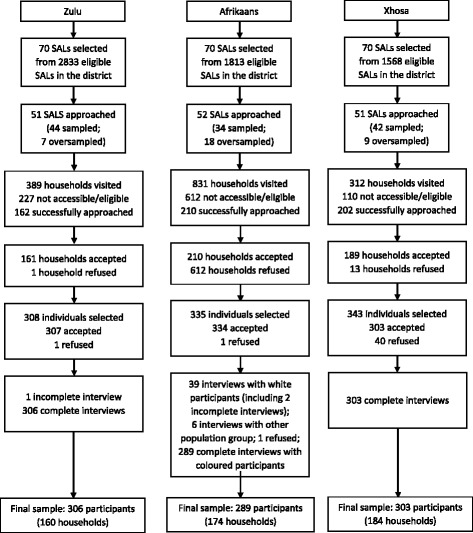
Stratified random samples of Xhosa, Afrikaans and Zulu-speaking participants aged 15 years or older (N = 944) were recruited from Cape Town Metro and Ethekwini districts. Face-to-face interviews included socio-demographic questions, the CES-D-10, Patient Health Questionnaire (PHQ-9), and WHO Disability Assessment Schedule 2.0 (WHODAS). Major depression was determined using the Mini International Neuropsychiatric Interview. All instruments were translated and back-translated to English. Construct validity was examined using exploratory factor analysis with varimax rotation. Receiver Operating Characteristics (ROC) curves were used to investigate the CES-D-10 and PHQ-9's criterion validity, and compared using the DeLong method.
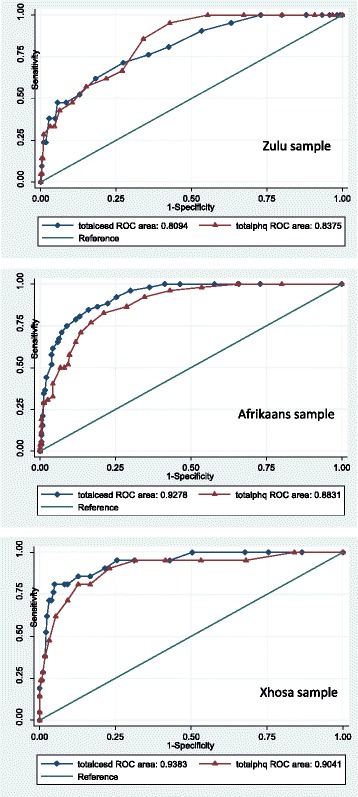
Overall, 6.6, 18.0 and 6.9% of the Zulu, Afrikaans and Xhosa samples were diagnosed with depression, respectively. The CES-D-10 had acceptable internal consistency across samples (α = 0.69-0.89), and adequate concurrent validity, when compared to the PHQ-9 and WHODAS. The CES-D-10 area under the Receiver Operator Characteristic curve was good to excellent: 0.81 (95% CI 0.71-0.90) for Zulu, 0.93 (95% CI 0.90-0.96) for Afrikaans, and 0.94 (95% CI 0.89-0.99) for Xhosa. A cut-off of 12, 11 and 13 for Zulu, Afrikaans and Xhosa, respectively, generated the most balanced sensitivity, specificity and positive predictive value (Zulu: 71.4, 72.6% and 16.1%; Afrikaans: 84.6%, 84.0%, 53.7%; Xhosa: 81.0%, 95.0%, 54.8%). These were slightly higher than those generated for the PHQ-9. The CES-D-10 and PHQ-9 otherwise performed similarly across samples.
The CES-D-10 is a valid, reliable screening tool for depression in Zulu, Xhosa and coloured Afrikaans populations.
10项流行病学研究中心抑郁量表(CES-D-10)是一种抑郁筛查工具,已用于南非全国性家庭面板研究——南非国民收入动态研究(NIDS)。该筛查工具尚未在南非得到验证。本研究旨在确定CES-D-10在祖鲁语、科萨语和南非荷兰语中的信度和效度。还将CES-D-10的心理测量特性与患者健康问卷(PHQ-9)进行了比较,PHQ-9是一种已在南非得到验证的抑郁筛查工具。
从开普敦都会区和伊泰科维尼区招募了15岁及以上讲科萨语、南非荷兰语和祖鲁语的分层随机样本(N = 944)。面对面访谈包括社会人口学问题、CES-D-10、患者健康问卷(PHQ-9)和世界卫生组织残疾评估量表2.0(WHODAS)。使用迷你国际神经精神访谈确定重度抑郁症。所有工具都进行了翻译并回译为英语。使用具有方差最大化旋转的探索性因素分析来检验结构效度。使用受试者工作特征(ROC)曲线来研究CES-D-10和PHQ-9的效标效度,并使用德龙方法进行比较。
总体而言,祖鲁语、南非荷兰语和科萨语样本中分别有6.6%、18.0%和6.9%被诊断为患有抑郁症。与PHQ-9和WHODAS相比,CES-D-10在各样本中具有可接受的内部一致性(α = 0.69 - 0.89)和足够的同时效度。CES-D-10在受试者工作特征曲线下的面积良好至优秀:祖鲁语为0.81(95%CI 0.71 - 0.90),南非荷兰语为0.93(95%CI 0.90 - 0.96),科萨语为0.94(95%CI 0.89 - 0.99)。祖鲁语、南非荷兰语和科萨语的截断值分别为12、11和13时,产生了最平衡的敏感性、特异性和阳性预测值(祖鲁语:71.4%、72.6%和16.1%;南非荷兰语:84.6%、84.0%、53.7%;科萨语:81.0%、95.0%、54.8%)。这些略高于PHQ-9产生的值)。否则,CES-D-10和PHQ-9在各样本中的表现相似。
CES-D-10是一种有效、可靠的筛查工具,可用于祖鲁语、科萨语和南非荷兰语有色人种人群的抑郁症筛查。