Nepomichene Thiery N, Andrianaivolambo Lala, Boyer Sébastien, Bourgouin Catherine
Unité d'Entomologie Médicale, Institut Pasteur de Madagascar, BP 1274, Ambatofotsikely, 101, Antananarivo, Madagascar.
Ecole doctorale Science de la vie et de l'Environnement, Université d'Antananarivo, BP 906, Antananarivo, Madagascar.
Malar J. 2017 Jan 9;16(1):21. doi: 10.1186/s12936-017-1681-7.
The changing malaria situation in Madagascar requires additional knowledge on the physiology and behaviour of local mosquito vectors. However, the absence of established colonies for several anopheline species present in Madagascar constitutes a limiting factor. To avoid labour intensive work and uncertainty for success of establishing Anopheles colonies from Malagasy species, field collections of blood-fed females and in-tube forced oviposition were combined to reliably produce large numbers of F1 progeny.
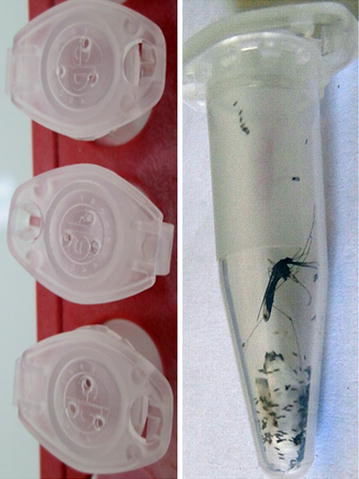
Blood-fed females were captured in zebu stables or open zebu parks. Oviposition was induced by enclosing gravid females in eppendorf tubes as initially described for Anopheles funestus. The effect of cold anaesthesia on inducing in-tube forced oviposition and on egg yield was assessed for five Anopheles species, namely Anopheles coustani, An. funestus, Anopheles mascarensis, Anopheles arabiensis and Anopheles squamosus. The production of eggs from in-tube forced oviposition and standard egg laying in cages was compared.
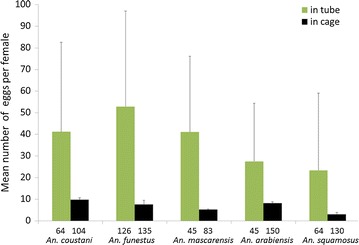
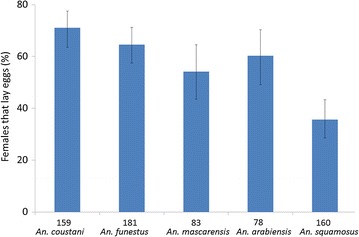
For the five anopheline species studied, the in-tube forced oviposition method had different efficacy ranging from 35.6 to 71.1% females willing to lay eggs in tubes. Interestingly, prior anaesthesia increased significantly the proportion of ovipositing females for An. mascarensis. Prior anaesthesia has a marginal effect on the number of eggs produced. However, the overall yield in eggs collected using the in-tube forced oviposition method largely exceeds the number of eggs that can be produced by females free to oviposit in cages.
The efficiency of the method allowed the production of F1 progeny in numbers sufficiently large for developing detailed analyses of the five species tested, including behavioural studies, insecticide resistance assessment and molecular characterization, as well as vector competence studies. It should be applicable to other anopheline species difficult to colonize.
马达加斯加疟疾形势的变化需要更多关于当地蚊媒生理和行为的知识。然而,马达加斯加存在的几种按蚊没有建立起稳定的种群,这是一个限制因素。为了避免从马达加斯加物种建立按蚊种群的劳动强度大且成功存在不确定性的工作,结合野外采集血饲雌蚊和管内强制产卵,以可靠地产生大量F1后代。
在瘤牛厩或露天瘤牛场捕获血饲雌蚊。如最初针对嗜人按蚊所述,将妊娠雌蚊封闭在微量离心管中诱导产卵。评估了冷麻醉对五种按蚊(即库斯塔尼按蚊、嗜人按蚊、马斯卡林按蚊、阿拉伯按蚊和鳞斑按蚊)管内强制产卵和产卵量的影响。比较了管内强制产卵和笼内标准产卵的产蛋情况。
对于所研究的五种按蚊,管内强制产卵方法的效果不同,愿意在管内产卵的雌蚊比例在35.6%至71.1%之间。有趣的是,预先麻醉显著增加了马斯卡林按蚊产卵雌蚊的比例。预先麻醉对产蛋数量有边际影响。然而,使用管内强制产卵方法收集的总产蛋量大大超过了自由在笼内产卵的雌蚊所能产生的蛋数。
该方法的效率使得能够产生足够数量的F1后代,用于对所测试的五个物种进行详细分析,包括行为研究、杀虫剂抗性评估和分子特征分析,以及媒介能力研究。它应该适用于其他难以定殖的按蚊物种。