Laboratory of Fear and Anxiety Disorders, Institute of Life Science, 330031, Nanchang, China.
College of Life Science, 330031, Nanchang, China.
Mol Brain. 2017 Jan 9;10(1):3. doi: 10.1186/s13041-016-0283-6.
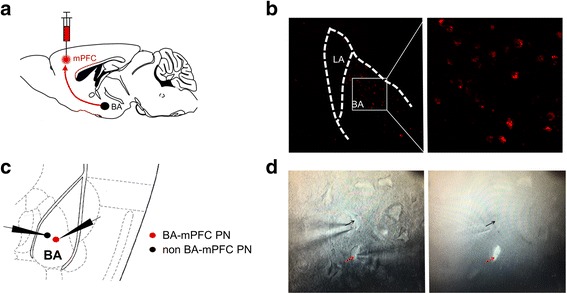
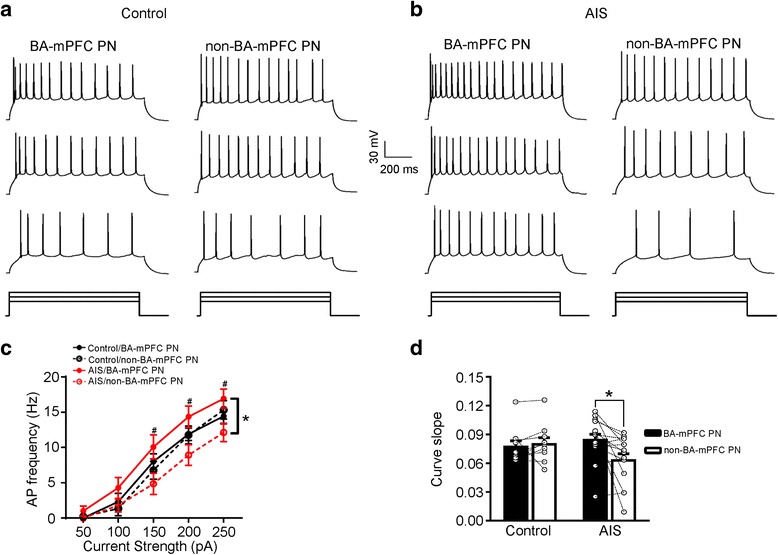
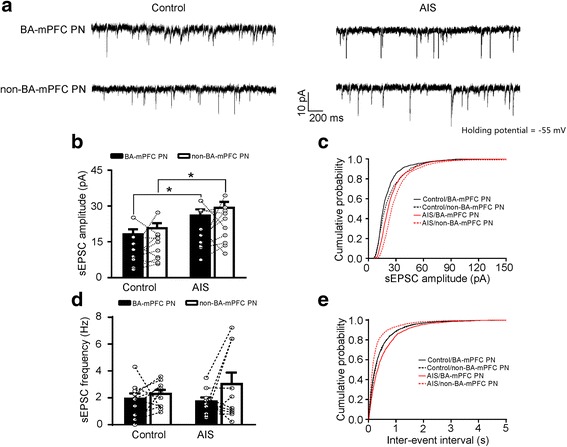
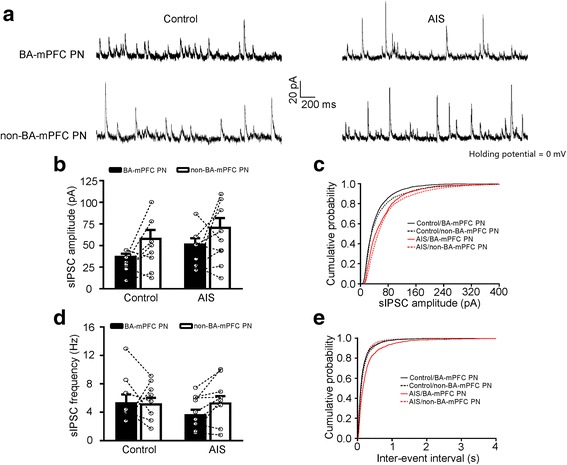
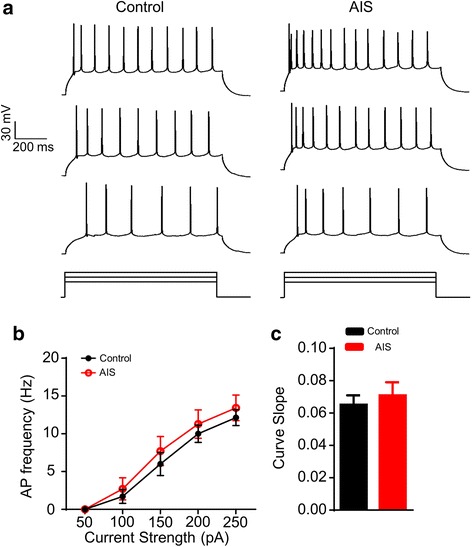
Amygdala activation is known to be critical for the processing of stressful events in brain. Recent studies have shown that the projection neurons (PNs) in amygdala, although architecturally intermingled, are integrated into distinct microcircuits and thus play divergent roles in amygdala-related behaviors. It remains unknown how stress regulates the individual amygdala PNs embedded in distinct microcircuits. Here, by using retrograde tracing and electrophysiological recording in in vitro slices, we explored the modulation of acute immobilization stress (AIS) on the basoamygdala (BA) PNs projecting either to medial prefrontal cortex (mPFC) or elsewhere, which we designated as BA-mPFC and non-BA-mPFC PNs respectively. The results showed that in the control mice, both the excitatory and inhibitory postsynaptic currents (sEPSCs/sIPSCs) were comparable between these two subsets of BA PNs. The influences of AIS on sEPSCs and sIPSCs were overall similar between the two neuronal populations. It markedly increased the sEPSCs amplitude but left unaltered their frequency as well as the sIPSCs amplitude and frequency. Despite this, several differences emerged between the effects of AIS on the distribution of sEPSCs/sIPSCs frequency in these two groups of BA PNs. Similar changes were also observed in the sEPSCs/sIPSCs of the two PN populations from mice experiencing forced swimming stress. Their intrinsic excitability, on the other hand, was nearly unaltered following AIS. Our results thus suggest that acute stress recruit both BA-mPFC and non-BA-mPFC PNs mainly through enhancing the glutamatergic transmission they receive.
杏仁核的激活被认为对大脑中应激事件的处理至关重要。最近的研究表明,杏仁核中的投射神经元(PNs)虽然在结构上相互混合,但整合到不同的微电路中,因此在与杏仁核相关的行为中发挥不同的作用。目前尚不清楚应激如何调节嵌入不同微电路中的单个杏仁核 PNs。在这里,我们通过在体外切片中使用逆行追踪和电生理记录,探讨了急性束缚应激(AIS)对投射到内侧前额叶皮层(mPFC)或其他部位的基底杏仁核(BA)PNs 的调制,我们分别将其命名为 BA-mPFC 和非-BA-mPFC PNs。结果表明,在对照小鼠中,这两个 BA PNs 亚群的兴奋性和抑制性突触后电流(sEPSCs/sIPSCs)相似。AIS 对 sEPSCs 和 sIPSCs 的影响在这两个神经元群体中总体相似。它显著增加了 sEPSCs 的幅度,但不改变其频率以及 sIPSCs 的幅度和频率。尽管如此,在 AIS 对这两组 BA PNs 的 sEPSCs/sIPSCs 频率分布的影响之间仍出现了几个差异。在经历强迫游泳应激的小鼠中,这两个 PN 群体的 sEPSCs/sIPSCs 也观察到了类似的变化。另一方面,它们的固有兴奋性在 AIS 后几乎没有改变。因此,我们的结果表明,急性应激主要通过增强它们接收到的谷氨酸能传递来招募 BA-mPFC 和非-BA-mPFC PNs。