Lu Yebin, Ji Niandong, Wei Wei, Sun Weijia, Gong Xuejun, Wang Xitao
Department of Gerneral Surgery, Xiangya Hospital, Central South University, Changsha, Hunan Province, People's Republic of China.
Department of Gerneral Surgery, Xiangya Hospital, Central South University, Changsha, Hunan Province, People's Republic of China
Biol Open. 2017 Feb 15;6(2):252-259. doi: 10.1242/bio.021774.
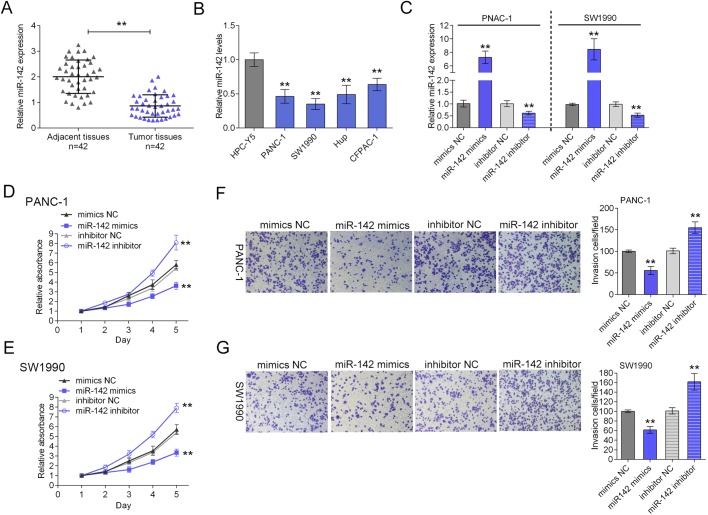
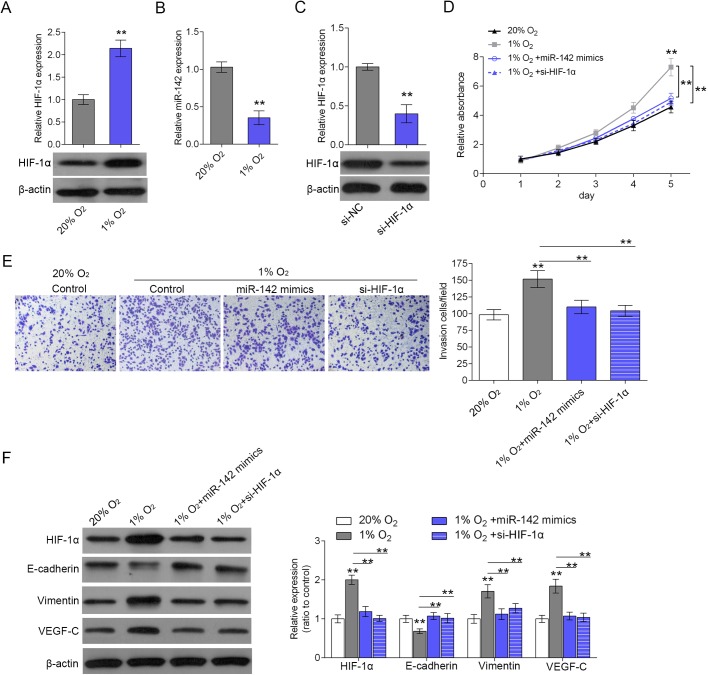
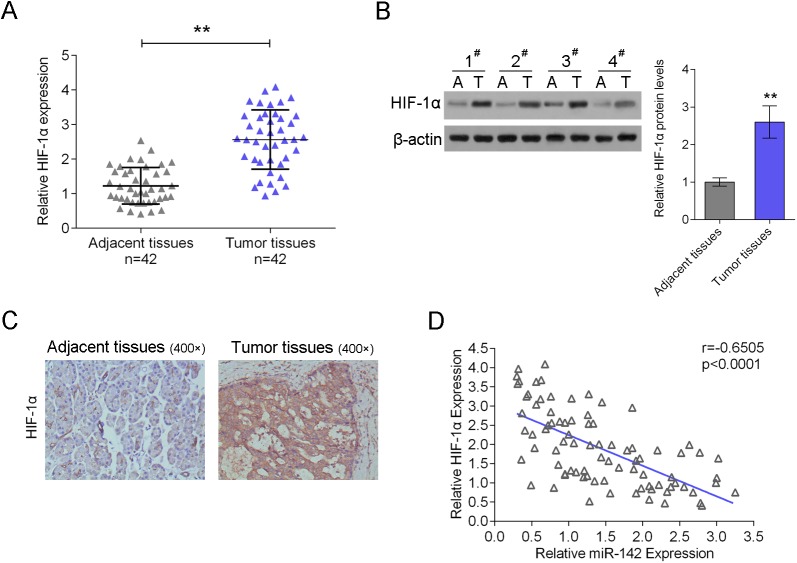
MicroRNAs regulate most protein-coding genes, including genes important in cancer and other diseases. In this study, we demonstrated that the expression of miR-142 could be significantly suppressed in pancreatic cancer specimens and cell lines compared to their adjacent tissues and normal pancreatic cells. Growth and invasion of PANC-1 and SW1990 cells were attenuated by overexpression of miR-142 With the help of bioinformatics analysis, hypoxia-inducible factor 1 (HIF-1α) was identified to be a direct target of miR-142, and a luciferase reporter experiment confirmed this discovery. Overexpression of miR-142 decreases protein expression of HIF-1α. In the hypoxic microenvironment, HIF-1α was up-regulated while miR-142 was down-regulated. The invaded cells significantly increased in the hypoxic microenvironment compared to the normoxic microenvironment. The hypoxia treatment induced cells' proliferation, and invasion could be inhibited by miR-142 overexpression or HIF-1α inhibition. Moreover, expression of epithelial-mesenchymal transition (EMT) markers, Vimentin, VEGF-C and E-cad, was altered under hypoxia conditions and regulated by miR-142/HIF-1α. Above all, these findings provided insights on the functional mechanism of miR-142, suggesting that the miR-142/HIF-1α axis may interfere with the proliferative and invasive properties of pancreatic cancer cells, and indicated that miR-142 could be a potential therapeutic target for pancreatic cancer.
微小RNA调控大多数蛋白质编码基因,包括在癌症和其他疾病中起重要作用的基因。在本研究中,我们证明与相邻组织和正常胰腺细胞相比,胰腺癌标本和细胞系中miR-142的表达可被显著抑制。miR-142过表达可减弱PANC-1和SW1990细胞的生长和侵袭。借助生物信息学分析,缺氧诱导因子1(HIF-1α)被确定为miR-142的直接靶点,荧光素酶报告基因实验证实了这一发现。miR-142过表达降低HIF-1α的蛋白表达。在缺氧微环境中,HIF-1α上调而miR-142下调。与常氧微环境相比,缺氧微环境中侵袭细胞显著增加。缺氧处理诱导细胞增殖,miR-142过表达或HIF-1α抑制可抑制侵袭。此外,缺氧条件下上皮-间质转化(EMT)标志物波形蛋白、血管内皮生长因子C(VEGF-C)和E-钙黏蛋白的表达发生改变,并受miR-142/HIF-1α调控。最重要的是,这些发现为miR-142的功能机制提供了见解,表明miR-142/HIF-1α轴可能干扰胰腺癌细胞的增殖和侵袭特性,并提示miR-142可能是胰腺癌的潜在治疗靶点。