Ali Saleema Mehboob, Adnan Yumna, Ahmad Zubair, Chawla Tabish, Farooqui Hasnain Ahmed, Adnan Ali S M
Department of Surgery, Aga Khan University Hospital, P.O. Box 3500, Stadium Road, Karachi, 74800, Pakistan.
Department of Pathology and Laboratory Medicine, Aga Khan University Hospital, P.O. Box 3500, Stadium Road, Karachi, 74800, Pakistan.
BMC Cancer. 2024 Dec 18;24(1):1543. doi: 10.1186/s12885-024-13259-6.
Pancreatic Ductal Adenocarcinoma (PDAC) is among the most aggressive cancers, characterized by high mortality rates. Studies on various cancers across the globe indicate that regulatory miRNAs play a vital role in cellular signaling. However, the expression and interactions of these miRNAs in the Pakistani patients with PDAC is yet to be explored. Here, we aim to investigate a panel of four regulatory miRNAs (miRNA 34a, 30b, 142 and 137) in PDAC and their interaction with selected target proteins in the signaling pathway (KRAS, p53, BRCA1, APC).
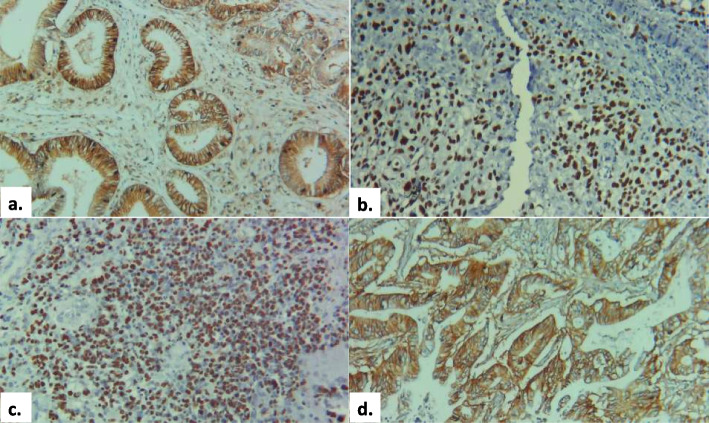
We conducted a study on 109 PDAC patients to analyze the selected miRNAs and protein targets. Formalin Fixed Paraffin Embedded (FFPE) tumor samples were obtained from the hospital's department of histopathology. After confirmation of diagnosis and appropriate tumor content, tissues were processed for RNA extraction. Based on the acceptable quality and quantity of RNA, 43 samples were proceeded for qRT-PCR. Relative expression of the miRNAs was determined through 2 method. Further, FFPE tumor blocks were used to perform tissue sectioning followed by immunohistochemistry experiments. Stained slides were scored independently by two pathologists according to set criteria.
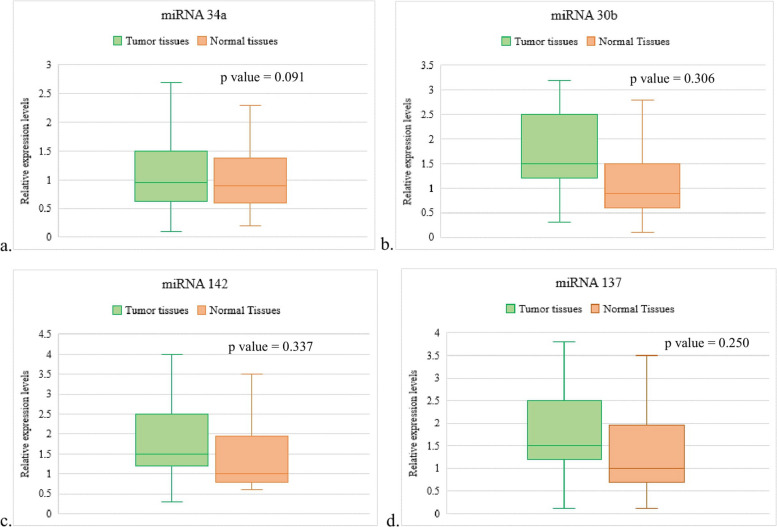
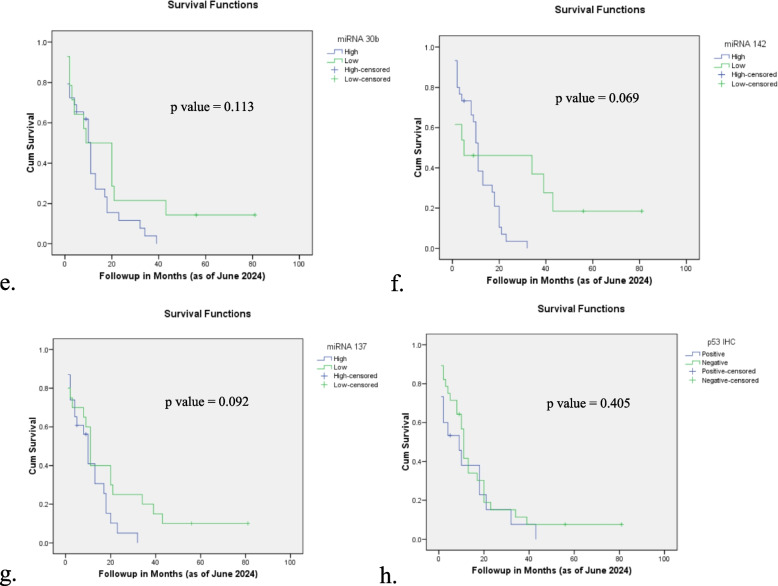
Expression profiles revealed that miRNA 34a, 30b, and 142 showed high expression in approximately 69-70% of cases, while miRNA 137 had a lower high expression frequency (53.4%). Among protein biomarkers, KRAS, BRCA1, and APC were predominantly expressed, with high expression levels observed in 79.1%, 69.8%, and 51.2% of cases, respectively, whereas p53 showed positive expression in only 34.9% of cases. Statistical analysis showed that expression of miRNA 34a was significantly associated with the expression of BRCA1 (p = 0.034). No significant associations were observed for KRAS, p53, or APC with the selected miRNAs. Moreover, the expression of miRNA 34a independently showed significant association with miRNA 30b (p = 0.000) and miRNA 137 (p = 0.001). None of the miRNA showed an association with the overall survival, patient demographics or the clinicopathological characteristics.
Our study highlights a potential bi-directional regulatory relationship between BRCA1 and miRNA 34a, suggesting that miRNA 34a may both respond to and influence BRCA1 activity within cellular signaling pathways. This complex interaction points to a layered regulatory network that could play a crucial role in tumor suppression in PDAC, underscoring the therapeutic potential of targeting this miRNA-protein crosstalk.
胰腺导管腺癌(PDAC)是侵袭性最强的癌症之一,死亡率很高。全球对各种癌症的研究表明,调控性微小RNA(miRNA)在细胞信号传导中起着至关重要的作用。然而,这些miRNA在巴基斯坦PDAC患者中的表达及相互作用尚未得到探索。在此,我们旨在研究一组四种调控性miRNA(miRNA 34a、30b、142和137)在PDAC中的情况及其与信号通路中选定靶蛋白(KRAS、p53、BRCA1、APC)的相互作用。
我们对109例PDAC患者进行了研究,以分析选定的miRNA和蛋白靶点。从医院组织病理学科室获取福尔马林固定石蜡包埋(FFPE)肿瘤样本。在确诊并确定肿瘤含量合适后,对组织进行RNA提取处理。根据RNA的质量和数量合格情况,选取43个样本进行qRT-PCR。通过2−ΔΔCT方法测定miRNA的相对表达量。此外,使用FFPE肿瘤组织块进行组织切片,随后进行免疫组织化学实验。两位病理学家根据既定标准对染色切片进行独立评分。
表达谱显示,miRNA 34a、30b和142在约69% - 70%的病例中高表达,而miRNA 137的高表达频率较低(5