
对 GINS 复合物的新认识解释了现有结构模型之间存在的争议。
New insights into the GINS complex explain the controversy between existing structural models.
机构信息
Department of Life Sciences, Imperial College London, London, United Kingdom.
Structural Biology Laboratory, Elettra - Sincrotrone Trieste, Trieste 34149, Italy.
出版信息
Sci Rep. 2017 Jan 10;7:40188. doi: 10.1038/srep40188.
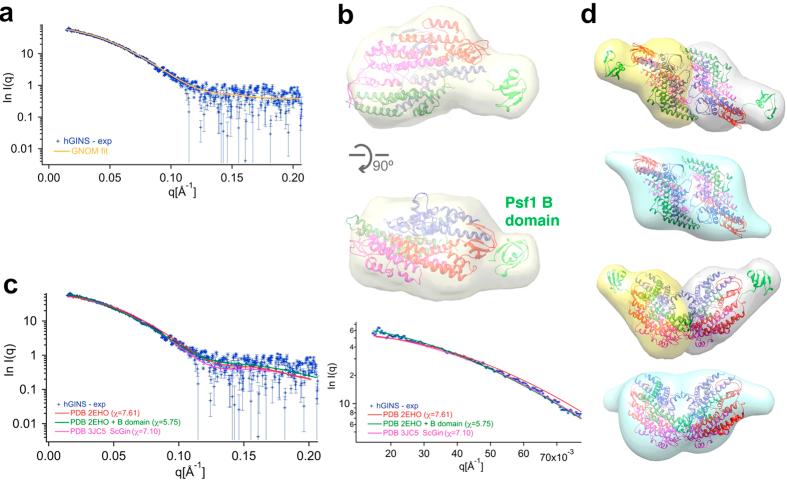
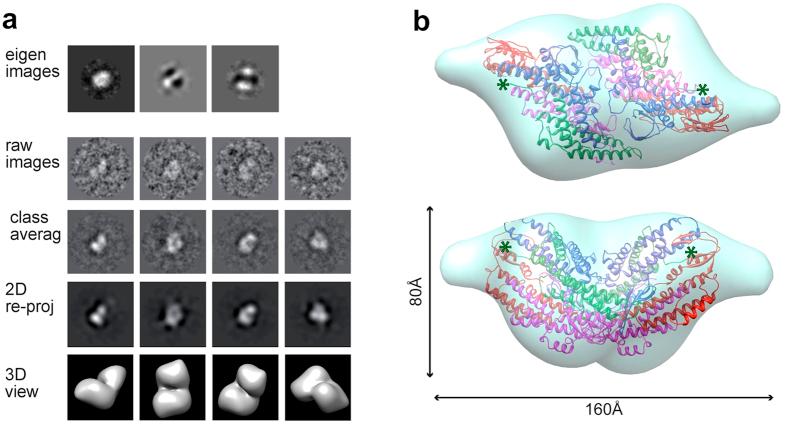
GINS is a key component of eukaryotic replicative forks and is composed of four subunits (Sld5, Psf1, Psf2, Psf3). To explain the discrepancy between structural data from crystallography and electron microscopy (EM), we show that GINS is a compact tetramer in solution as observed in crystal structures, but also forms a double-tetrameric population, detectable by EM. This may represent an intermediate step towards the assembly of two replicative helicase complexes at origins, moving in opposite directions within the replication bubble. Reconstruction of the double-tetrameric form, combined with small-angle X-ray scattering data, allows the localisation of the B domain of the Psf1 subunit in the free GINS complex, which was not visible in previous studies and is essential for the formation of a functional replication fork.
GINS 是真核复制叉的关键组成部分,由四个亚基(Sld5、Psf1、Psf2、Psf3)组成。为了解释晶体学和电子显微镜(EM)结构数据之间的差异,我们表明 GINS 在溶液中是一个紧密的四聚体,如晶体结构中观察到的那样,但也形成了一个双四聚体群体,可通过 EM 检测到。这可能代表了在起源处组装两个复制解旋酶复合物的中间步骤,在复制泡内朝着相反的方向移动。双四聚体形式的重建,结合小角度 X 射线散射数据,允许定位 Psf1 亚基的 B 结构域在游离 GINS 复合物中,这在以前的研究中是不可见的,对于形成功能复制叉是必不可少的。


 Zotero 插件