Chen WeiYue, Young Laurence J, Lu Meng, Zaccone Alessio, Ströhl Florian, Yu Na, Kaminski Schierle Gabriele S, Kaminski Clemens F
Department of Chemical Engineering and Biotechnology, University of Cambridge , Pembroke Street, Cambridge CB2 3RA, United Kingdom.
Nano Lett. 2017 Jan 11;17(1):143-149. doi: 10.1021/acs.nanolett.6b03686. Epub 2016 Dec 8.
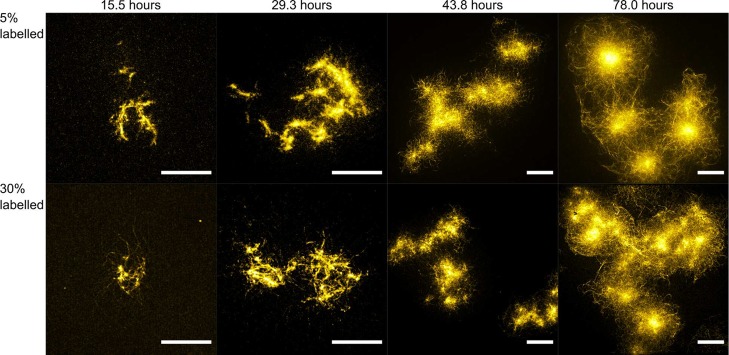
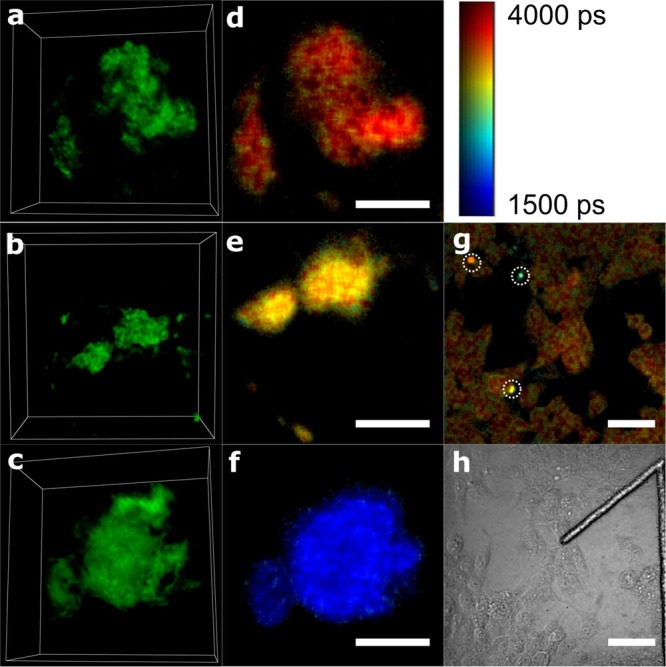
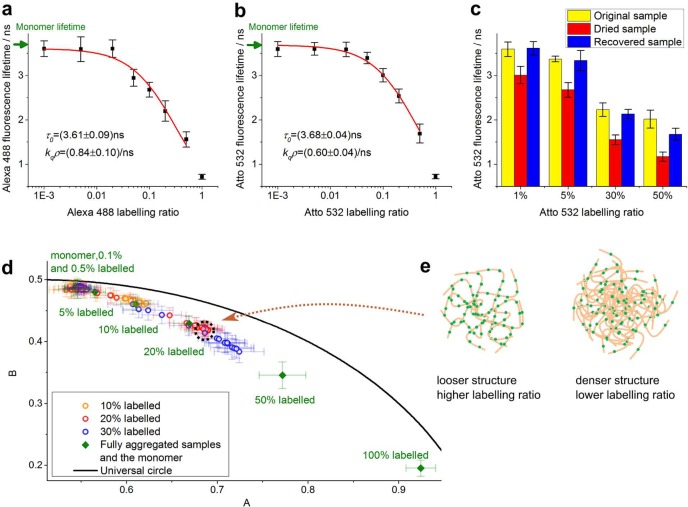
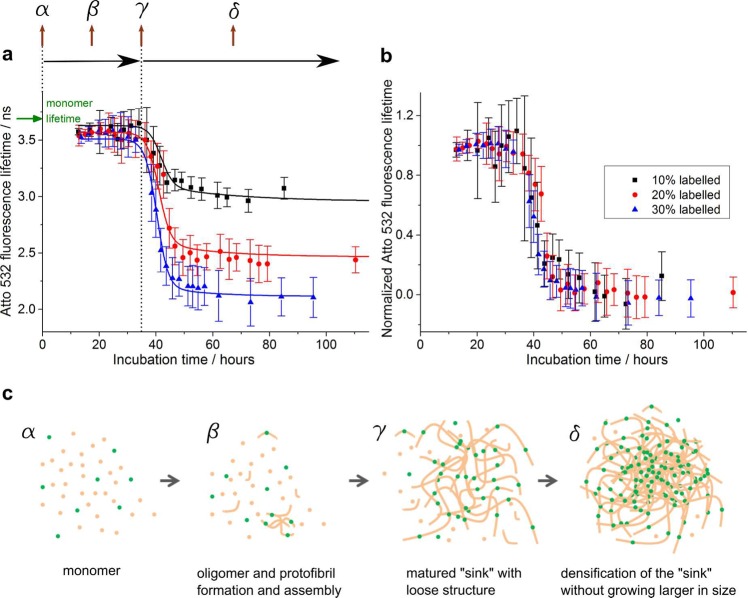
The characterization of the aggregation kinetics of protein amyloids and the structural properties of the ensuing aggregates are vital in the study of the pathogenesis of many neurodegenerative diseases and the discovery of therapeutic targets. In this article, we show that the fluorescence lifetime of synthetic dyes covalently attached to amyloid proteins informs on the structural properties of amyloid clusters formed both in vitro and in cells. We demonstrate that the mechanism behind such a "lifetime sensor" of protein aggregation is based on fluorescence self-quenching and that it offers a good dynamic range to report on various stages of aggregation without significantly perturbing the process under investigation. We show that the sensor informs on the structural density of amyloid clusters in a high-throughput and quantitative manner and in these aspects the sensor outperforms super-resolution imaging techniques. We demonstrate the power and speed of the method, offering capabilities, for example, in therapeutic screenings that monitor biological self-assembly. We investigate the mechanism and advantages of the lifetime sensor in studies of the K18 protein fragment of the Alzheimer's disease related protein tau and its amyloid aggregates formed in vitro. Finally, we demonstrate the sensor in the study of aggregates of polyglutamine protein, a model used in studies related to Huntington's disease, by performing correlative fluorescence lifetime imaging microscopy and structured-illumination microscopy experiments in cells.
蛋白质淀粉样蛋白聚集动力学的表征以及由此产生的聚集体的结构特性,在许多神经退行性疾病的发病机制研究和治疗靶点的发现中至关重要。在本文中,我们表明,与淀粉样蛋白共价连接的合成染料的荧光寿命能够反映体外和细胞内形成的淀粉样蛋白簇的结构特性。我们证明,这种蛋白质聚集“寿命传感器”背后的机制基于荧光自猝灭,并且它提供了一个良好的动态范围来报告聚集的各个阶段,而不会显著干扰正在研究的过程。我们表明,该传感器能够以高通量和定量的方式反映淀粉样蛋白簇的结构密度,在这些方面,该传感器优于超分辨率成像技术。我们展示了该方法的强大功能和速度,例如在监测生物自组装的治疗筛选中提供了相应能力。我们研究了寿命传感器在阿尔茨海默病相关蛋白tau的K18蛋白片段及其体外形成的淀粉样聚集体研究中的机制和优势。最后,我们通过在细胞中进行相关荧光寿命成像显微镜和结构光照明显微镜实验,在聚谷氨酰胺蛋白聚集体的研究中展示了该传感器,聚谷氨酰胺蛋白是用于亨廷顿舞蹈病相关研究的一个模型。