Han Chang S, Dingemanse Niels J
Behavioural Ecology, Department of Biology, Ludwig-Maximilians University of Munich, Großhaderner Str. 2, 82152, Planegg-Martinsried, Germany.
Current address: School of Biological Sciences, University of Queensland, St Lucia, 4072, Australia.
BMC Evol Biol. 2017 Jan 10;17(1):8. doi: 10.1186/s12862-016-0852-4.
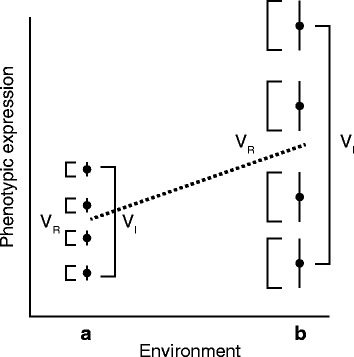
Behavioural phenotypes vary within and among individuals. While early-life experiences have repeatedly been proposed to underpin interactions between these two hierarchical levels, the environmental factors causing such effects remain under-studied. We tested whether an individual's diet affected both its body composition, average behaviour (thereby causing among-individual variation or 'personality') and within-individual variability in behaviour and body weight (thereby causing among-individual differences in residual within-individual variance or 'stability'), using the Southern field cricket Gryllus bimaculatus as a model. We further asked whether effects of diet on the expression of these variance components were sex-specific.
Manipulating both juvenile and adult diet in a full factorial design, individuals were put, in each life-stage, on a diet that was either relatively high in carbohydrates or relatively high in protein. We subsequently measured the expression of multiple behavioural (exploration, aggression and mating activity) and morphological traits (body weight and lipid mass) during adulthood.
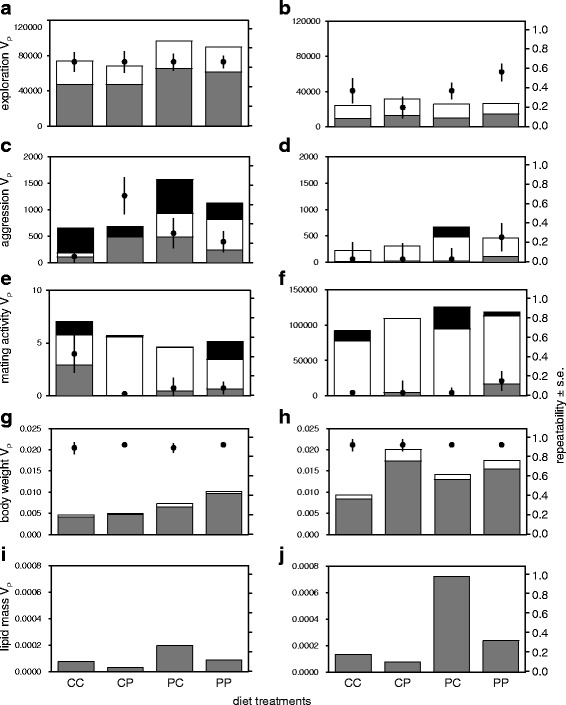
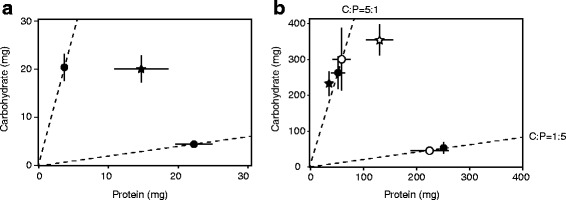
Dietary history affected both average phenotype and level of within-individual variability: males raised as juveniles on high-protein diets were heavier, more aggressive, more active during mating, and behaviourally less stable, than conspecifics raised on high-carbohydrate diets. Females preferred more protein in their diet compared to males, and dietary history affected average phenotype and within-individual variability in a sex-specific manner: individuals raised on high-protein diets were behaviourally less stable in their aggressiveness but this effect was only present in males. Diet also influenced individual differences in male body weight, but within-individual variance in female body weight.
This study thereby provides experimental evidence that dietary history explains both heterogeneous residual within-individual variance (i.e., individual variation in 'behavioural stability') and individual differences in average behaviour (i.e., 'personality'), though dietary effects were notably trait-specific. These findings call for future studies integrating proximate and ultimate perspectives on the role of diet in the evolution of repeatedly expressed traits, such as behaviour and body weight.
行为表型在个体内部和个体之间存在差异。虽然早期生活经历一再被认为是这两个层次水平之间相互作用的基础,但导致这种影响的环境因素仍未得到充分研究。我们以双斑蟋作为模型,测试了个体的饮食是否会影响其身体组成、平均行为(从而导致个体间差异或“个性”)以及行为和体重的个体内变异性(从而导致个体间在个体内剩余变异性或“稳定性”方面的差异)。我们还进一步探讨了饮食对这些变异成分表达的影响是否具有性别特异性。
采用完全析因设计,对幼虫和成虫的饮食进行操控,在每个生命阶段,将个体置于碳水化合物含量相对较高或蛋白质含量相对较高的饮食中。随后,我们测量了成虫期多种行为(探索、攻击和交配活动)和形态特征(体重和脂质质量)的表达情况。
饮食史影响了平均表型和个体内变异性水平:幼虫期以高蛋白饮食饲养的雄性比以高碳水化合物饮食饲养的同种个体更重、更具攻击性、交配时更活跃,且行为上更不稳定。与雄性相比,雌性在饮食中更喜欢更多的蛋白质,并且饮食史以性别特异性方式影响平均表型和个体内变异性:以高蛋白饮食饲养的个体在攻击性方面行为上更不稳定,但这种影响仅在雄性中存在。饮食也影响了雄性体重的个体差异,但影响的是雌性体重的个体内变异性。
本研究从而提供了实验证据,表明饮食史既解释了个体内剩余变异性的异质性(即“行为稳定性”的个体差异),也解释了平均行为的个体差异(即“个性”),尽管饮食影响具有显著性状特异性。这些发现呼吁未来开展研究,将饮食在反复表达的性状(如行为和体重)进化中的作用的近端和远端观点整合起来。