Magara Henlay J O, Hugel Sylvain, Fisher Brian L
Department of Feed Development, Madagascar Biodiversity Center, Antananarivo 101, Madagascar.
Institut des Neurosciences Cellulaires et Intégratives, UPR 3212 CNRS-Université de Strasbourg, 67087 Strasbourg, France.
Foods. 2024 Sep 30;13(19):3139. doi: 10.3390/foods13193139.
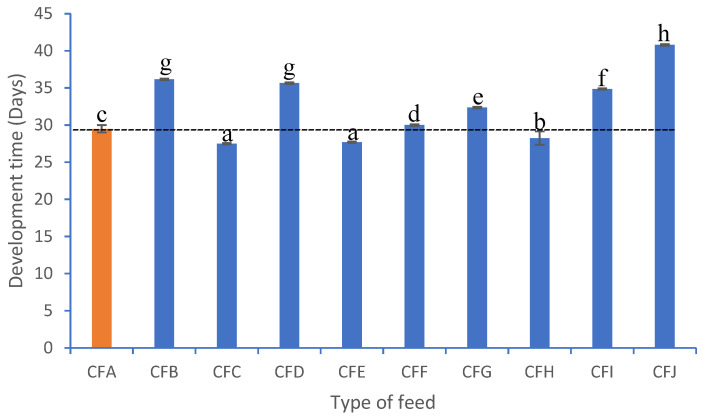
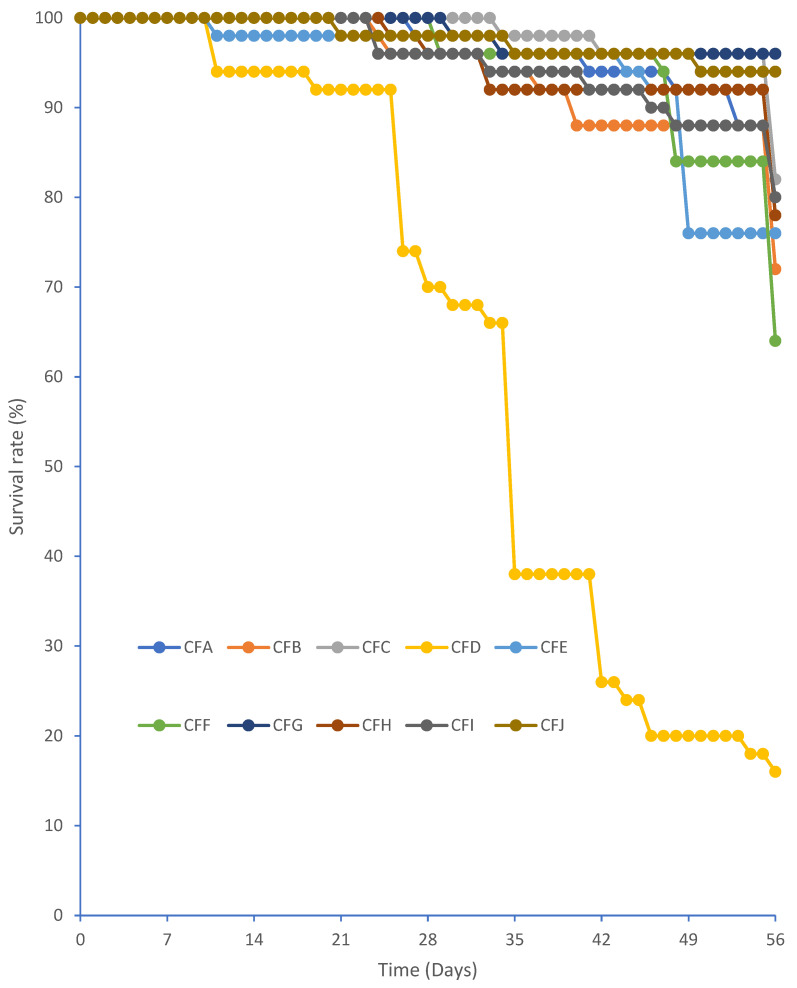
The field cricket, , is a sustainable and nutritious food resource that has the potential to mitigate global malnutrition. Feeds provided to this cricket can influence its growth parameters, nutritional content, and the cost of raising it for food. The current study aimed to evaluate the effects of feeds formulated from weeds, agro-byproducts, and chicken feed (control) on the growth parameters and nutritional content of . The formulated feeds included CFB (25.0% protein), CFC (24.5% protein), CFD (24.0% protein), CFE (23.5% protein), CFF (22.5% protein), CFG (21.5% protein), CFH (20.0% protein), CFI (14.5% protein), and CFJ (13.5% protein), and chicken feed (CFA) (28% protein) was used as the control. The formulation of the feeds was based on the acceptability and protein content of the 12 selected weeds and agro-byproducts. Proximate, mineral, and fatty acid analyses were conducted to determine the nutrient content of each feed, as well as the crickets raised on these feeds. The fastest development time was recorded with CFE and CFC. The highest survivorship (98%) was observed in CFG, CFE, and CFC. The highest body mass (1.15 g) and body length (26.80 mm) were observed in crickets fed CFG. By comparison, crickets fed control feed averaged a body mass of 0.81 g and a body length of 23.55 mm. The feed conversion ratio for fed CFG, CFE, and CFC was 1.71. Crickets raised on CFH and CFG had the lowest cost of feeding per kg live mass gain. Crickets fed on CFF had the highest quantity of protein (67%), followed by those fed CFG (65% protein); crickets with the lowest protein content (50%) were fed CFJ. Crickets fed on CFG had the highest mineral content. Linoleic acid, oleic acid, and palmitic acid were the major fatty acids. The findings indicate that formulated feeds from weeds and agro-byproducts have great potential to be used as an alternative feed source for crickets for two reasons: their capacity to positively influence the biology and nutrition of the cricket, and they can serve as an inexpensive replacement for chicken feed.
田蟋蟀是一种可持续且营养丰富的食物资源,有潜力缓解全球营养不良问题。提供给这种蟋蟀的饲料会影响其生长参数、营养成分以及将其饲养作为食物的成本。当前研究旨在评估由杂草、农业副产品和鸡饲料(对照)配制的饲料对田蟋蟀生长参数和营养成分的影响。配制的饲料包括CFB(蛋白质含量25.0%)、CFC(蛋白质含量24.5%)、CFD(蛋白质含量24.0%)、CFE(蛋白质含量23.5%)、CFF(蛋白质含量22.5%)、CFG(蛋白质含量21.5%)、CFH(蛋白质含量20.0%)、CFI(蛋白质含量14.5%)和CFJ(蛋白质含量13.5%),并以鸡饲料(CFA)(蛋白质含量28%)作为对照。饲料的配制基于12种选定杂草和农业副产品的可接受性和蛋白质含量。进行了近似分析、矿物质分析和脂肪酸分析,以确定每种饲料以及以这些饲料饲养的蟋蟀的营养成分。CFE和CFC的发育时间最短。在CFG、CFE和CFC中观察到最高的存活率(98%)。喂食CFG的蟋蟀体重最高(1.15克),体长最长(26.80毫米)。相比之下,喂食对照饲料的蟋蟀平均体重为0.81克,体长为23.55毫米。喂食CFG、CFE和CFC的蟋蟀的饲料转化率为1.71。以CFH和CFG饲养的蟋蟀每千克活体重增加的饲养成本最低。喂食CFF的蟋蟀蛋白质含量最高(67%),其次是喂食CFG的蟋蟀(蛋白质含量65%);蛋白质含量最低(50%)的蟋蟀喂食CFJ。喂食CFG的蟋蟀矿物质含量最高。亚油酸、油酸和棕榈酸是主要脂肪酸。研究结果表明,由杂草和农业副产品配制的饲料有很大潜力用作蟋蟀的替代饲料来源,原因有二:它们能够对蟋蟀的生物学特性和营养产生积极影响,并且可以作为鸡饲料的廉价替代品。