Hughes Michelle M, Englund Janet A, Kuypers Jane, Tielsch James M, Khatry Subarna K, Shrestha Laxman, LeClerq Steven C, Steinhoff Mark, Katz Joanne
Johns Hopkins Bloomberg School of Public Health, Department of International Health, Global Disease Epidemiology and Control, Baltimore, Maryland.
University of Washington, Seattle Children's Hospital.
J Pediatric Infect Dis Soc. 2017 Mar 1;6(1):33-39. doi: 10.1093/jpids/piw079.
BACKGROUND.: Pertussis is estimated to cause 2 percent of childhood deaths globally and is a growing public health problem in developed countries despite high vaccination coverage. Infants are at greatest risk of morbidity and mortality. Maternal vaccination during pregnancy may be effective to prevent pertussis in young infants, but population-based estimates of disease burden in infants are lacking, particularly in low-income countries. The objective of this study was to estimate the incidence of pertussis in infants less than 6 months of age in Sarlahi District, Nepal.
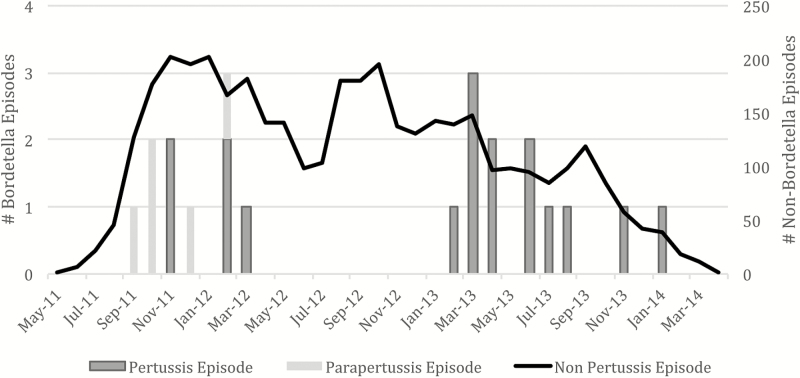
METHODS.: Nested within a population-based randomized controlled trial of influenza vaccination during pregnancy, infants were visited weekly from birth through 6 months to assess respiratory illness in the prior week. If any respiratory symptoms had occurred, a nasal swab was collected and tested with a multitarget pertussis polymerase chain reaction (PCR) assay. The prospective cohort study includes infants observed between May 2011 and August 2014.
RESULTS.: The incidence of PCR-confirmed Bordetella pertussis was 13.3 cases per 1000 infant-years (95% confidence interval, 7.7-21.3) in a cohort of 3483 infants with at least 1 day of follow-up.
CONCLUSIONS.: In a population-based active home surveillance for respiratory illness, a low risk for pertussis was estimated among infants in rural Nepal. Nepal's immunization program, which includes a childhood whole cell pertussis vaccine, may be effective in controlling pertussis in infants.
据估计,百日咳在全球导致2%的儿童死亡,并且在发达国家尽管疫苗接种率很高,但仍是一个日益严重的公共卫生问题。婴儿发病和死亡风险最高。孕期进行母体疫苗接种可能有效预防幼儿患百日咳,但缺乏基于人群的幼儿疾病负担估计,尤其是在低收入国家。本研究的目的是估计尼泊尔萨拉希区6个月以下婴儿的百日咳发病率。
在一项基于人群的孕期流感疫苗接种随机对照试验中,从婴儿出生至6个月每周进行访视,以评估前一周的呼吸道疾病情况。如果出现任何呼吸道症状,采集鼻拭子并用多靶点百日咳聚合酶链反应(PCR)检测法进行检测。这项前瞻性队列研究纳入了2011年5月至2014年8月期间观察的婴儿。
在3483名至少随访1天的婴儿队列中,PCR确诊的百日咳博德特菌发病率为每1000婴儿年13.3例(95%置信区间,7.7 - 21.3)。
在一项基于人群的呼吸道疾病主动家庭监测中,尼泊尔农村地区婴儿百日咳风险较低。尼泊尔的免疫规划,包括儿童全细胞百日咳疫苗,可能对控制婴儿百日咳有效。