Li Jiannan, Sheng Shihou, Zhang Kai, Liu Tongjun
Department of General Surgery, The Second Hospital of Jilin University, Changchun, Jilin, China.
Department of Gastrointestinal Colorectal and Anal Surgery, China-Japan Union Hospital of Jilin University, Changchun, Jilin, China.
Biomed Res Int. 2016;2016:2543026. doi: 10.1155/2016/2543026. Epub 2016 Dec 15.
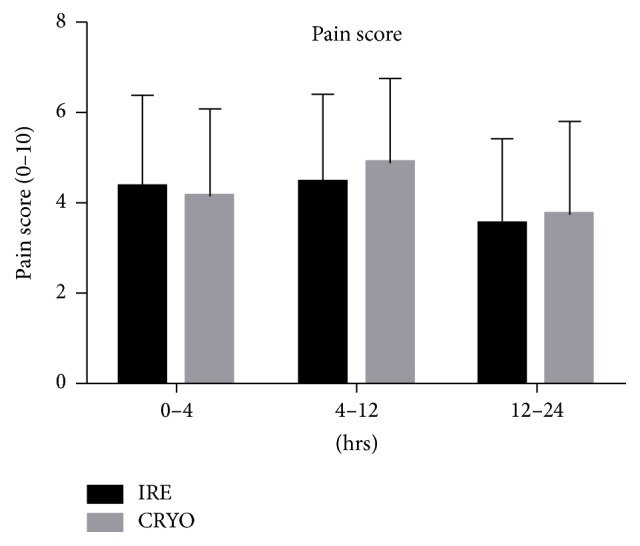
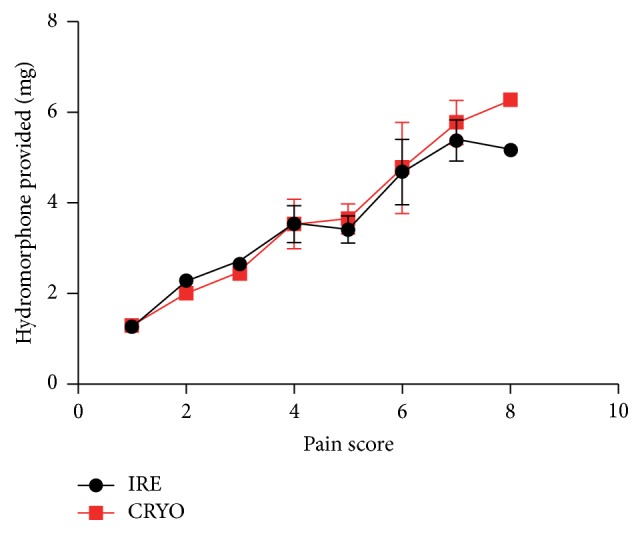
The aim of this article is to evaluate and compare the postprocedure pain in patients with pancreatic carcinoma treated with irreversible electroporation (IRE) and cryoablation (CRYO). We compared 22 patients with 22 lesions in pancreas treated with IRE and 26 patients with 27 lesions treated with cryosurgery. All the patients in the two groups were under celiac plexus block (CPB) treatment to alleviate the postprocedure pain. A numerical rating scale (VAS) consisting of 11-point scales and the 24 h total hydromorphone use were recorded for the analysis of the pain level in the patients who underwent these two technologies separately. Other parameters, such as the complications and the ECOG performance status, were also noted. Statistical analysis was performed by Fisher's exact test, the Chi-square test, and Student's -test. All the pancreatic carcinoma patients in our study were reported to have postprocedure pain in the two groups. But there was no significant difference in the mean pain score (4.95 (IRE) versus 4.85 (CRYO); = 0.52) and 24 h total hydromorphone use (3.89 mg (IRE) versus 3.97 mg (CRYO); = 0.30). IRE is comparable to cryotherapy in the amount of pain that patients with pancreatic carcinoma experience.
本文旨在评估和比较接受不可逆电穿孔(IRE)和冷冻消融(CRYO)治疗的胰腺癌患者术后疼痛情况。我们比较了22例接受IRE治疗的胰腺有22个病灶的患者和26例接受冷冻手术治疗的有27个病灶的患者。两组所有患者均接受腹腔神经丛阻滞(CPB)治疗以减轻术后疼痛。记录由11点量表组成的数字评分量表(VAS)以及24小时氢吗啡酮总用量,以分别分析接受这两种技术治疗患者的疼痛程度。还记录了其他参数,如并发症和东部肿瘤协作组(ECOG)体能状态。采用Fisher精确检验、卡方检验和学生t检验进行统计分析。据报道,我们研究中的所有胰腺癌患者两组均有术后疼痛。但平均疼痛评分(IRE组为4.95,CRYO组为4.85;P = 0.52)和24小时氢吗啡酮总用量(IRE组为3.89 mg,CRYO组为3.97 mg;P = 0.30)均无显著差异。在胰腺癌患者经历的疼痛程度方面,IRE与冷冻疗法相当。