Lillis Teresa A, Gerhart James, Bouchard Laura C, Cvengros Jamie, O'Mahony Sean, Kopkash Katherine, Kabaker Katherine B, Burns John
1 Department of Behavioral Sciences, Rush University Medical Center, Chicago, IL, USA.
2 Palliative Medicine Section, Department of Internal Medicine, Rush University Medical Center, Chicago, IL, USA.
Am J Hosp Palliat Care. 2018 May;35(5):788-793. doi: 10.1177/1049909117739299. Epub 2017 Oct 30.
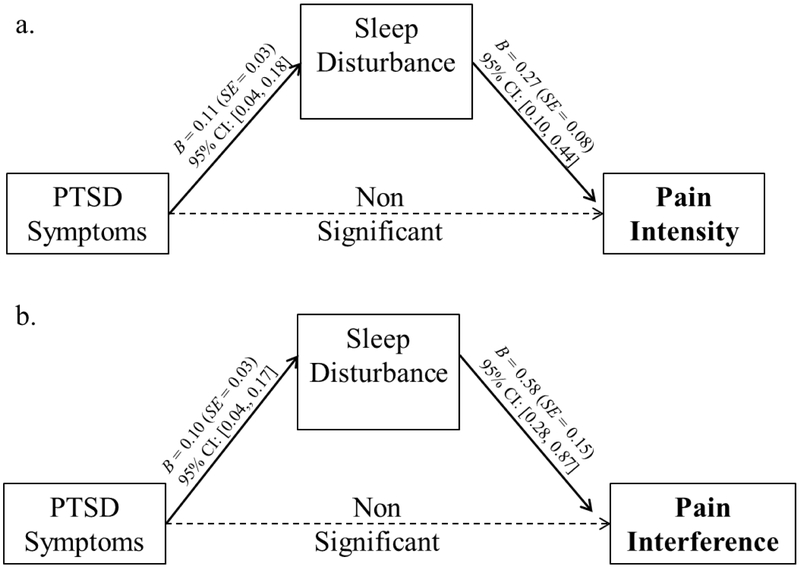
Sleep disturbance is a common complaint of patients with cancer and is well established in both pain conditions and post-traumatic stress disorder (PTSD). An estimated one-third of patients with cancer develop symptoms of PTSD at some point in their treatment. However, few studies have evaluated the contributions of PTSD and sleep disturbance to pain processes in cancer populations. The current study used mediation models to test the hypothesis that sleep disturbance would mediate the relationships between PTSD symptoms and pain intensity and PTSD symptoms and pain interference in a sample of patients with cancer.
A cross-sectional, retrospective chart review was conducted of the electronic medical records of 85 adult patients with cancer (89.4% female; 59% white; 42% metastatic) who sought individual psychosocial support services at our institution.
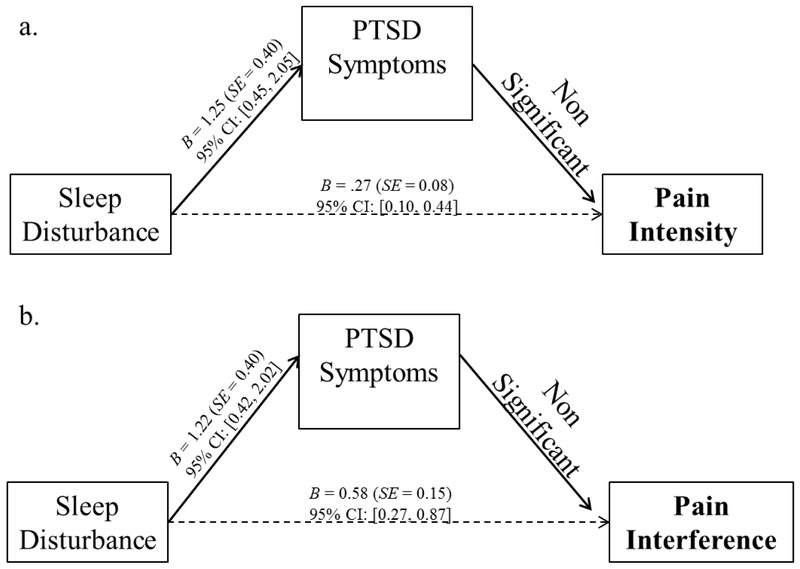
Post-traumatic stress disorder symptoms, sleep disturbance, pain intensity, and pain interference were all positively correlated ( P < .01). Clinical levels of PTSD symptoms were reported by 30% to 60% of the sample. Even after controlling for metastatic disease, race, and cancer type, sleep disturbance mediated the relationships between PTSD symptoms and pain intensity ( B = 0.27; 95% CI: 0.10-0.44) and PTSD symptoms and pain-related interference ( B = 0.58; 95% CI: 0.28-0.87).
The relationships among PTSD symptoms, pain intensity, and pain interference could be explained by co-occurring sleep disturbance. Given the high frequency of PTSD symptoms among patients with cancer and PTSD's known links to sleep problems and pain, clinicians should be attentive to the role that traumatogenic processes may play in eliciting sleep and pain-related complaints among patients with cancer.
睡眠障碍是癌症患者常见的主诉,在疼痛情况和创伤后应激障碍(PTSD)中都很常见。估计有三分之一的癌症患者在治疗的某个阶段会出现PTSD症状。然而,很少有研究评估PTSD和睡眠障碍对癌症患者疼痛过程的影响。本研究使用中介模型来检验以下假设:在一组癌症患者样本中,睡眠障碍将介导PTSD症状与疼痛强度之间以及PTSD症状与疼痛干扰之间的关系。
对在我们机构寻求个体心理社会支持服务的85名成年癌症患者(89.4%为女性;59%为白人;42%为转移性癌症)的电子病历进行横断面回顾性图表审查。
创伤后应激障碍症状、睡眠障碍、疼痛强度和疼痛干扰均呈正相关(P <.01)。样本中有30%至60%报告了PTSD症状的临床水平。即使在控制了转移性疾病、种族和癌症类型之后,睡眠障碍仍介导了PTSD症状与疼痛强度之间的关系(B = 0.27;95% CI:0.10 - 0.44)以及PTSD症状与疼痛相关干扰之间的关系(B = 0.58;95% CI:0.28 - 0.87)。
PTSD症状、疼痛强度和疼痛干扰之间的关系可以通过同时存在的睡眠障碍来解释。鉴于癌症患者中PTSD症状的高发生率以及PTSD与睡眠问题和疼痛的已知关联,临床医生应注意创伤性过程在引发癌症患者睡眠和疼痛相关主诉中可能起的作用。