Hughes Catherine F, Ward Mary, Tracey Fergal, Hoey Leane, Molloy Anne M, Pentieva Kristina, McNulty Helene
Northern Ireland Centre for Food and Health, Ulster University, Cromore Road, Coleraine BT52 1SA, Northern Ireland, UK.
Causeway Hospital, Northern Health and Social Care Trust, Coleraine BT52 1HS, Northern Ireland, UK.
Nutrients. 2017 Jan 10;9(1):53. doi: 10.3390/nu9010053.
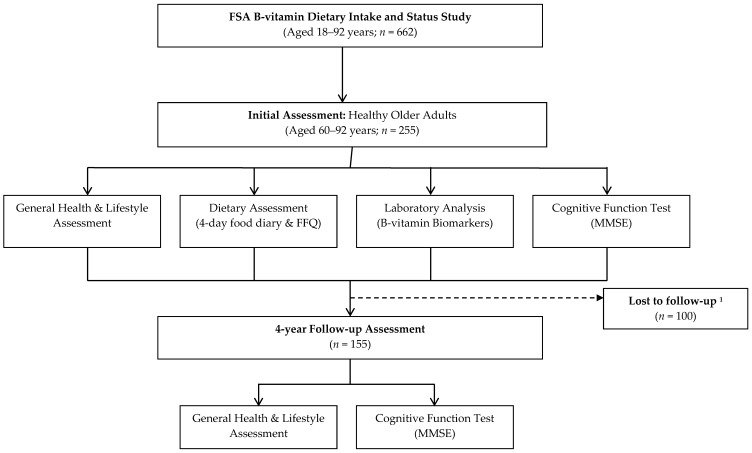
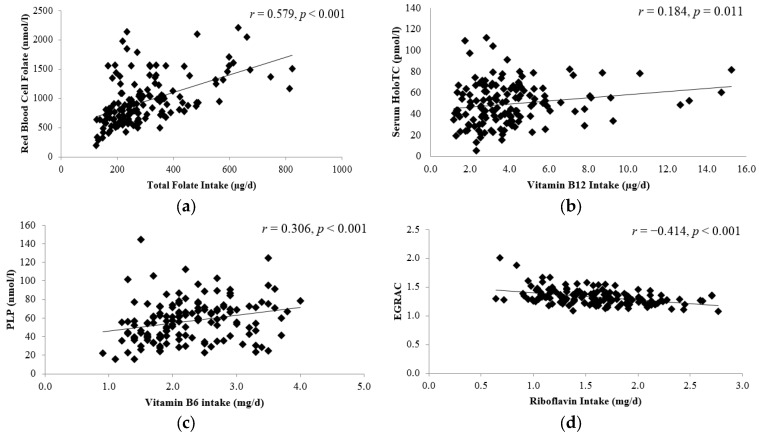
Advancing age can be associated with an increase in cognitive dysfunction, a spectrum of disability that ranges in severity from mild cognitive impairment to dementia. Folate and the other B-vitamins involved in one-carbon metabolism are associated with cognition in ageing but the evidence is not entirely clear. The hypothesis addressed in this study was that lower dietary intake or biomarker status of folate and/or the metabolically related B-vitamins would be associated with a greater than expected rate of cognitive decline over a 4-year follow-up period in healthy older adults. Participants (aged 60-88 years; = 155) who had been previously screened for cognitive function were reassessed four years after initial investigation using the Mini-Mental State Examination (MMSE). At the 4-year follow-up assessment when participants were aged 73.4 ± 7.1 years, mean cognitive MMSE scores had declined from 29.1 ± 1.3 at baseline to 27.5 ± 2.4 ( < 0.001), but some 27% of participants showed a greater than expected rate of cognitive decline (i.e., decrease in MMSE > 0.56 points per year). Lower vitamin B6 status, as measured using pyridoxal-5-phosphate (PLP; <43 nmol/L) was associated with a 3.5 times higher risk of accelerated cognitive decline, after adjustment for age and baseline MMSE score (OR, 3.48; 95% CI, 1.58 to 7.63; < 0.05). Correspondingly, lower dietary intake (0.9-1.4 mg/day) of vitamin B6 was also associated with a greater rate of cognitive decline (OR, 4.22; 95% CI, 1.28-13.90; < 0.05). No significant relationships of dietary intake or biomarker status with cognitive decline were observed for the other B-vitamins. In conclusion, lower dietary and biomarker status of vitamin B6 at baseline predicted a greater than expected rate of cognitive decline over a 4-year period in healthy older adults. Vitamin B6 may be an important protective factor in helping maintain cognitive health in ageing.
年龄增长可能与认知功能障碍增加有关,认知功能障碍是一系列残疾,严重程度从轻度认知障碍到痴呆不等。叶酸和参与一碳代谢的其他B族维生素与衰老过程中的认知有关,但证据并不完全明确。本研究探讨的假设是,在健康老年人4年的随访期内,叶酸和/或代谢相关B族维生素的较低饮食摄入量或生物标志物状态将与高于预期的认知衰退率相关。对先前进行过认知功能筛查的参与者(年龄60 - 88岁;n = 155)在初次调查四年后使用简易精神状态检查表(MMSE)进行重新评估。在4年随访评估时,参与者年龄为73.4±7.1岁,认知MMSE平均得分从基线时的29.1±1.3降至27.5±2.4(P < 0.001),但约27%的参与者表现出高于预期的认知衰退率(即MMSE每年下降> 0.56分)。使用磷酸吡哆醛(PLP;<43 nmol/L)测量的较低维生素B6状态与加速认知衰退风险高3.5倍相关,在调整年龄和基线MMSE得分后(OR,3.48;95% CI,1.58至7.63;P < 0.05)。相应地,较低的维生素B6饮食摄入量(0.9 - 1.4毫克/天)也与更高的认知衰退率相关(OR,4.22;95% CI,1.28 - 13.90;P < 0.05)。对于其他B族维生素,未观察到饮食摄入量或生物标志物状态与认知衰退之间的显著关系。总之,基线时维生素B6的较低饮食和生物标志物状态预测了健康老年人在4年内高于预期的认知衰退率。维生素B6可能是帮助维持老年人认知健康的重要保护因素。