Agnew-Blais Jessica C, Wassertheil-Smoller Sylvia, Kang Jae H, Hogan Patricia E, Coker Laura H, Snetselaar Linda G, Smoller Jordan W
J Acad Nutr Diet. 2015 Feb;115(2):231-241. doi: 10.1016/j.jand.2014.07.006. Epub 2014 Sep 8.
Whether higher B vitamin intake (ie, B-6, B-12, and folate) is protective against cognitive decline in later life remains uncertain. Several prospective, observational studies find higher B vitamin intake to be associated with lower risk of dementia; other studies, including most trials of B vitamin supplementation, have observed no effect on cognition. We examined this question in a large population of older women carefully monitored for development of mild cognitive impairment (MCI) and probable dementia.
To determine whether baseline folate, vitamin B-6, and/or vitamin B-12 intake, alone or in combination, are associated with incident MCI/probable dementia among older women.
Prospective, longitudinal cohort study. Participants were enrolled between 1993 and 1998, and B vitamin intake was self-reported using a food frequency questionnaire administered at baseline.
PARTICIPANTS/SETTING: Postmenopausal women (N=7,030) free of MCI/probable dementia at baseline in the Women's Health Initiative Memory Study.
Over a mean follow-up of 5.0 years, 238 cases of incident MCI and 69 cases of probable dementia were identified through rigorous screening and expert adjudication.
Cox proportional hazard models adjusting for sociodemographic and lifestyle factors examined the association of B vitamin intake above and below the Recommended Daily Allowance and incident MCI/probable dementia.
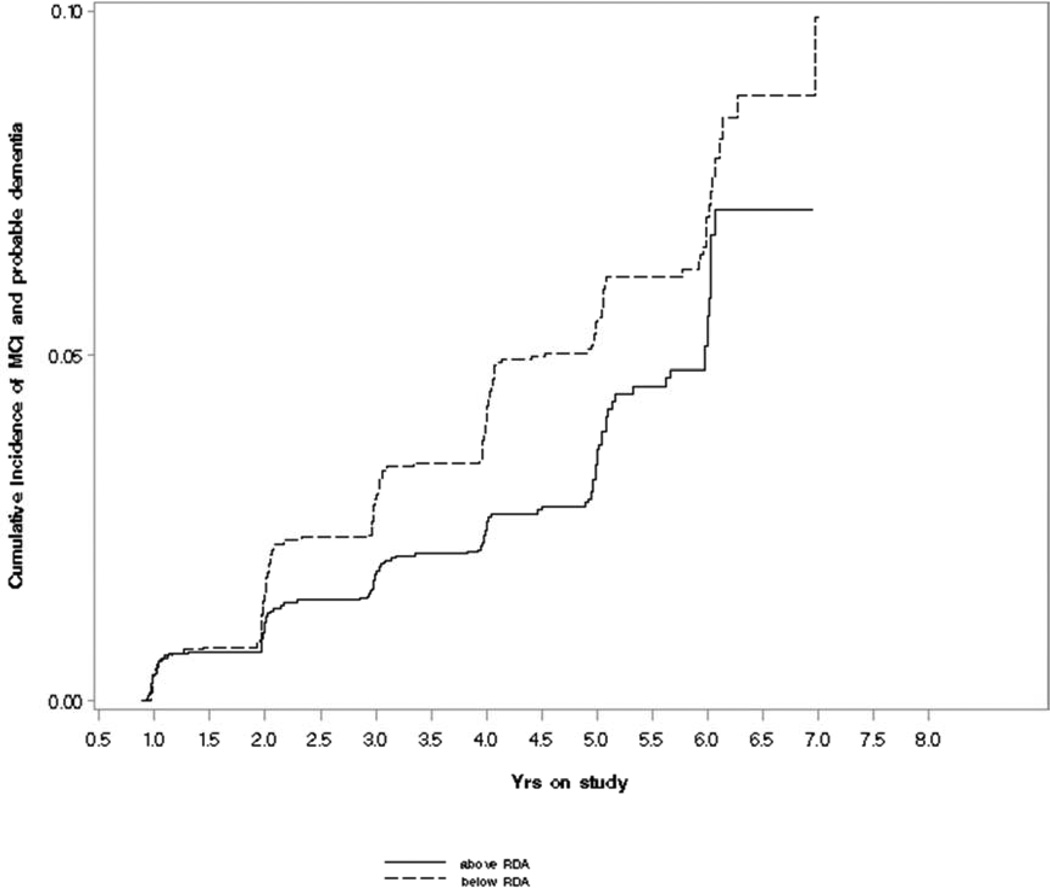
Folate intake below the Recommended Daily Allowance at study baseline was associated with increased risk of incident MCI/probable dementia (hazard ratio 2.0, 95% CI 1.3 to 2.9), after controlling for multiple confounders. There were no significant associations between vitamins B-6 or B-12 and MCI/probable dementia, nor any evidence of an interaction between these vitamins and folate intake.
Folate intake below the Recommended Daily Allowance may increase risk for MCI/probable dementia in later life. Future research should include long-term trials of folic acid supplementation to examine whether folate may impart a protective effect on cognition in later life.
较高的B族维生素摄入量(即维生素B-6、B-12和叶酸)是否能预防晚年认知能力下降仍不确定。几项前瞻性观察性研究发现,较高的B族维生素摄入量与较低的痴呆风险相关;而其他研究,包括大多数B族维生素补充剂试验,均未观察到对认知有影响。我们在一大群老年女性中研究了这个问题,这些女性被仔细监测是否会发展为轻度认知障碍(MCI)和可能的痴呆症。
确定基线时叶酸、维生素B-6和/或维生素B-12的摄入量单独或联合起来是否与老年女性发生MCI/可能的痴呆症有关。
前瞻性纵向队列研究。参与者于1993年至1998年入组,B族维生素摄入量通过基线时使用的食物频率问卷进行自我报告。
参与者/研究地点:女性健康倡议记忆研究中基线时无MCI/可能痴呆症的绝经后女性(N = 7030)。
在平均5.0年的随访中,通过严格筛查和专家判定确定了238例新发MCI病例和69例可能的痴呆症病例。
采用Cox比例风险模型,对社会人口学和生活方式因素进行调整,研究高于和低于推荐每日摄入量的B族维生素摄入量与新发MCI/可能的痴呆症之间的关联。
在控制多个混杂因素后,研究基线时低于推荐每日摄入量的叶酸摄入量与新发MCI/可能的痴呆症风险增加相关(风险比2.0,95%置信区间1.3至2.9)。维生素B-6或B-12与MCI/可能的痴呆症之间无显著关联,也没有证据表明这些维生素与叶酸摄入量之间存在相互作用。
低于推荐每日摄入量的叶酸摄入量可能会增加晚年发生MCI/可能的痴呆症的风险。未来的研究应包括叶酸补充剂的长期试验,以研究叶酸是否可能对晚年认知能力产生保护作用。